Quiz · Medium
Twenty-two questions on motivation, perception, attitudes, decision types, social influence and adoption for marketing students.
A shopper spends weeks comparing laptops on price, specs and reviews, and asks friends. Which type of decision making is this?
Extensive problem solving
Routine response behavior
Impulse buying
Habitual loyalty
Expensive, risky and infrequent purchases trigger extensive problem solving with a long search. Routine behavior and habit apply to cheap, repeat purchases. Impulse buying is unplanned, which this is not.
Which level of Maslow's hierarchy do life-insurance and home-alarm ads mainly target?
Physiological needs
Love and belonging
Esteem needs
Safety needs
Insurance and alarms address security and protection from harm, which are safety needs. Physiological needs are food, water and sleep.
A customer feels uneasy after buying an expensive phone, wondering whether a rival model would have been better. What is this?
Selective retention
Cognitive dissonance
Stimulus generalization
Reactance
Cognitive dissonance (Festinger) is discomfort after a difficult, costly choice. Reactance is resisting perceived pressure; generalization is transferring a response to similar stimuli.
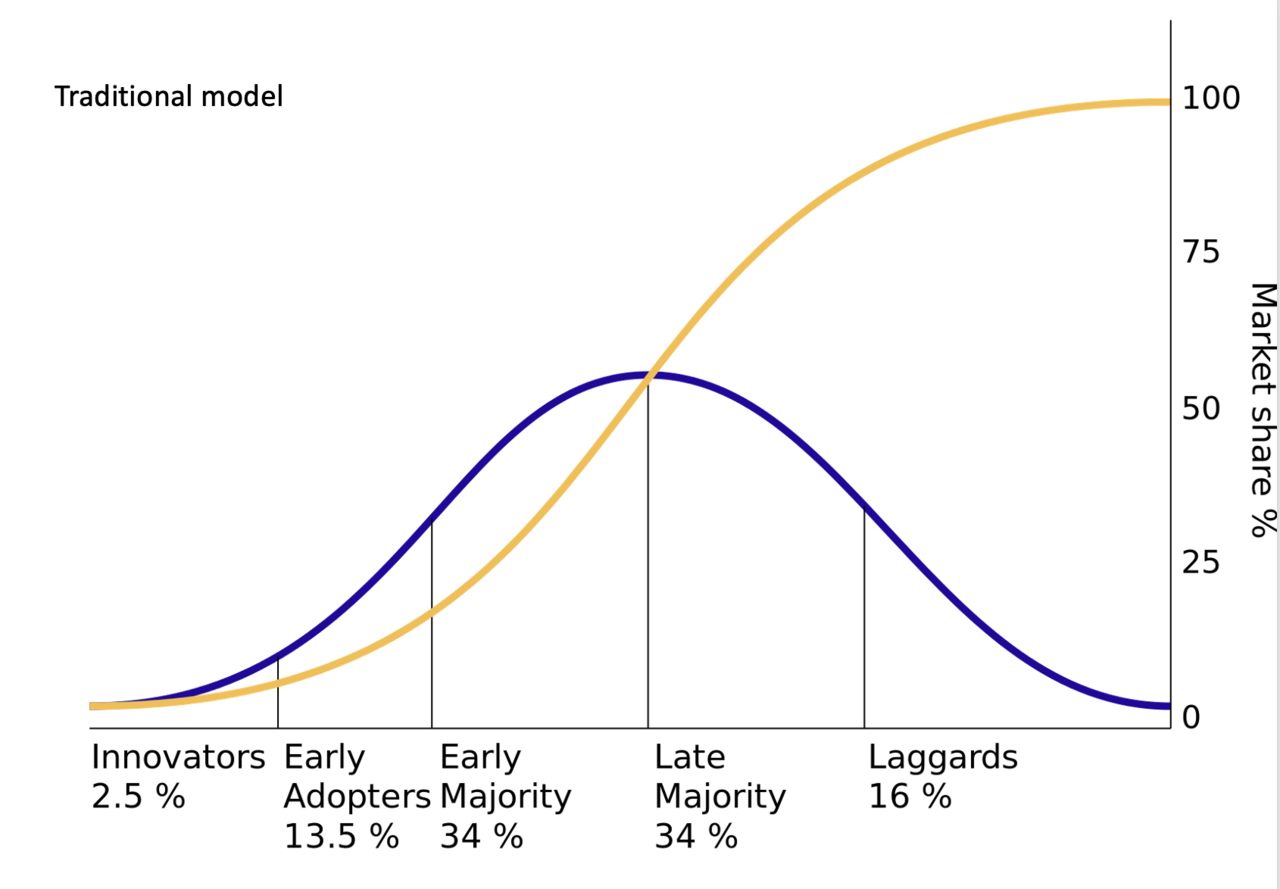
Looking at the adoption curve, which group makes up the largest shares, 34% each?
Innovators and early adopters
Early majority and late majority
Early adopters and laggards
Innovators and laggards
In Rogers' model the early and late majority are each 34% of adopters, together 68%. Innovators are 2.5%, early adopters 13.5% and laggards 16%. Image: Seb.von.st-sund, CC BY-SA 4.0, via Wikimedia Commons.
In the elaboration likelihood model, a celebrity endorsement for a low-involvement product mainly works through which route?
Central route
Rational route
Cognitive route
Peripheral route
With low involvement people do not scrutinize arguments, so cues such as likeability and celebrity (peripheral route) drive attitudes. The central route needs high motivation to think.
Which statement about Weber's law is correct?
The just noticeable difference is proportional to the original price
Customers notice every price change equally
Only price decreases are noticed
Small changes are always ignored
The JND grows with the base level. A $1 rise on a $5 item is noticeable; on a $500 item it is not.
A grocery brand adds 'now with extra fiber' to its cereal. Using the multi-attribute model, which strategy is this?
Changing beliefs about competitors
Changing the ideal point
Adding a new attribute
Reducing perceived risk
Adding an attribute introduces a new belief and evaluation term in the sum. It does not change beliefs about rivals or the ideal.
A friend whose advice many people follow recommends a new app, and it spreads to her followers. Which concept explains this best?
Reference group avoidance
Subliminal perception
Black box model
Opinion leader and two-step flow
Opinion leaders pass on information from media or brands to a wider group (two-step flow). Dissociative reference groups are groups people want to avoid.
Which pair are Assael's two dimensions for classifying buying behavior?
Price and quality
Involvement and perceived brand differences
Income and age
Need and want
Complex, dissonance-reducing, habitual and variety-seeking behavior come from high or low involvement crossed with big or small brand differences.
A gum brand is placed next to the checkout to exploit unplanned buying. This targets:
Extensive problem solving
Brand loyalty
Impulse buying
Dissonance reduction
Low-cost items placed at checkout trigger unplanned, emotional purchases (impulse buying).
Which is NOT one of the six types of perceived risk?
Competitive
Social
Psychological
Financial
The perceived risk types are functional, financial, physical, social, psychological and time. 'Competitive' risk is not a consumer-risk type.
In a supermarket test, a display of 24 jams drew more shoppers but fewer purchases than a display of 6 jams. This illustrates:
Decoy effect
Endowment effect
Choice overload
Anchoring
Iyengar and Lepper (2000): large assortments attract attention but can reduce purchase. A decoy is an extra inferior option, not a larger assortment.
Which marketing action uses classical conditioning?
Pairing a soft drink with joyful music in every ad
Giving points for each purchase
Listing detailed technical specs
Offering a money-back guarantee
Associating the brand with a stimulus that already produces positive feelings is classical conditioning. Points are operant rewards.
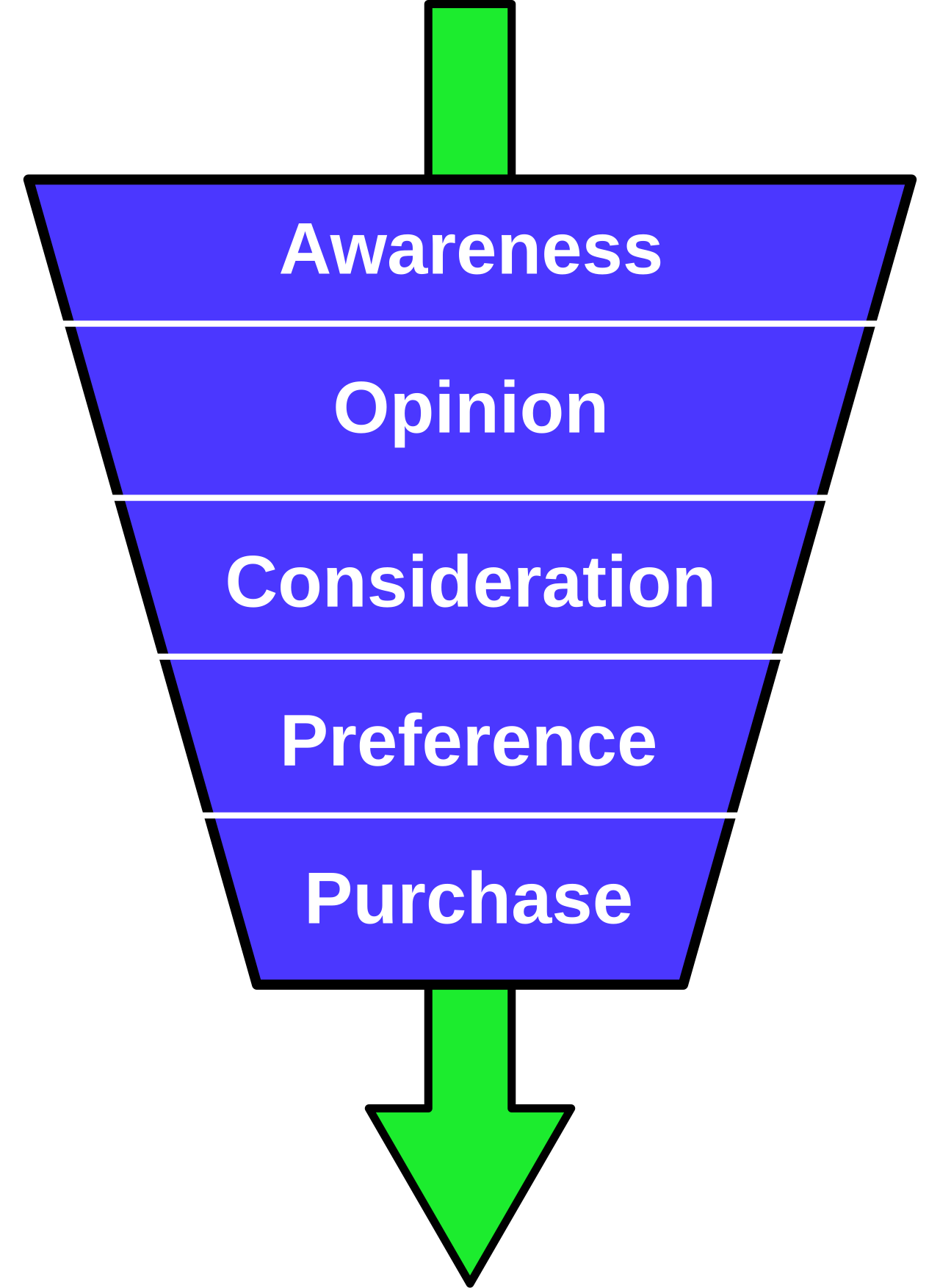
In the funnel shown, which stage sits directly below 'Consideration'?
Awareness
Opinion
Purchase
Preference
The stages are Awareness, Opinion, Consideration, Preference, Purchase. Image: Steve simple, CC BY 3.0, via Wikimedia Commons.
True or False: According to Maslow, a person must fully satisfy one level before any higher need can motivate them.
True
False
Maslow described a general tendency, but later work shows people pursue several levels simultaneously and the order varies by culture. Treat the hierarchy as a guide, not a strict ladder.
A luxury brand deliberately sets a very high price and sales increase as a result. This describes:
A Giffen good
A Veblen good
A convenience good
A commodity
For Veblen goods demand rises with price because the price signals status. Giffen goods are inferior goods in economic theory with a different logic.
Two executives, the buyer and a gatekeeper, plus users and influencers, jointly purchase software. This group is called a:
Reference group
Market segment
Focus group
Buying center
In B2B, the buying center includes users, influencers, buyers, deciders and gatekeepers.
Which of these is an example of a hedonic purchase?
Booking tickets to a festival
Buying laundry detergent
Paying an electricity bill
Replacing a flat tire
Hedonic purchases are for pleasure and experience. The others are utilitarian, problem-solving purchases.
Which of the following best defines the endowment effect?
Consumers pay less for items they own
Consumers prefer the first option shown
Consumers value an item more once they own it
Consumers copy what others buy
Ownership raises perceived value, which is why free trials and easy returns raise conversion. Anchoring is about the first number shown; social proof is copying others.
Why did the 'Eat Popcorn' subliminal experiment (1957) never prove subliminal ads work?
It was banned before it started
It used television
It only tested drinks
The results were later admitted to be fabricated
James Vicary admitted in 1962 that the data had not been properly collected. No reliable evidence shows subliminal messages cause purchase.
Which model says satisfaction depends on the gap between expectations and perceived performance?
Black box model
Expectancy-disconfirmation
Hierarchy of effects
Two-step flow
Performance above expectations produces delight (positive disconfirmation); below produces dissatisfaction.
Selective retention means consumers:
Notice only some ads
Distort messages to fit existing beliefs
Remember information that supports their attitudes
Avoid all advertising
Selective attention is noticing some stimuli; selective distortion is twisting information; selective retention is remembering what fits our attitudes.
