Quiz · Medium
Councils, schisms, the Reformation, sacraments and key doctrines, for intro religious studies and AP/IB-level courses.
Which practice belongs to Lent?
Fasting, prayer and almsgiving
Feasting for 40 days
Ordaining priests
Baptizing infants only
Lent prepares for Easter with penitential practices.
Which council produced the first version of the Nicene Creed and condemned Arianism?
Council of Nicaea
Council of Chalcedon
Council of Trent
Council of Jerusalem
Nicaea (325) was called by Constantine. Chalcedon (451) defined Christ's two natures; Trent was a 16th-century Catholic council.
True or False: Constantine made Christianity the only legal religion of the empire in 313.
True
False
The Edict of Milan granted toleration. The Nicene faith became the state religion under Theodosius in 380.
What does the Trinity teach?
Three gods who cooperate
One God in three distinct persons
One person who appears in three modes
The Father created the Son and the Spirit
Three gods is tritheism, one person in three modes is modalism, and a created Son and Spirit is Arianism-style subordination; all were rejected.
Which Gospel is NOT one of the Synoptics?
Matthew
Mark
John
Luke
John has a different structure and many unique passages (e.g. the Word became flesh).
Which of these books is in the Catholic Old Testament but not the Protestant one?
Ruth
Lamentations
Ecclesiastes
Wisdom of Solomon
Wisdom is among the deuterocanonical books. The others are in all Bibles.
Who made Christianity the official religion of the Roman Empire?
Theodosius I, in 380
Nero
Constantine, in 313
Charlemagne
Constantine tolerated Christianity (Edict of Milan, 313) but Theodosius made it the state religion in 380.
The Great Schism of 1054 separated:
Catholics and Protestants
Roman Catholics and Eastern Orthodox
Lutherans and Calvinists
Jews and Christians
The Reformation (1517) is what produced Protestants.
Which statement about the Immaculate Conception is correct?
It says Jesus was born of a virgin
It says Mary did not die
It says Mary was conceived without original sin
It is a doctrine of all Protestants
The virgin birth is about Jesus; the Immaculate Conception (1854) is about Mary. Her Assumption (1950) is the teaching that she was taken into heaven.
Which Reformer is associated with the Institutes of the Christian Religion?
Martin Luther
Ulrich Zwingli
John Wesley
John Calvin
Calvin published it in 1536. Luther wrote the 95 Theses and the Small Catechism.
Which diagram shows 'is' and 'is not' relations between God, Father, Son and Holy Spirit?
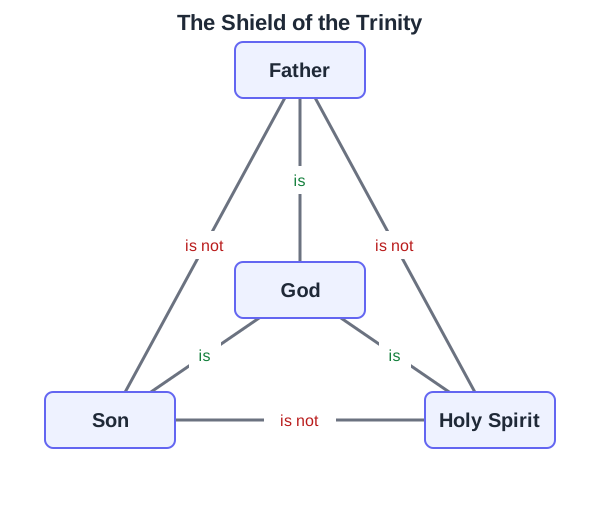
The Shield of the Trinity.
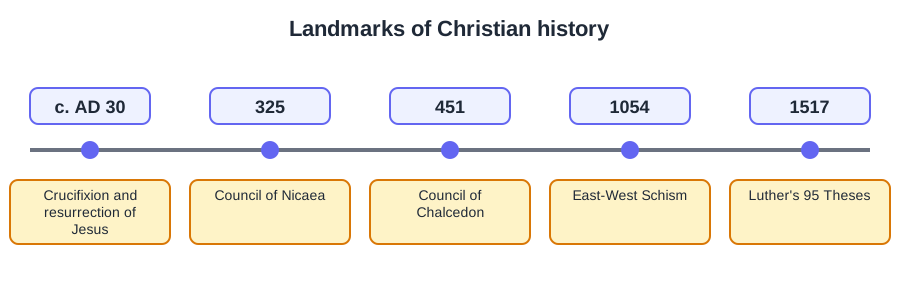
According to the image, which event is dated 1054?
East-West Schism
Council of Chalcedon
Luther's 95 Theses
Council of Nicaea
The timeline marks 1054 as the East-West Schism.
Which is a core Protestant principle?
Papal infallibility
Sola scriptura
Transubstantiation
Seven sacraments
Sola scriptura means Scripture alone is the final authority. The others are Catholic teachings.
How many sacraments do most Protestants recognize?
Two
Three
Five
Seven
Baptism and the Lord's Supper. Catholics and Orthodox count seven.
Pentecost occurs how long after Easter?
10 days
40 days
50 days
7 days
Acts 2. The Ascension is 40 days after Easter.
The Council of Chalcedon (451) taught that Christ is:
Only divine
Only human
One person with two natures, fully God and fully man
Two persons in one body
Two persons in one body is Nestorianism; only divine (or a blended nature) is the monophysite error.
Which text begins 'Blessed are the poor in spirit'?
The Ten Commandments
The Lord's Prayer
The Magnificat
The Beatitudes
The Beatitudes open the Sermon on the Mount (Matthew 5).
Which document did Henry VIII use to make himself head of the Church of England?
Edict of Worms
Act of Supremacy (1534)
Peace of Augsburg
95 Theses
The Act of Supremacy followed the pope's refusal to annul his marriage.
Who wrote Confessions and City of God?
Thomas Aquinas
Jerome
Augustine
Ignatius
Augustine of Hippo (354-430). Aquinas wrote the Summa Theologica; Jerome translated the Vulgate.
What does 'transubstantiation' describe?
Baptism by immersion
The Church's union with Rome
The Spirit descending at Pentecost
The substance of bread and wine becoming Christ's body and blood
A Catholic teaching rejected by Reformers such as Zwingli and Calvin.
What was the main aim of the Council of Trent?
To answer the Protestant Reformation and reform the Catholic Church
To define the Trinity
To end iconoclasm
To start the Crusades
Held 1545-1563.
Which statement about the Orthodox Church is correct?
It accepts the pope as supreme head
It permits married men to be parish priests
It rejects icons
It was founded by Luther
Married men may become priests (not bishops). Orthodoxy rejects papal supremacy and venerates icons.
Which letter writer was previously a Pharisee who persecuted Christians?
Peter
John
Paul
James
Paul (Saul of Tarsus) encountered the risen Christ on the road to Damascus.
Which pair is correctly matched?
Vulgate - Greek Old Testament
Septuagint - Latin Bible by Jerome
Septuagint - English Bible
Vulgate - Latin Bible by Jerome
The Septuagint is the Greek translation of Hebrew Scripture.
