Quiz · Medium
Image-supported questions on shot sizes, camera angles, lighting, sound and basic editing techniques.
Which shot size frames a person from roughly the waist up?
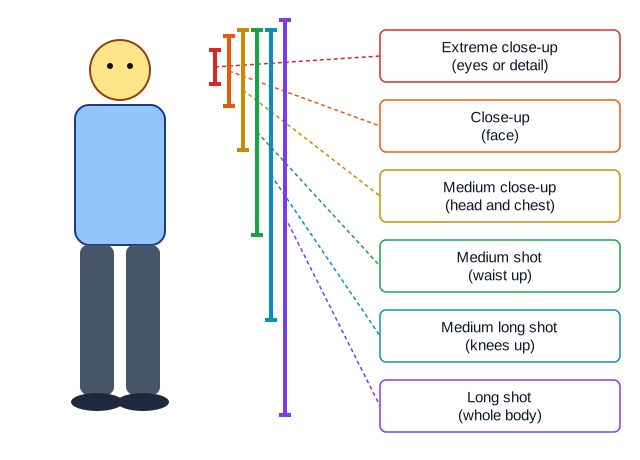
Medium long shot
Medium shot
Close-up
Long shot
Medium shot is waist up; medium long shot goes to the knees; a close-up frames the face.
A character is filmed from below so that they tower over the viewer. The usual effect is to make them seem:
Powerful or threatening
Weak or vulnerable
Confused
Far away
Low angles empower the subject. High angles diminish them; a Dutch angle conveys disorientation.
A filmmaker tilts the camera so the horizon is diagonal during a tense moment. This is called a:
Pan
Rack focus
Match cut
Dutch angle
A Dutch (canted) angle suggests unease. A pan rotates horizontally and a rack focus shifts focus.
Which technique moves the camera toward the subject while zooming out so the background appears to stretch, as in Vertigo?
Rack focus
Pan
Dolly zoom
Cross-cutting
The dolly zoom keeps the subject the same size while changing perspective. Rack focus changes focus; cross-cutting is an editing method.
In Todorov's narrative model, what follows 'equilibrium'?
Disruption
Recognition
Repair
Resolution
Equilibrium, disruption, recognition, attempt to repair, new equilibrium.
Which aspect ratio is the typical anamorphic widescreen 'scope' ratio?
4:3
1.37:1
1:1
About 2.39:1
4:3 and 1.37:1 are early/Academy ratios; 1:1 is square; scope is about 2.39:1.
In three-point lighting, which light is usually the strongest and sets the main exposure?
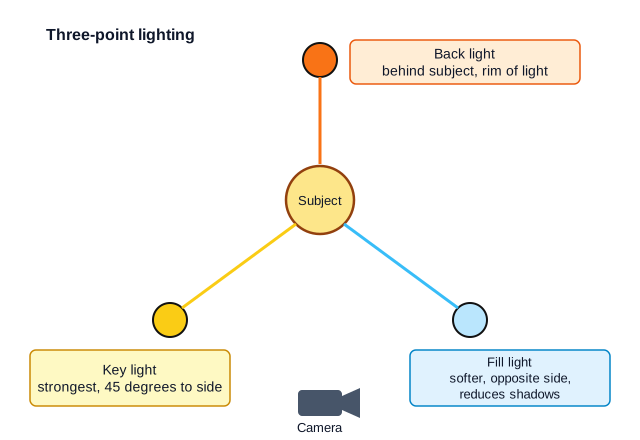
Fill light
Back light
Practical light
Key light
The key is the main light; fill reduces shadows from the key; the back light separates the subject from the background.
Which sound is diegetic?
The orchestral score during a chase
A radio playing in the character's kitchen
A narrator's voice-over added in post
The opening theme music over the titles
Diegetic sound comes from the story world. Score, voice-over narration and title music are non-diegetic.
Which type of editing aims to make cuts invisible so space and time feel continuous?
Continuity editing
Soviet montage
Jump cutting
Dissolve editing
Continuity editing underlies classical Hollywood style. Soviet montage emphasizes collision of shots; jump cuts draw attention.
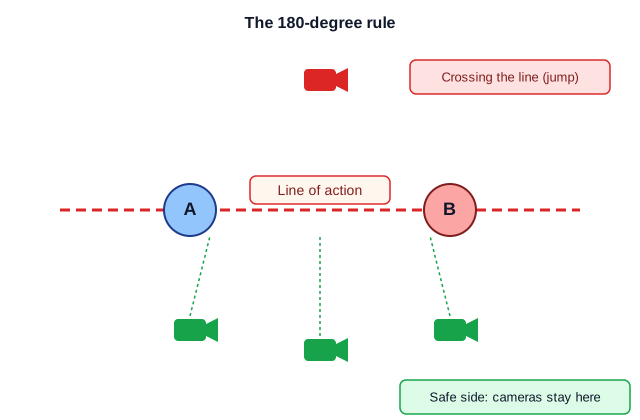
The 180-degree rule says the camera should stay on one side of:
The key light
The horizon
The line of action between characters
The center of the frame
Staying on one side preserves screen direction. The diagram shows the line of action and the safe zone for cameras.
Which film is known for popularizing the jump cut in the French New Wave?
Metropolis (1927)
Breathless (1960)
Citizen Kane (1941)
Jaws (1975)
Godard's Breathless used jump cuts deliberately. Citizen Kane is known for deep focus, and Metropolis for expressionist design.
The Kuleshov effect demonstrates that:
Close-ups are more emotional than long shots
Meaning and emotion come from the juxtaposition of shots
Sound is more important than image
Actors must show emotion on their faces
The same neutral face seemed hungry, sad or desirous depending on the shot it was cut with.
Which term describes everything placed in front of the camera, including set, costume, lighting and actor staging?
Montage
Mise-en-scène
Diegesis
Cinematography
Mise-en-scène is the arrangement of the scene; montage is editing; cinematography concerns camera and photography.
A high-key lighting setup is most typical in:
A film noir detective scene
A horror cellar scene
A bright musical or comedy
A night chase in the rain
High-key is bright with few shadows. Noir and horror use low-key lighting for contrast and mood.
Deep focus keeps objects in the foreground and background sharp at the same time.
True
False
Citizen Kane (1941) used deep focus to let the audience choose where to look.
The Hays Code was the voluntary rating system introduced in 1968.
True
False
The Production Code (Hays Code) was 1930s self-censorship; the MPAA rating system replaced it in 1968.
Which is the correct pairing of director and film?
F. W. Murnau, Metropolis
Akira Kurosawa, Rashomon
Sergei Eisenstein, Bicycle Thieves
Steven Spielberg, Star Wars
Murnau made Nosferatu (Lang made Metropolis); Eisenstein made Potemkin (De Sica made Bicycle Thieves); Lucas made Star Wars.
Which sequence is the classic example of cross-cutting?
Alternating between a hero racing to a rescue and the danger at the destination
A single long take following one character
A fade to black between scenes
A close-up on a prop
Cross-cutting alternates simultaneous action in different places; the others are different techniques.
Which role is responsible for the film's look through camera and lighting?
Script supervisor
Director of photography (cinematographer)
Key grip
Foley artist
The DP leads the camera and lighting departments; the script supervisor handles continuity; Foley artists make sound effects.
What is ADR used for?
Re-recording dialogue in a studio
Adding color grading
Creating storyboards
Adjusting aspect ratio
Automated dialogue replacement fixes unusable on-set audio or changes lines.
