Quiz · Medium
Motif development, phrase structure, binary, ternary, rondo, sonata form, canon and fugue.
What does a canon feature?
A strictly imitated melody entering later
Only chords
Random pitches
A single unaccompanied melody
A canon imitates a melody exactly in another voice.
What is a ground bass?
A repeating bass line over which other parts vary
A final bass note
A bass drum pattern
A bass clef sign
As in passacaglia and chaconne.
What do we call a short, distinctive musical idea that can be developed throughout a piece?
Cadence
Motif
Coda
Ostinato
A motif such as the opening four notes of Beethoven's Fifth.
Which technique repeats a motif at a higher or lower pitch, step by step?
Retrograde
Augmentation
Sequence
Inversion
A sequence repeats an idea at successive pitch levels.
Playing a theme backwards, from last note to first, is called what?
Retrograde
Diminution
Fragmentation
Inversion
Retrograde. Inversion flips the intervals upside down.
Halving the note values of a theme is called what?
Augmentation
Diminution
Sequence
Ostinato
Diminution; augmentation lengthens values.
Which pair of phrases forms a musical period?
Verse and chorus
Antecedent and consequent
Subject and answer
Theme and coda
The antecedent ends open, the consequent closes.
In the sonata-form diagram, which section modulates through V and other keys?
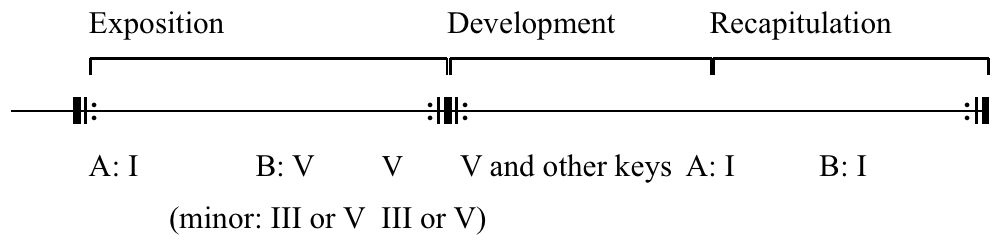
Exposition
Development
Recapitulation
Coda
The development.
Image: Hyacinth, public domain, via Wikimedia Commons.
In the diagram, which section brings back both themes in the tonic?
Exposition
Development
Recapitulation
Introduction
The recapitulation.
Image: Hyacinth, public domain, via Wikimedia Commons.
In this fugue excerpt, which label marks the second voice's entry in the dominant?
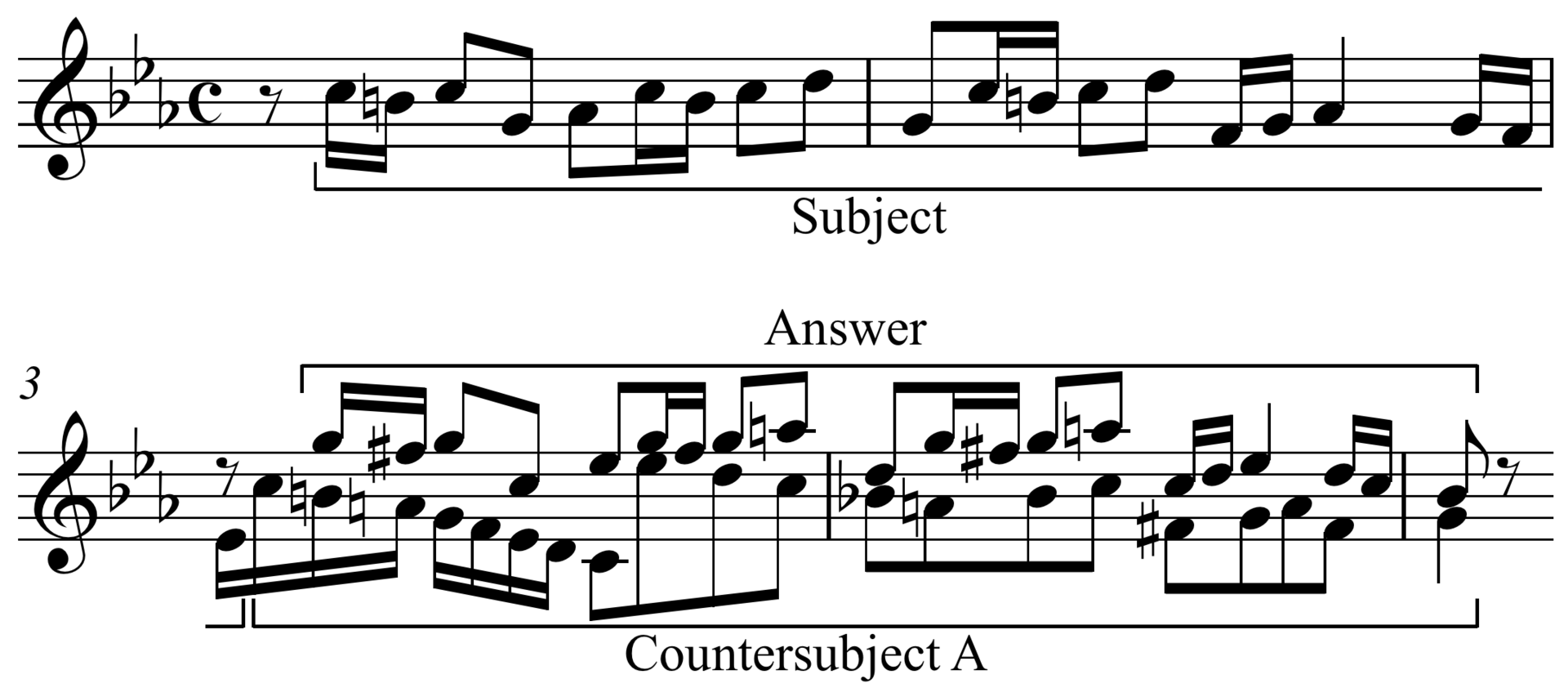
Subject
Answer
Episode
Stretto
The answer, accompanied by countersubject A.
Image: Hyacinth, public domain, via Wikimedia Commons.
What do we call a fugue's overlapping entries of the subject before it has finished?
Episode
Inversion
Stretto
Pedal
Stretto intensifies the texture.
This bass line (D A B F-sharp G D G A) underlies which famous work?

Bach's Air on the G String
Pachelbel's Canon
Vivaldi's Spring
Handel's Messiah
The ground bass of Pachelbel's Canon in D.
Image: Benjamin D. Esham, public domain, via Wikimedia Commons.
Which form has the pattern ABACA?
Binary
Ternary
Rondo
Strophic
A rondo returns to A between contrasting episodes.
In ternary form, what happens after the contrasting B section?
A new C section
A returns
The piece ends on V
The exposition repeats
ABA: the first section returns.
Which form repeats the same music for every verse of text?
Strophic
Through-composed
Sonata
Canon
Strophic, as in hymns and folk songs.
Which Mozart variation set is based on 'Ah! vous dirai-je, Maman'?
K. 265
K. 331
K. 545
K. 550
Twelve Variations, K. 265.
What does the page of sketches by Beethoven show?
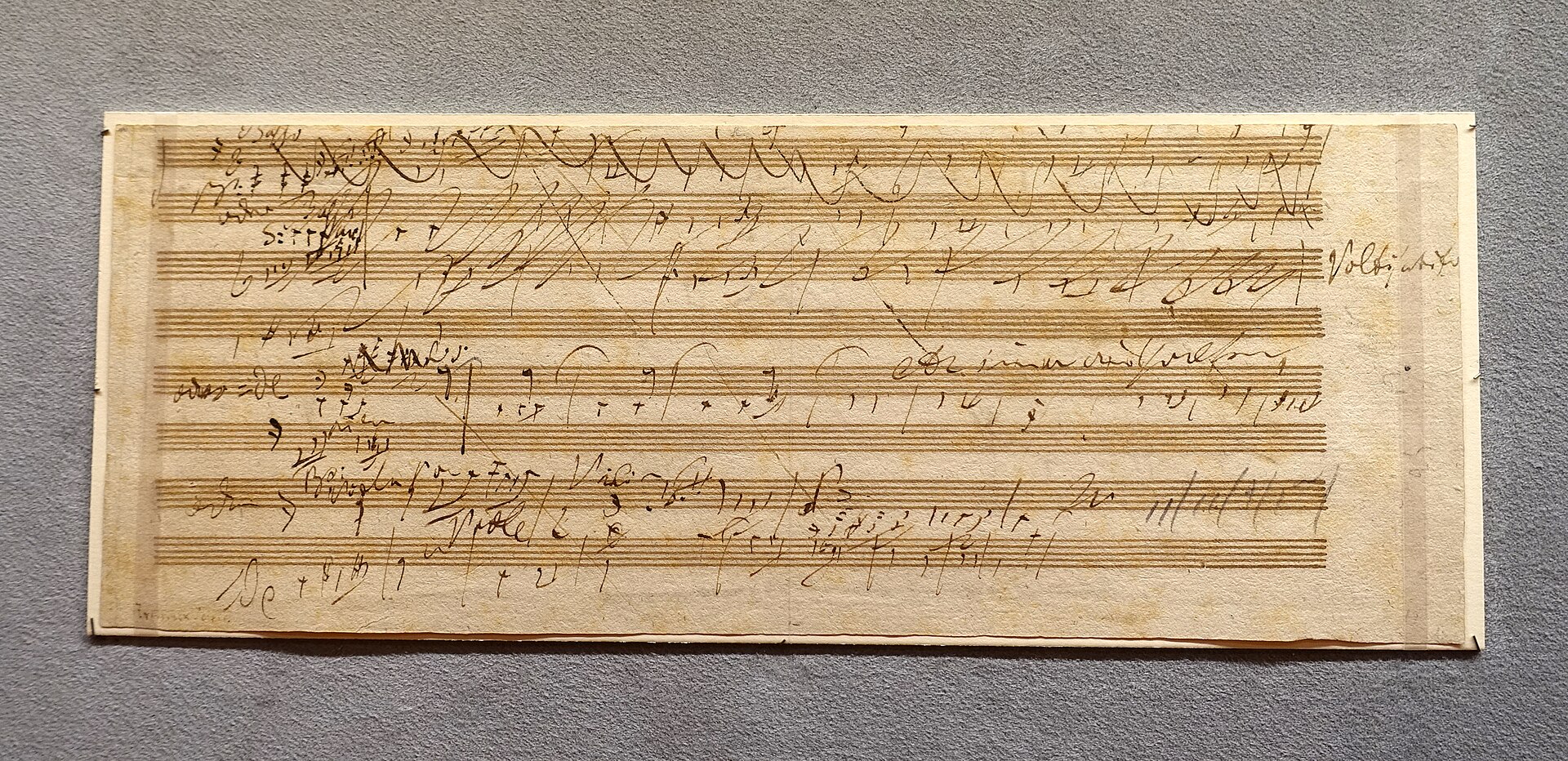
Final printed score
How composers develop ideas through drafts
A piano roll
A conductor's baton
These are sketches for the slow movement of the Seventh Symphony.
Image: Ludwig van Beethoven, public domain, via Wikimedia Commons.
What is a coda?
The first theme
A closing passage
A key change
A tempo sign
Coda is Italian for 'tail'.
