Quiz · Medium
Eighteen questions on gross income, AGI, credits versus deductions, brackets, capital gains basics, self-employment tax and the history of top marginal rates.
Which item is excluded from federal gross income?
Unemployment compensation
Life insurance proceeds received on the death of the insured
A cash prize won in a contest
Tips received by a server
Death benefits from life insurance are excluded. The other three are included in gross income.
Which is a deduction FOR adjusted gross income?
Charitable contributions
Interest paid on a qualified student loan (subject to limits)
Home mortgage interest
State income taxes paid
Student loan interest is an above-the-line deduction. The other items are itemized deductions from AGI.
Wages are $80,000, interest income $2,000, a deductible IRA contribution is $6,000 and the standard deduction is assumed at $15,000. What is taxable income?
$76,000
$67,000
$82,000
$61,000
AGI = 80,000 + 2,000 - 6,000 = 76,000. Subtract the $15,000 standard deduction for $61,000. $76,000 is AGI.
A taxpayer in the 24% bracket has a $1,000 deduction and a different taxpayer has a $1,000 credit. Which statement is correct?
The credit lowers tax by $1,000 and the deduction by $240
Both lower tax by $1,000
The deduction lowers tax by $1,000 and the credit by $240
Both lower tax by $240
A credit reduces tax dollar for dollar. A deduction reduces taxable income, so its value is the deduction times the marginal rate.
Which credit is nonrefundable?
Earned income tax credit
Refundable portion of the child tax credit
Lifetime learning credit
Refundable portion of the American opportunity credit
The lifetime learning credit cannot exceed the tax owed. The EITC and parts of the other credits can produce a refund.
Illustrative brackets: 10% to $10,000; 12% from $10,000 to $40,000; 22% above $40,000. What is the tax on $50,000 of taxable income?
$11,000
$6,800
$7,500
$5,000
1,000 + 3,600 + 2,200 = 6,800. Applying 22% to all $50,000 gives $11,000, which is the usual misconception about brackets.
In the previous example, what is the average tax rate?
22%
13.6%
12%
10%
6,800 / 50,000 = 13.6%. 22% is the marginal rate on the next dollar.
An unmarried taxpayer pays more than half the cost of keeping up a home that is the main home of her 8-year-old child. Her best filing status is...
Single
Married filing separately
Head of household
Qualifying surviving spouse
Head of household has a larger standard deduction and more favorable brackets than single. Qualifying surviving spouse needs a spouse who died in the last two years.
How is the net capital loss of $5,000 treated by an individual this year?
$3,000 deducted and $2,000 carried forward
$5,000 deducted
$5,000 carried forward
$3,000 deducted and $2,000 lost
The annual limit against ordinary income is $3,000. The excess carries forward indefinitely.
What holding period makes a capital gain long term?
More than one year
At least six months
More than two years
At least 90 days
Assets held one year or less produce short-term gain taxed at ordinary rates.
A taxpayer inherits stock that the decedent bought for $10,000. It was worth $60,000 at death and the heir sells it for $62,000 a few months later. What is the gain, and is it long or short term?
$52,000 short-term gain
$52,000 long-term gain
$2,000 short-term gain
$2,000 long-term gain
Inherited property takes a basis equal to FMV at death ($60,000) and is automatically treated as long term.
A single taxpayer sells her home for $570,000 net of costs. Her basis is $300,000 and she meets the ownership and use tests. How much gain is taxable?
$0
$20,000
$270,000
$70,000
Realized gain = $270,000; the exclusion for a single taxpayer is $250,000, leaving $20,000 taxable.
A sole proprietor has net earnings from self-employment of $100,000. What is the approximate self-employment tax (ignoring the wage base)?
$15,300
$7,650
$14,130
$12,400
100,000 x 92.35% = 92,350 x 15.3% = $14,130. Forgetting the 92.35% adjustment gives $15,300.
A taxpayer files Form 4868 by April 15 but does not pay any tax. What is the effect?
Both the filing and payment deadlines are extended
No penalty or interest applies until October 15
The filing deadline is extended, but interest and penalties for late payment still apply
The extension is invalid without payment
An extension to file is not an extension to pay.
Tax evasion is the legal minimization of tax liability.
True
False
That describes tax avoidance. Evasion is the willful, illegal attempt to avoid tax.
The form shown is a 1941 Form 1040 for a calendar-year taxpayer. By what date was it due?
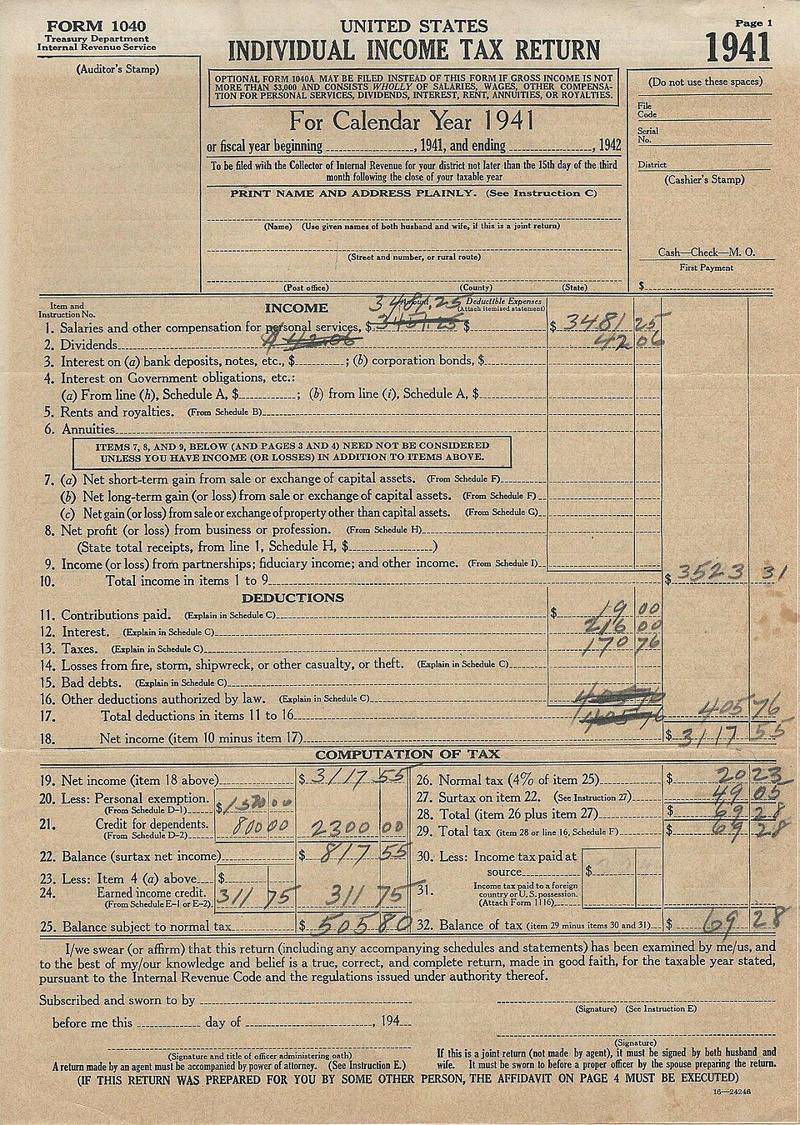
April 15, 1942
March 15, 1942
June 15, 1942
January 31, 1942
The form states returns were due by the 15th day of the third month after year-end. The April 15 date came later, in the 1950s.
In the chart of top US federal marginal income tax rates, in which period was the rate highest?
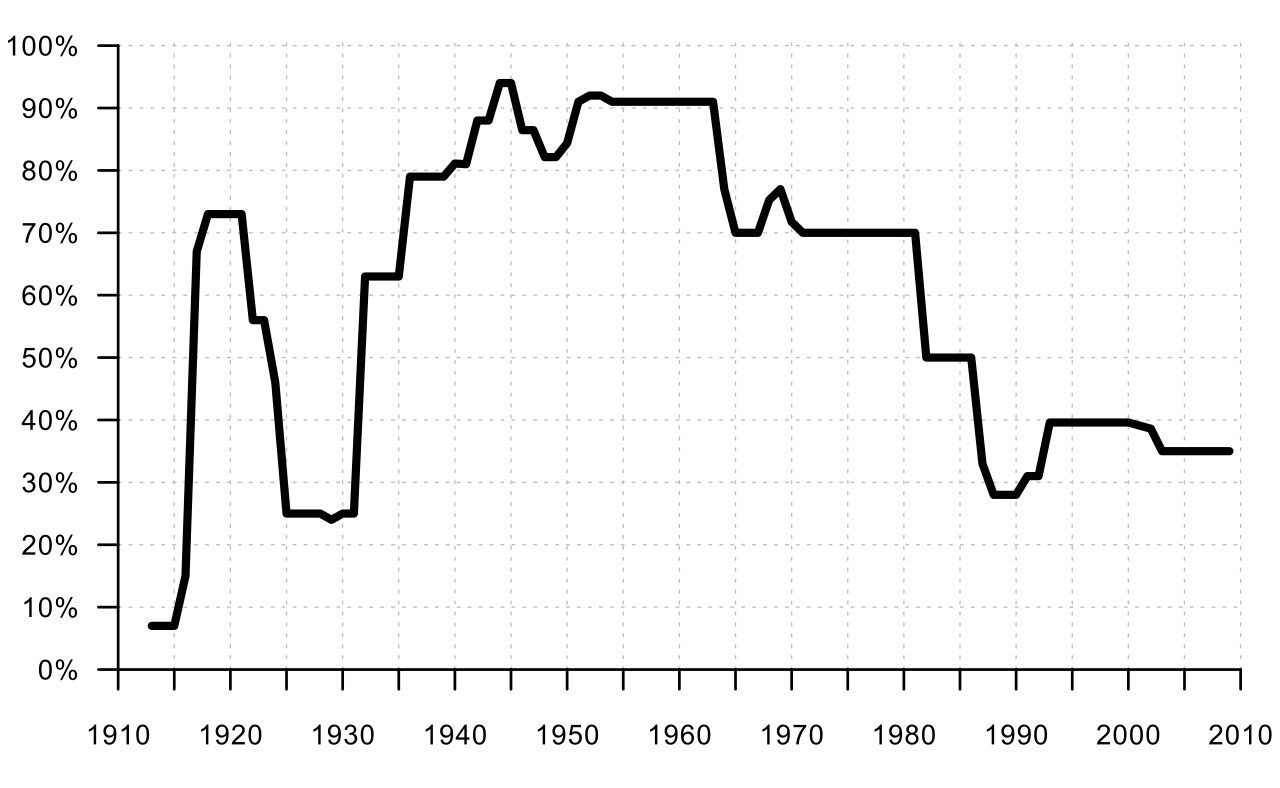
The 1940s and 1950s
The 1920s
The 1980s
The 2000s
The top rate peaked near 94% during World War II and stayed around 91% through the early 1960s.
About what was the top federal marginal rate in the late 1990s according to the chart?
About 28%
About 40%
About 60%
About 70%
After the 1993 increase the top rate stood near 39.6%. The 28% level was from 1988 to 1990, and 70% applied from 1965 to 1981.
Which period shows the sharpest decline in the top rate?
The 1980s
The 1930s
The 1960s
The 2000s
The top rate fell from 70% to 50% in 1982 and to 28% by 1988. The 1930s saw large increases and the 2000s only a modest decline.
