Quiz · Medium
Foundational questions on offer and acceptance, the mailbox rule, consideration, defenses, the Statute of Frauds, UCC Article 2 and the basic contract remedies.
Which of the following is the best description of the elements needed to form an enforceable contract?
Offer, acceptance, and a written document
Agreement and notarization
Offer, acceptance, and consideration (or a substitute), with no defense to enforcement
A promise and reliance only
Most contracts need no writing. The Statute of Frauds requires a writing only for certain categories. Reliance can substitute for consideration only through promissory estoppel.
Seller ships a newspaper ad: "Brand-new bicycles, $100." Buyer walks in and says "I accept." The store refuses. Is there a contract?
Probably not, because ads are generally invitations to negotiate rather than offers
Yes, because the ad stated a price
Yes, because the buyer accepted in person
Yes, because stores must honor ads by law
An ad is an offer only if it is clear, definite, and explicit and leaves nothing for negotiation (Lefkowitz, "first come, first served"). A general price ad usually does not.
On Monday, A mails an offer to B. On Tuesday, B mails an acceptance. On Wednesday, A mails a revocation, which B receives on Thursday. B's acceptance arrives on Friday. Is there a contract?
No, because the revocation was sent before the acceptance arrived
No, because A revoked before B's acceptance reached A
Yes, but only if B had accepted in writing
Yes, because acceptance was effective on Tuesday when mailed
Under the mailbox rule, acceptance is effective on dispatch. A revocation is effective only on receipt, so it came too late.
B responds to A's offer with, "I accept, but I want delivery on Friday instead of Monday." At common law this is
an acceptance with a modification
a counteroffer, which rejects the original offer
a binding acceptance with a request
a revocation of the offer
Under the mirror image rule, an acceptance must match the offer exactly. A change creates a counteroffer. In a sale of goods, UCC 2-207 may treat it as an acceptance.
Which is NOT a way an offer is terminated?
Rejection by the offeree
The offeree's silence for a short period after receiving the offer
Revocation before acceptance
Death of the offeror
Silence generally does not terminate an offer, though the offer can lapse after a reasonable time. Rejection, counteroffer, revocation, lapse, and death or incapacity all terminate it.
Uncle promises to pay Nephew $1,000 if Nephew stays sober until his 21st birthday. Nephew complies. Is the promise supported by consideration?
No, because the Uncle received no tangible benefit
No, because family promises are never enforceable
No, because Nephew only did what he should have done
Yes, because giving up a legal right is a legal detriment bargained for by the Uncle
Hamer v. Sidway: legal detriment is enough, whether or not the promisor receives a tangible benefit. Abstaining from a legal right is a detriment.
After Mechanic fixes Owner's car, Owner promises to pay him an extra $200 for his good work. Mechanic sues for the $200. He will most likely
lose, because the promise was supported only by past consideration
win, because a promise in writing is enforceable
win, because the work was valuable
lose, because mechanics may not sue for tips
The repair was done before the promise and not in exchange for it. Past consideration is not consideration, unless the material benefit rule applies.
A contractor refuses to continue a job unless the owner pays $5,000 more than agreed, and the owner agrees. The owner later refuses to pay the extra amount. Under the common law
the contractor prevails, because the owner agreed in writing
the contractor prevails, since the owner benefited
the owner prevails, because the contractor had a pre-existing duty and gave no new consideration
the owner prevails only if there was duress
At common law, a modification needs consideration. Under the UCC, a good faith modification needs none. Duress might also apply but it is not required.
Which contract must be in writing to be enforceable under the Statute of Frauds?
An oral agreement to paint a house
A promise to pay for a friend's lunch
A one-month employment contract
A promise to sell goods for $2,000
Goods of $500 or more fall under UCC 2-201. Painting a house (services, not land) and a one-month job can be performed within a year.
An oral agreement to employ someone for 18 months is
outside the Statute of Frauds because employment is a service
within the Statute of Frauds, because it cannot be performed within one year
enforceable only if the employee has completed performance
void
The one-year provision applies if the contract by its terms cannot be completed within a year. An agreement for 18 months falls within it.
A 16-year-old buys a car on credit and later wants out of the deal. The contract is
void
fully enforceable
voidable at the minor's option
voidable at the seller's option
A minor can disaffirm during minority or within a reasonable time after reaching majority. The seller cannot disaffirm.
A signs a contract after B threatens to publish false statements about him unless he signs. A can most likely avoid the contract because of
duress
undue influence
mutual mistake
unconscionability
An improper threat that leaves no reasonable alternative is duress. The contract is voidable.
Two parties contract to sell a ship named Peerless, but each is thinking of a different ship with that name. The best result is
no contract, because of a latent ambiguity with no meeting of the minds
a contract for the ship in the seller's mind
a contract for the ship in the buyer's mind
a contract that the buyer must pay for either way
Raffles v. Wichelhaus. A material latent ambiguity with no objective way to choose a meaning means there was no mutual assent.
The parol evidence rule bars
evidence of fraud in formation
proof of a later modification
prior oral agreements that contradict a fully integrated written agreement
evidence that interprets an ambiguous term
The rule applies to prior and contemporaneous agreements. Fraud, later modifications, and interpretation of ambiguity are exceptions.
Which of the following is governed by UCC Article 2?
A lease of a warehouse
A sale of 200 laptops
A contract to deliver legal services
A sale of a house
Article 2 governs sales of goods. Real estate and services are governed by the common law.
Merchant A sends a purchase order for 100 widgets at $10. Merchant B replies with a form accepting but adding an arbitration clause. Neither party objects. Under UCC 2-207
no contract exists because the terms differ
B's form is a counteroffer in every case
the arbitration clause automatically becomes part of the contract
a contract exists, and the arbitration clause is a proposal that becomes part of the contract only if it does not materially alter it
A definite expression of acceptance operates as acceptance even with additional terms. Between merchants, additional terms become part of the contract unless they materially alter it, the offer limits acceptance, or there is an objection.
Which remedy is the default measure of damages for a breach of contract?
Punitive damages
Reliance damages
Expectation damages
Restitution
Expectation damages protect the benefit of the bargain. Reliance and restitution are alternatives, and punitive damages are not available.
A buyer wrongfully refuses to accept a shipment of goods that the seller then resells at a lower price. The seller's measure of damages is generally
the contract price minus the resale price, plus incidental damages
the resale price
the cost of the goods
the contract price
UCC 2-706 allows the difference between the contract price and the resale price, plus incidental damages, less expenses saved.
When a seller delivers goods that do not conform in some minor respect, the buyer under the UCC may
only recover damages
only reject if the defect is material
not reject once the goods arrive
reject the goods, subject to the seller's right to cure
The perfect tender rule lets the buyer reject for any nonconformity in a single-delivery contract. The seller may have a right to cure.
Who can enforce a contract made between A and B that was clearly intended to benefit C?
Only A
C, as an intended third-party beneficiary
Only B
No one, since C gave no consideration
An intended beneficiary can enforce the promise once the rights have vested. An incidental beneficiary cannot.
A contract to deliver goods is excused when
performance becomes more expensive
an unforeseen event makes performance impracticable, and the party did not assume the risk
the market price rises
one party changes his mind
Increased cost alone is not enough. The event must be unforeseeable, not the party's fault, and the risk must not have been allocated.
True or false: A liquidated damages clause is enforceable if it is a reasonable forecast of the damages, which were difficult to estimate at the time of contracting.
True
False
A clause that is a penalty, because it is unreasonably large, is unenforceable.
According to the diagram, which of these does NOT terminate an offer?
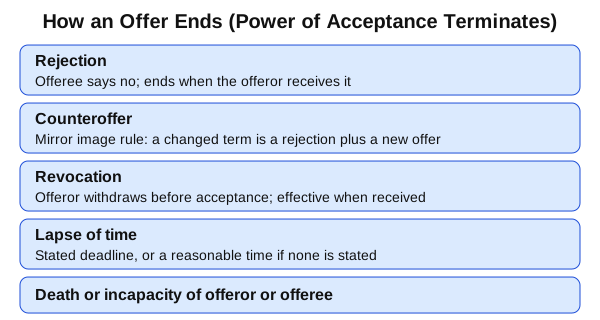
The offeree's asking a question about the terms
Rejection
Counteroffer
Revocation
A mere inquiry or request for information does not reject or counter the offer. Rejection, counteroffer, revocation, lapse, and death or incapacity do terminate it.
Which measure of damages in the diagram is the default in contract law?
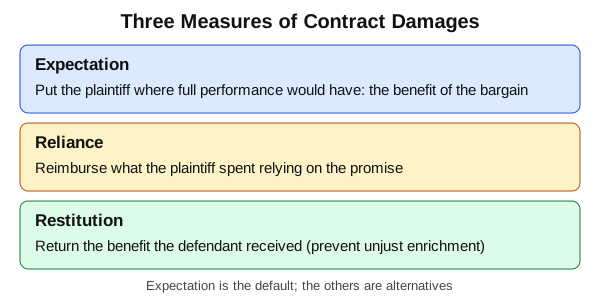
Reliance
Restitution
Expectation
Punitive
Expectation protects the benefit of the bargain. Reliance and restitution are alternatives. Punitive damages are not listed because they are generally not available.
