Quiz · Hard
Applied questions: audit risk components, assertions and testing direction, COSO, deficiencies, confirmations, fraud and sampling calculations.
In the audit risk model, which component is directly controlled by the auditor?
Detection risk
Inherent risk
Control risk
Risk of material misstatement
The auditor sets detection risk by deciding the nature, timing and extent of substantive procedures. Inherent and control risks exist independently of the audit.
The assessed risk of material misstatement rises from low to high. What is the appropriate response?
Raise acceptable detection risk
Reduce the sample size
Lower acceptable detection risk and perform more extensive substantive tests
Rely more on inquiries of management
Audit risk is held constant, so as RMM goes up, detection risk must go down, which requires more or better substantive evidence.
To test the completeness of recorded sales, the auditor should trace from...
The sales journal to shipping documents
The sales journal to the general ledger
The general ledger to customer statements
Shipping documents to the sales journal
Completeness is about unrecorded items, so start with the source documents and follow them into the records. Starting from the records tests existence.
To test the existence of recorded inventory, the auditor selects items...
From the shelves and traces to the records
From the sales journal and traces to cash receipts
From the inventory records and inspects them physically
From purchase requisitions and traces to the ledger
Existence tests start with the recorded amounts and check that the items are real. Selecting from the floor to the records tests completeness.
Which assertion is most directly tested by a search for unrecorded liabilities?
Existence
Completeness
Valuation
Rights and obligations
Unrecorded liabilities mean the balance is understated. Examining subsequent disbursements finds payables that should have been recorded.
Which type of evidence is the most reliable?
A copy of the bank statement from the client
Management's oral explanation
The client's bank reconciliation
A bank confirmation received directly by the auditor
External, independent evidence obtained directly by the auditor is most reliable. Client-held copies and inquiries are less so.
Which COSO component sets the foundation for all others?
Control environment
Risk assessment
Monitoring activities
Control activities
Tone at the top, integrity and ethics shape how other components work.
A company has one employee who approves purchases, receives goods and records liabilities. Which fundamental control principle is violated?
Physical controls over assets
Segregation of duties
Independent verification
Adequate documentation
The functions of authorization, custody and recording are combined, so errors or theft could go undetected.
Which deficiency gives a reasonable possibility that a material misstatement will not be prevented or detected on a timely basis?
A material weakness
A significant deficiency
A control deficiency
A scope limitation
That is the definition of a material weakness. A significant deficiency is less severe but still merits attention.
The auditor sends negative confirmations. Which circumstance makes this acceptable?
Few large balances and high control risk
Many small balances, low control risk and recipients likely to consider the request
The auditor suspects fraud in receivables
Customers are mostly related parties
Negative confirmations give weaker evidence because silence is not proof, so they fit only when risk is low.
A customer does not respond to a positive confirmation. What should the auditor do?
Perform alternative procedures such as examining subsequent cash receipts
Treat the balance as an error
Send a negative confirmation instead
Accept the balance based on management's representation
Alternative procedures can provide the evidence the confirmation would have. Nonresponse is not by itself a misstatement.
Which element of the fraud triangle is most directly affected by implementing effective internal controls?
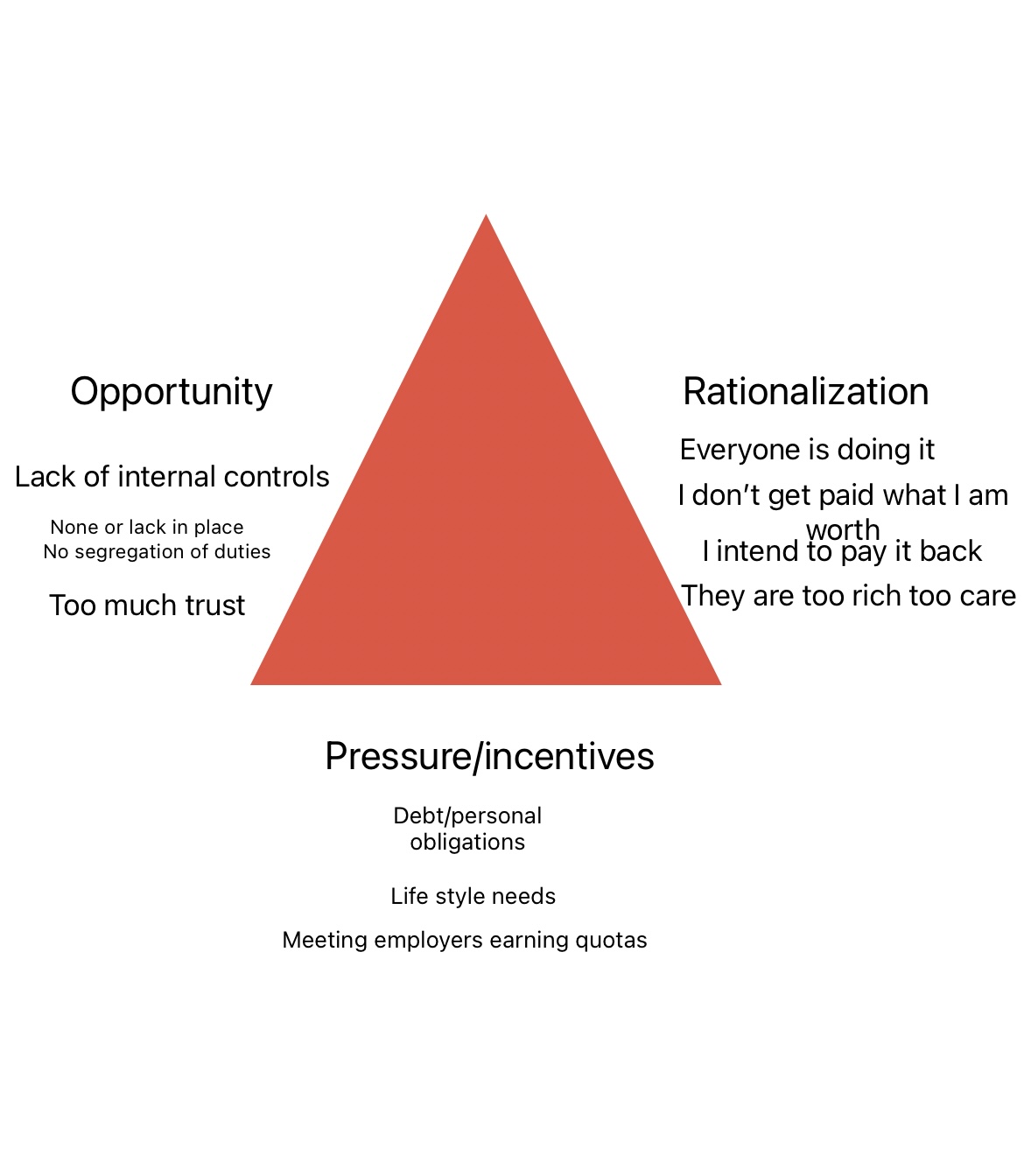
Opportunity
Pressure
Rationalization
Incentive
Controls reduce the opportunity to commit and conceal fraud. Pressure and rationalization are internal to the perpetrator.
A clerk who handles customer remittances posts payments to accounts receivable and also prepares the bank deposit. Which scheme does this make possible?
Lapping
Check kiting
Channel stuffing
Cookie jar reserves
The clerk can pocket one payment and cover it with later customers' payments. Segregating cash handling from recording prevents it.
In an attribute sampling test of controls, the tolerable deviation rate is 5% and the sample deviation rate is 3%, but the computed upper deviation limit is 7%. What is the conclusion?
Control risk cannot be assessed at the planned low level
The control may be relied on at the planned level
The sample is too large
The tolerable rate should be increased
The upper limit exceeds the tolerable rate, so the auditor must increase assessed control risk or expand testing.
Which change would increase the required sample size in attribute sampling?
A higher tolerable deviation rate
A larger population with the same risk
A lower expected deviation rate
A lower tolerable deviation rate
Tighter tolerance requires more evidence. Population size has little effect unless the population is very small.
The auditor concludes that a control is not effective when it is effective. This is the risk of...
Assessing control risk too low
Incorrect acceptance
Assessing control risk too high
Nonsampling risk
This error causes extra substantive testing (efficiency). Assessing control risk too low leads to insufficient testing and a possible incorrect opinion (effectiveness).
A monetary unit sample selects 100 dollar units from a $2,000,000 population. What is the sampling interval?
$2,000
$200,000
$20,000
$100,000
Interval = population value / sample size = 2,000,000 / 100.
A sample of $50,000 contains $2,000 of overstatement. The population is $500,000. What is the projected misstatement?
$2,000
$20,000
$4,000
$200,000
The ratio method projects (2,000 / 50,000) x 500,000 = $20,000. The sample error alone understates the likely population error.
