Quiz · Hard
Seat allocation calculations, FPTP vs PR, packing and cracking, voting rights and campaign finance cases.
Under which electoral system does the candidate with the most votes in a district win even without a majority?
First-past-the-post
Instant runoff
Mixed-member proportional
Single transferable vote
Plurality rule is used for the US Congress and UK House of Commons.
Duverger's law links which two things?
PR and one-party rule
Federalism and weak parties
Plurality single-member districts and two-party systems
Primaries and coalitions
PR is associated with multiparty systems (Duverger's hypothesis).
With 5 seats, the D'Hondt method, and votes A 48,000, B 31,000, C 14,000, D 7,000, how many seats does A win?
2
4
3
5
Quotients: 48,000 (A), 31,000 (B), 24,000 (A), 16,000 (A), 15,500 (B). A gets 3, B 2. Sainte-Laguë would give A 2, B 2, C 1.
With the same votes under Sainte-Laguë (divisors 1, 3, 5), which party wins one seat that it would not win under D'Hondt?
C
D
A
B
Under Sainte-Laguë, C's first quotient 14,000 beats B's second quotient of 10,333. D'Hondt favors larger parties.
What is the Hare quota for 100,000 votes and 5 seats?
16,667
25,000
10,000
20,000
Hare: V divided by S. The Droop quota is floor(V/(S+1)) + 1 = 16,667.
Compute the effective number of parties for shares .50, .50.
1
2
4
0.5
N = 1 divided by (0.25 + 0.25) = 2. More equal parties raise N.
In this diagram, which map shows 'cracking' of the red voters?
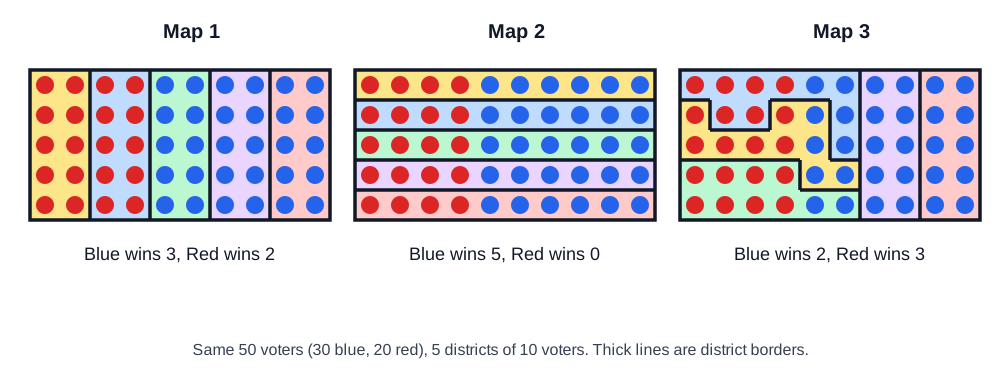
Map 1: compact vertical strips
Map 2: red voters are split across every district
Map 3: blue voters packed into two districts
None of them
In Map 2 each district has 4 red and 6 blue voters, so red wins no seats despite 40 percent of voters.
In Map 3 of the diagram, how does the red party win 3 of 5 districts with only 40 percent of the voters?
Red voters are cracked evenly
The districts are all equally sized strips
Blue voters are packed into two all-blue districts and red voters narrowly win the other three
Blue voters are not counted
Packing wastes blue votes in two lopsided districts. The three remaining districts have 6 or 7 red voters out of 10.
Which case held that partisan gerrymandering claims are not justiciable in federal court?
Rucho v. Common Cause (2019)
Baker v. Carr (1962)
Shaw v. Reno (1993)
Reynolds v. Sims (1964)
Rucho left the issue to the states and Congress. Baker opened the door to redistricting suits; Shaw dealt with race.
Which case required equal population in congressional districts?
Reynolds v. Sims (1964)
Shaw v. Reno (1993)
Citizens United (2010)
Wesberry v. Sanders (1964)
Reynolds covered state legislative districts; Wesberry the US House.
What did Shelby County v. Holder (2013) do?
It banned literacy tests
It upheld voter ID laws
It struck down the coverage formula that determined which jurisdictions needed federal preclearance
It abolished the Electoral College
Section 5 preclearance cannot be used without a new coverage formula from Congress.
Which constitutional amendment banned poll taxes in federal elections?
The 15th Amendment
The 24th Amendment
The 19th Amendment
The 26th Amendment
Harper v. Virginia Board of Elections (1966) extended the ban to state elections.
What did Buckley v. Valeo (1976) hold about campaign finance?
All limits are unconstitutional
All limits are constitutional
Only corporations can spend freely
Contribution limits are constitutional but limits on independent expenditures are not
The Court treated spending money as speech but accepted contribution limits to prevent corruption.
Which decision allowed corporations and unions to spend unlimited independent funds on elections?
Citizens United v. FEC (2010)
McCain-Feingold (2002)
Buckley v. Valeo (1976)
McCutcheon v. FEC (2014)
McCutcheon struck down aggregate contribution limits; BCRA tried to restrict such spending.
Which statement about Germany's mixed-member proportional system is correct?
Each voter casts a vote for a local candidate and a vote for a party, and party votes largely determine each party's share of the seats
Seats are allocated only by local winners
Voters rank candidates
There is no threshold
This is why Germany is proportional overall even with local candidates. A 5 percent threshold applies.
Ranked-choice (instant-runoff) voting is used for which of these?
The UK House of Commons
The US Senate nationally
Australia's House of Representatives
The German Bundestag
Voters rank candidates and the lowest are eliminated until one has a majority.
Which system is used for the lower house in the Netherlands?
First-past-the-post
Nationwide list proportional representation
Two-round runoff
Single transferable vote
The Netherlands' 150 seats are allocated nationally with a very low effective threshold.
A new party wins 12 percent of the vote in a PR system with a 5 percent threshold. What follows?
It wins none
It wins exactly half of its share
It must merge with another party
It wins about 12 percent of the seats
Above the threshold, seats follow votes proportionally.
In a runoff between two candidates after a first round with four, Candidate X got 38 percent and Y 30 percent in round one. What is the usual rule in a two-round system?
X wins immediately with a plurality
The top two advance and the winner needs a majority in the second round
All four advance
The legislature decides
The French presidential election uses this system.
Which pair of countries both use first-past-the-post for their lower houses?
Germany and the Netherlands
Israel and Spain
Ireland and Malta
Canada and India
Canada and India inherited the British system. Ireland and Malta use STV.
Which statement about majority-minority districts is accurate?
They can be required by Section 2 of the Voting Rights Act to avoid diluting minority votes
They are always unconstitutional
They are required in every state
They only exist for state legislatures
Race-based districting is limited by the Equal Protection Clause (Shaw v. Reno), but Section 2 may require them; see Allen v. Milligan (2023).
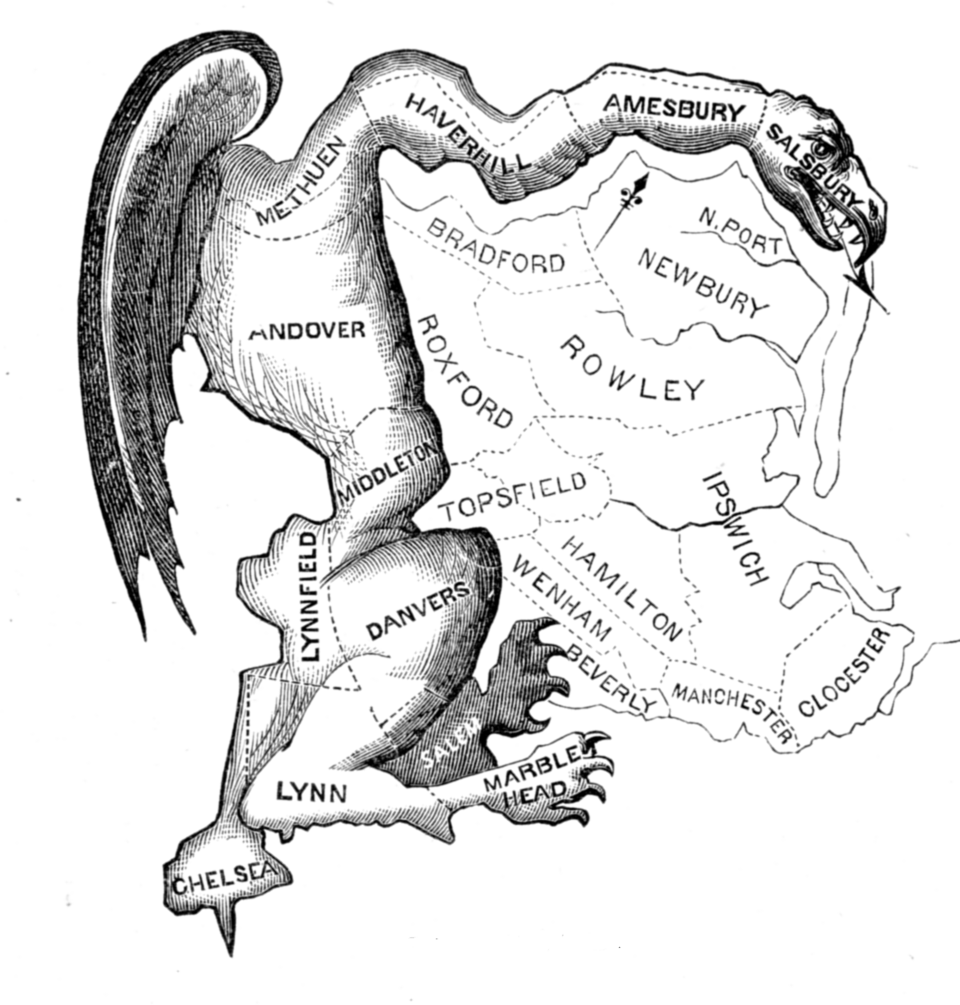
Where does the word 'gerrymander' come from?
A district in Georgia in 1920
A Supreme Court case in 1964
A Massachusetts district of 1812 signed by Governor Elbridge Gerry that resembled a salamander
An English electoral term
The Boston Gazette combined 'Gerry' and 'salamander.'
