Quiz · Medium
Intro-level questions on evolutionary forces, human variation, primate classification and key hominin species.
Which of the following is the only source of new alleles?
Gene flow
Mutation
Natural selection
Genetic drift
Gene flow moves existing alleles, drift and selection change their frequencies; only mutation creates new ones.
A small group leaves a large population and starts a new one, carrying only some of the original alleles. This is:
Convergent evolution
Founder effect
Gene flow
Natural selection
The founder effect is a form of genetic drift.
In Hardy-Weinberg equilibrium, if q = 0.3, the expected frequency of homozygous recessive individuals is:
0.49
0.3
0.09
0.42
q squared = 0.09. 0.42 is 2pq; 0.49 is p squared.
Which statement about human race is best supported by genetics?
Humans fall into distinct genetic races
Skin color predicts intelligence
Racial groups are separate species
Most variation is within populations and varies clinally
Human variation is continuous; racial categories are social constructs.
Heterozygous carriers of the sickle cell allele are protected against:
Cholera
Malaria
Rickets
Tuberculosis
This is heterozygote advantage, which keeps the allele common in malarial areas.
According to Bergmann's rule, populations in colder climates tend to have:
Darker skin
Longer limbs
Larger, stockier bodies
Less body fat
A smaller surface-area-to-volume ratio conserves heat. Allen's rule covers shorter limbs.
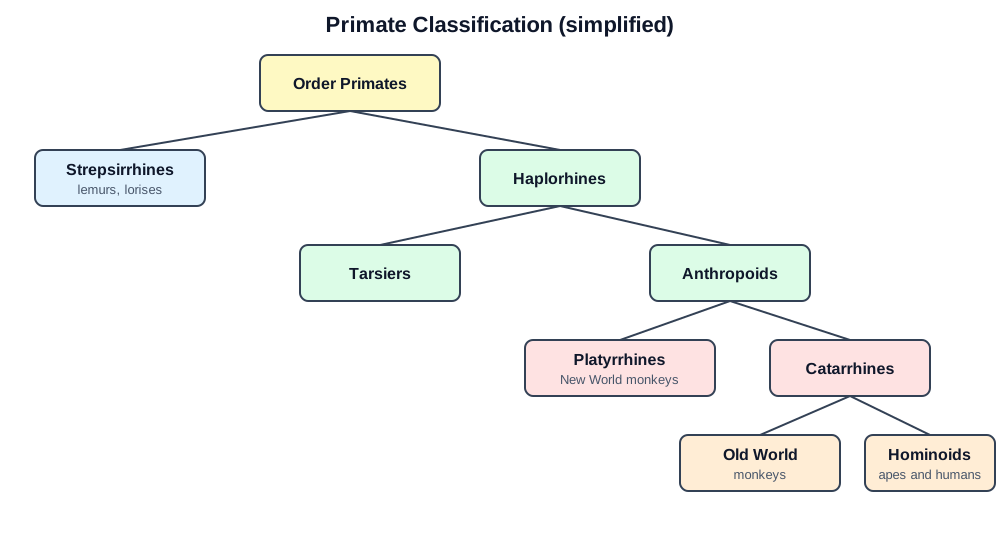
Lemurs and lorises belong to which group?
Catarrhines
Haplorhines
Platyrrhines
Strepsirrhines
Strepsirrhines are the 'wet-nosed' primates.
In the diagram, which group is made up of the New World monkeys?
Catarrhines
Hominoids
Tarsiers
Platyrrhines
Platyrrhines (flat noses, sideways nostrils) live in Central and South America.
The dental formula 2.1.2.3 is characteristic of:
Lemurs
Catarrhines including humans
New World monkeys
Tarsiers only
New World monkeys have 2.1.3.3 (an extra premolar).
Which apes are knuckle-walkers?
Spider monkeys
Orangutans
Chimpanzees and gorillas
Gibbons
Gibbons and orangutans are mainly arm-swinging brachiators.
Which skeletal feature is evidence of bipedalism?
Sagittal crest
Foramen magnum positioned under the skull
Large canine teeth
Long, narrow pelvis
The pelvis in bipeds is short and bowl-shaped; the foramen magnum sits beneath the skull.
The 'Lucy' skeleton is a member of which species?
Australopithecus afarensis
Paranthropus boisei
Ardipithecus ramidus
Homo habilis
Found in 1974 at Hadar, Ethiopia, about 3.2 mya.
According to the chart, which was the first hominin to spread widely beyond Africa?
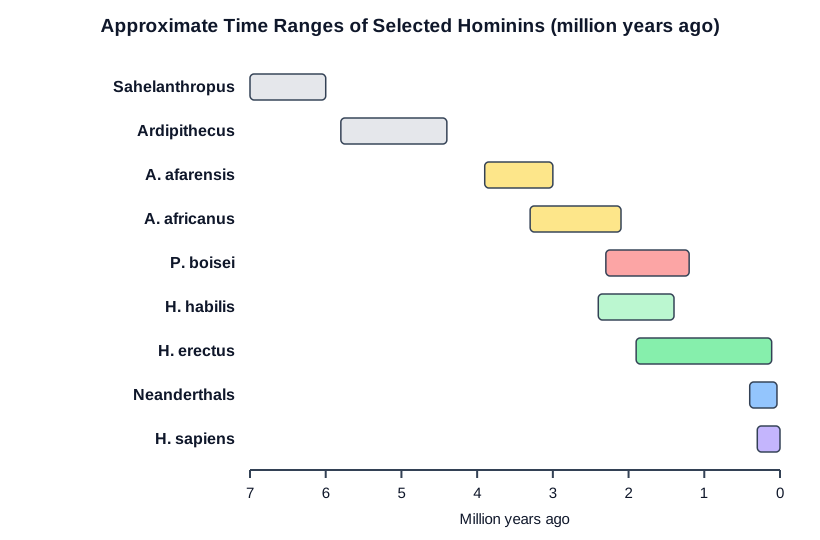
Homo erectus
Australopithecus afarensis
Homo habilis
Paranthropus boisei
H. erectus appeared about 1.9 mya and spread across Africa and Asia.
The Taung Child, discovered in 1924, belonged to:
Australopithecus africanus
Homo naledi
Neanderthals
Homo erectus
Raymond Dart described it, but his claim was initially rejected.
Which hominin is known from DNA obtained at Denisova Cave, Siberia?
Denisovans
Homo floresiensis
Homo heidelbergensis
Paranthropus
The Denisovans were identified in 2010 from DNA.
What is the best summary of the Out of Africa model?
Homo erectus evolved in Europe
Modern humans evolved separately on each continent
Neanderthals were direct ancestors of all Europeans
Modern humans evolved in Africa and spread, replacing or mixing with archaic populations
Genetic evidence supports an African origin around 300,000 years ago, with limited interbreeding.
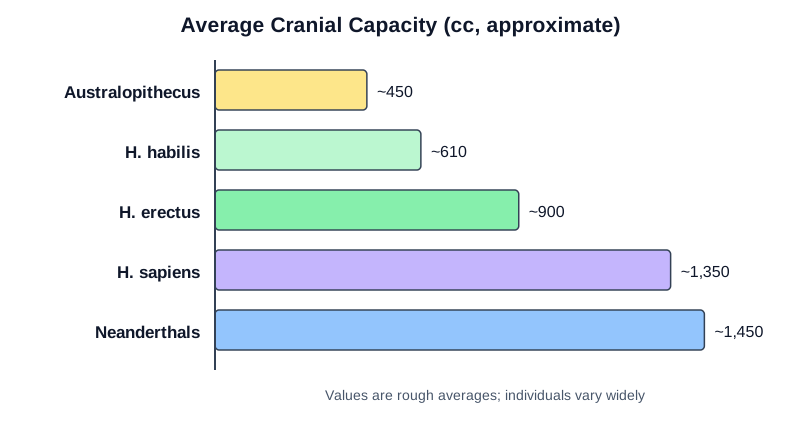
Which trait generally increased across hominin evolution, as in the chart?
Sagittal crest size in Homo
Prognathism
Cranial capacity
Canine size
Brain size rose from about 450 cc (Australopithecus) to about 1,350 cc in modern humans.
Hamilton's rule predicts that helping relatives evolves when:
rB > C
r = 0
C > rB
B = C
Relatedness times benefit must exceed cost.
The Piltdown hoax involved:
A Neanderthal burial
A fake footprint
A human skull combined with an orangutan jaw
A Denisovan tooth
Exposed in 1953.
Which is the best skeletal indicator of sex?
Ribs
Cranial capacity
Pelvis
Femur length
The pelvis shows the strongest differences related to childbirth.
Which fossil site has footprints of bipedal Australopithecus about 3.66 million years old?
Laetoli, Tanzania
Hadar, Ethiopia
Flores, Indonesia
Taung, South Africa
Found by Mary Leakey's team in 1978.
