Quiz · Medium
Test the Four Noble Truths, Eightfold Path, three marks of existence, the Buddha's life and the main Buddhist traditions.
Which Mahayana school stresses faith in Amitabha?
Zen
Pure Land
Nichiren
Gelug
Pure Land Buddhism aims at rebirth in Amitabha's Pure Land.
What is the second Noble Truth?
Life is suffering
Suffering is caused by craving
Suffering can cease
There is a path to end suffering
Samudaya: craving (tanha) is the cause. The first is dukkha, the third cessation, the fourth the path.
Which are the three marks of existence?
Anicca, dukkha, anatta
Sila, samadhi, prajna
Buddha, Dharma, Sangha
Greed, hatred, delusion
Impermanence, suffering and non-self. The second option is the three groups of the Path, the third the Three Jewels, the fourth the three poisons.
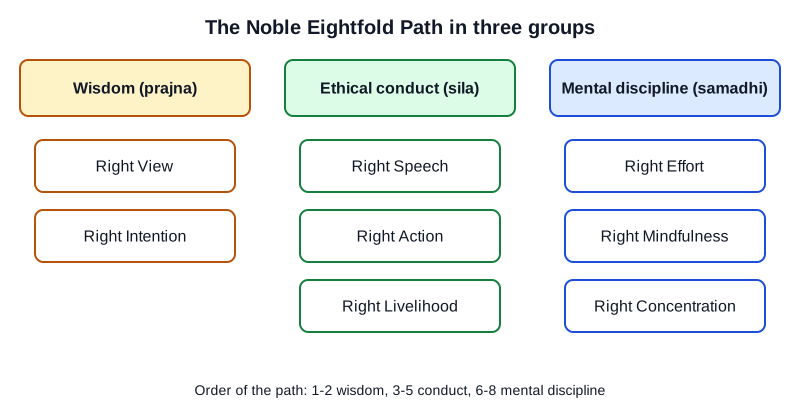
In the diagram, Right Livelihood belongs to which group?
Wisdom
Ethical conduct
Mental discipline
None; it is outside the Path
Right Speech, Action and Livelihood form the ethical conduct (sila) group.
The Buddha gave his first sermon at:
Lumbini
Bodh Gaya
Sarnath
Kushinagar
Sarnath. Lumbini is the birthplace, Bodh Gaya the enlightenment, Kushinagar the death.
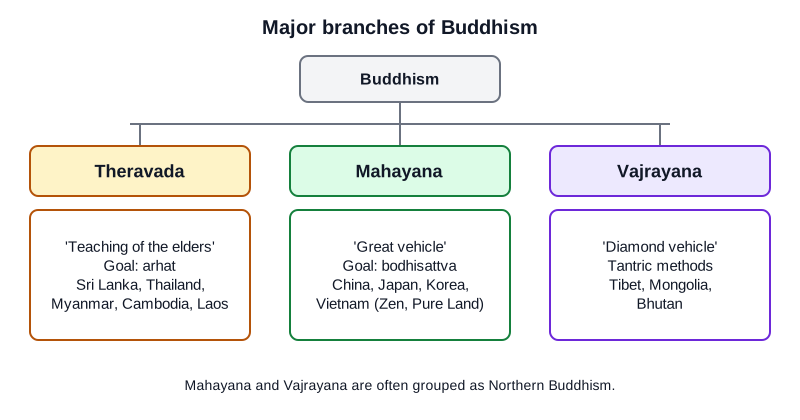
Which branch holds the bodhisattva as its ideal?
Theravada
Mahayana
Neither; both prefer the arhat
Only Zen
Mahayana. Theravada's ideal is the arhat.
Anatta teaches that:
The soul is immortal
There is no permanent unchanging self
Karma does not exist
Nirvana is a place
Non-self: what we call a self is five changing aggregates.
Which emperor spread Buddhism after the Kalinga war?
Ashoka
Akbar
Kanishka
Harsha
Ashoka (Mauryan). Kanishka also supported Buddhism, but the Kalinga conversion story is Ashoka's.
Which is NOT one of the five precepts?
Do not kill
Do not lie
Do not eat after noon
Do not take intoxicants
Not eating after noon is a monastic rule (and extra lay precept on observance days), not one of the five.
Siddhartha rejected extreme asceticism in favor of:
The Middle Way
Brahmin ritual
Philosophical skepticism
The Vedas
The Middle Way avoids both indulgence and self-torment.
Which describes the Tripitaka?
Three baskets: Vinaya, Sutta, Abhidhamma
Three jewels
Three kinds of meditation
Three poisons
The Pali Canon is organized into discipline, discourses and philosophical analysis.
True or false: Buddhists believe in an eternal soul that is reborn.
True
False
Buddhism denies a permanent soul; rebirth is a continuity of cause and effect.
The Dalai Lama belongs to which tradition?
Theravada
Zen
Tibetan (Vajrayana)
Pure Land
The Gelug school of Tibetan Buddhism.
Which pair of poisons is correctly named?
Greed and hatred
Pride and fear
Doubt and wealth
Shame and anger
Greed, hatred and delusion are the three poisons.
Vipassana meditation develops:
Calm only
Insight into impermanence and non-self
Devotion to Amitabha
Chanting skill
Samatha is calm; vipassana is insight.
What do the eight spokes of the Dharma wheel represent?
The eight precepts
The Eightfold Path
Eight Buddhas
Eight realms
The Noble Eightfold Path.
Zen koans are used to:
Memorize sutras
Break through conceptual thinking
Fix monastic rules
Record history
Koans are paradoxical prompts for direct insight.
Brahmaviharas include all EXCEPT:
Metta
Karuna
Upekkha
Tanha
Tanha is craving, the cause of suffering. The other three are loving-kindness, compassion and equanimity.
Vesak commemorates:
Only the Buddha's death
Birth, enlightenment and death of the Buddha
The first sermon
Ashoka's conversion
Vesak marks all three; Asalha Puja marks the first sermon.
Which country is predominantly Theravada?
Japan
Thailand
Tibet
Korea
Thailand follows Theravada; Japan and Korea are Mahayana, Tibet Vajrayana.
