Quiz · Medium
Twenty questions on calculating inflation from price indexes, comparing CPI, PCE and the deflator, causes of inflation, hyperinflation and who wins and loses.
The CPI was 200 last year and is 210 this year. What was the inflation rate?
5%
10%
4.8%
2.1%
(210 − 200) ÷ 200 = 5%. Using the new CPI as the denominator gives 4.8%, a common slip; 10 is the index point change, not a percent.
A basket of goods costs $500 in the base year and $575 this year. What is the CPI this year?
115
75
87
15
CPI = 575 ÷ 500 × 100 = 115. 15 is the percent increase, not the index level.
Which pair best describes demand-pull and cost-push inflation?
Demand-pull: SRAS shifts right. Cost-push: AD shifts left
Demand-pull: AD shifts right. Cost-push: SRAS shifts left
Demand-pull: SRAS shifts left. Cost-push: AD shifts right
Both are caused by a rightward shift of LRAS
Demand-pull inflation comes from excess spending (AD right); cost-push comes from higher input costs (SRAS left), which also lowers output.
Unexpected inflation most benefits:
A retiree living on a fixed pension
A bank that has just made fixed-rate loans
A homeowner with a fixed-rate mortgage
A saver holding cash
The borrower repays in cheaper dollars. Retirees on fixed pensions, banks holding fixed-rate loans and cash savers all lose purchasing power.
The nominal interest rate is 7% and expected inflation is 3%. The expected real interest rate is:
10%
4%
7%
−4%
Real rate = nominal − expected inflation = 7 − 3 = 4%. Adding them gives the nominal rate if the real rate were 7.
Which measure does the Federal Reserve use for its 2% inflation target?
PCE price index
GDP deflator
Producer Price Index
CPI-W
The Fed announced in 2012 that its 2% goal applies to the PCE price index. The CPI is published by the BLS and commonly used in contracts, but is not the target variable.
What does the CPI tend to do because of substitution bias?
Understate the increase in the cost of living
Overstate the increase in the cost of living
Measure inflation exactly
Ignore changes in food prices
The fixed basket does not allow consumers to switch to cheaper goods when prices rise, so the CPI overstates the true cost-of-living increase.
Which of the following is a menu cost of inflation?
A restaurant reprints its menus and updates its price displays
A saver makes extra trips to the bank
A borrower repays a loan with cheaper dollars
A worker's raise is pushed into a higher tax bracket
Menu costs are the resources firms use to change prices. Extra bank trips are shoe-leather costs; repaying with cheaper dollars is redistribution; bracket creep is a tax distortion.
The GDP deflator differs from the CPI because it:
Measures only consumer goods bought by urban households
Uses a fixed basket from the base year
Includes all domestically produced goods and services but excludes imports
Includes only food and energy
The deflator covers everything produced in the economy (C, I, G, exports) and its basket changes with output. The CPI is a fixed consumer basket that includes imports.
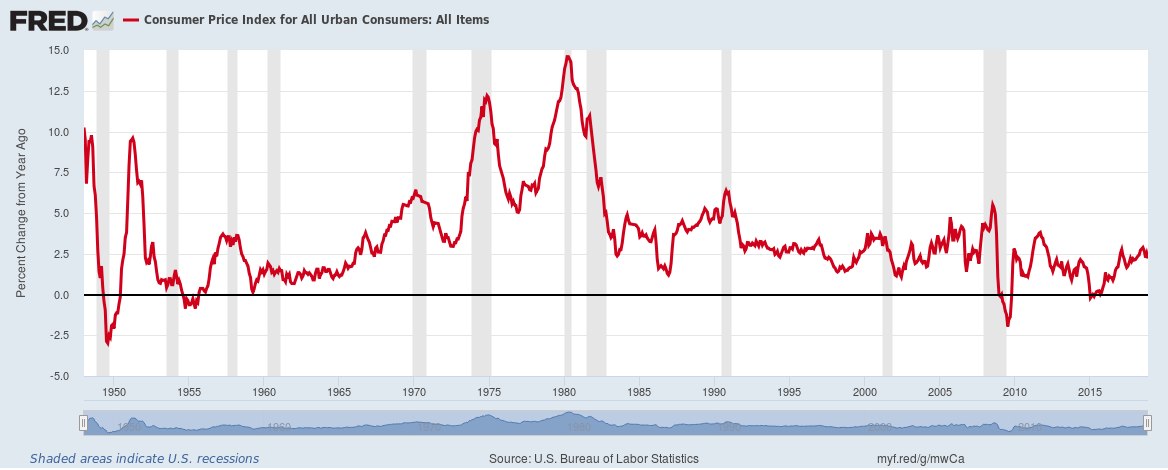
The chart shows annual US inflation from 1948. Inflation peaked at its highest level around:
1951
1980
1990
2008
US CPI inflation peaked near 15% in 1980 after the second oil shock. There was also a Korean War peak around 1951 (about 9.5%) and a mid-1970s peak, but 1980 was highest. Image: Soibangla, public domain.
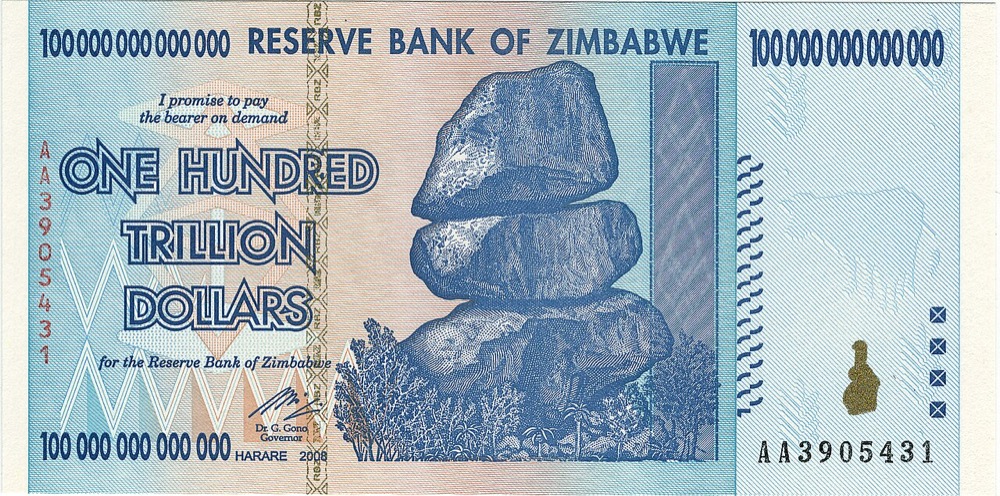
Which country's currency crisis does this note illustrate?
Germany
Hungary
Zimbabwe
Argentina
The Reserve Bank of Zimbabwe issued 100 trillion dollar notes in 2009 during hyperinflation. Germany (1923) and Hungary (1946) also had hyperinflations, but the note says 'Reserve Bank of Zimbabwe'. Image: Reserve Bank of Zimbabwe, public domain.
True or False: Hyperinflation is usually defined as inflation above 50% per month.
True
False
True. This is Phillip Cagan's conventional definition. Annual rates of 10% or 20% are high inflation, but not hyperinflation.
A worker's nominal wage rises 3% while the price level rises 5%. The real wage:
Falls by about 2%
Rises by about 2%
Rises by about 8%
Is unchanged
Real wage growth ≈ nominal wage growth − inflation = 3 − 5 = −2%.
If the money supply grows 6%, real GDP grows 2% and velocity is constant, the quantity theory predicts inflation of about:
8%
4%
6%
2%
%ΔM + %ΔV = %ΔP + %ΔY → 6 + 0 = %ΔP + 2, so inflation is 4%.
Deflation can be harmful mainly because it:
Always reduces government debt
Raises the real burden of debt and may discourage spending
Raises real wages for every worker
Reduces unemployment
Falling prices increase the real value of fixed nominal debts and encourage consumers to postpone purchases. Falling prices can raise real wages for those still employed, but sticky wages often lead to layoffs.
Treasury Inflation-Protected Securities (TIPS) protect investors by:
Paying a floating interest rate tied to the Fed
Guaranteeing a fixed nominal yield above 5%
Adjusting principal with changes in the CPI
Exchanging principal for gold
A TIPS' principal rises with CPI, so interest payments and the final payoff keep up with inflation.
Who led the Federal Reserve when it raised rates to nearly 20% to defeat 1970s inflation?

Paul Volcker
Alan Greenspan
Ben Bernanke
Arthur Burns
Volcker chaired the Fed from 1979 to 1987. Arthur Burns (1970-78) presided over much of the Great Inflation. Image: Federal Reserve, public domain.
A price index rises from 100 to 120 over a period. If a good cost $50 in the first period and tracks the index, what does it cost now?
$70
$60
$55
$62
Price × (120 ÷ 100) = $60. A 20% increase on $50 is $10.
Two years ago a hamburger cost $4. The CPI then was 160 and now is 176. If the burger tracked the CPI, its price now is:
$4.16
$4.80
$4.40
$5.76
176 ÷ 160 = 1.10, so $4 × 1.10 = $4.40.
Which statement about anticipated (expected) inflation is TRUE?
It redistributes wealth from borrowers to lenders
It always raises real GDP
It has no costs at all
Most of its costs are menu and shoe-leather costs because wages and interest rates adjust
When inflation is expected, interest rates and wages adjust, so redistribution is small, but resources are still wasted on changing prices and holding less cash.
