Quiz · Medium
Perfect competition, monopoly, monopolistic competition and oligopoly: diagrams, profit rules, efficiency and pricing.
A perfectly competitive firm sells at $8, MC at its output of 100 units is $8, ATC is $9 and AVC is $6. In the short run the firm should:
Shut down
Produce 100 units and make a loss of $100
Produce more until MC = ATC
Raise price to $9
P = MC, so 100 units is the best output. Since P ($8) exceeds AVC ($6), producing loses less than shutting down: loss = (8 - 9) × 100 = $100. A price taker cannot raise its price.
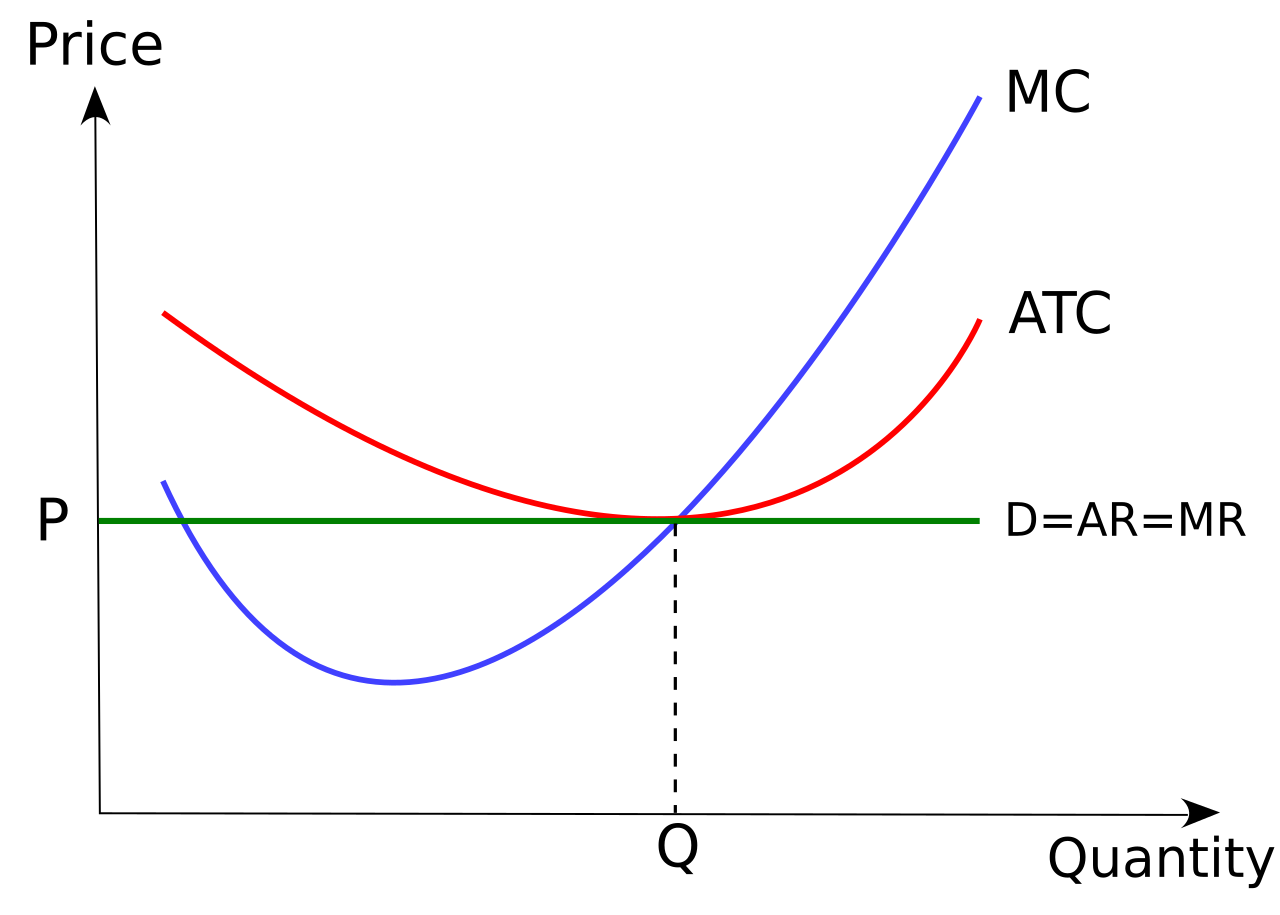
The figure shows a competitive firm in long-run equilibrium. Which condition is true?
P > ATC and economic profit is positive
P < MC
P = AVC and the firm shuts down
P = MC = minimum ATC and economic profit is zero
Entry and exit drive profit to zero (P = ATC), and profit maximization gives P = MC. Together they imply the firm is at the minimum of ATC.
Image: Trampled and Bluemoose (English Wikipedia), derivative work by Jarry1250, CC BY-SA 3.0, via Wikimedia Commons.
A monopolist's demand is . Its marginal revenue is:
TR = 80Q - Q², so MR = 80 - 2Q: same intercept, twice the slope of demand. The option 80 - Q is the price, not MR.
Demand and MC = $20. The profit-maximizing monopolist sells at what price?
$20
$40
$50
$60
MR = MC: gives Q = 30. The price comes from demand: P = 80 - 30 = $50. $20 would be the competitive price (MC) and $40 the price on the MR curve at Q = 20.
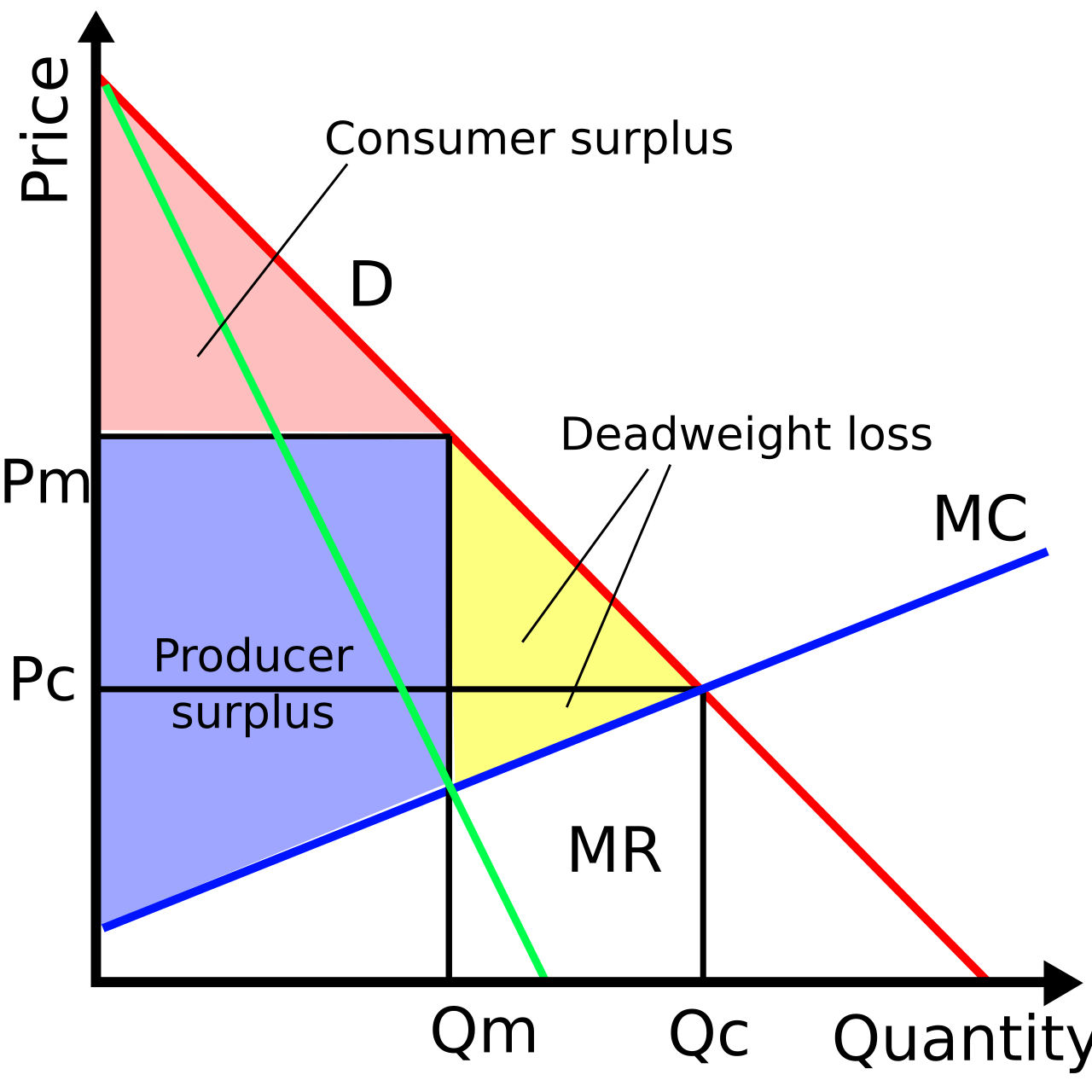
In the diagram, compared with perfect competition, the monopoly:
Produces more at a lower price
Charges the same price but produces less
Produces Qm instead of Qc, charges Pm instead of Pc
Has no deadweight loss
A monopolist restricts output to where MR = MC (Qm), below the competitive quantity (Qc) where P = MC, and charges a higher price (Pm > Pc). The yellow triangle is the resulting deadweight loss.
Image: SilverStar at English Wikipedia, CC BY 2.5, via Wikimedia Commons.
A monopolist with MC = $9 charges $12. The Lerner index is:
0.33
0.25
0.75
1.33
. It implies . The 0.33 mistakenly divides by MC.
Which is NOT required for price discrimination?
Market power
Ability to separate customers by elasticity
Prevention of resale
Identical demand elasticities in all groups
If all groups had the same elasticity, charging them different prices would not raise profit. The firm needs groups with different elasticities.
A cinema charges students $6 and adults $10. Which explains this?
Student demand is more elastic
Student demand is less elastic
Adults have lower marginal cost
Perfect price discrimination
Third-degree price discrimination: the group with the more elastic demand (students) gets the lower price.
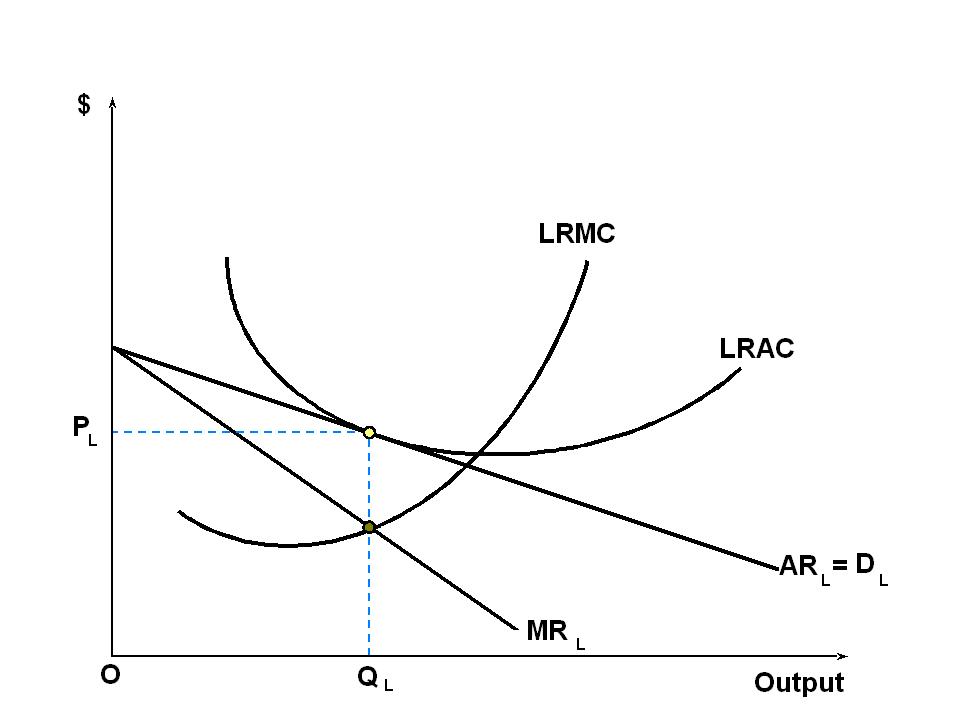
The figure shows a monopolistically competitive firm in long-run equilibrium. Which statement is correct?
P = MC and the firm is allocatively efficient
P = ATC, economic profit is zero, but output is below the minimum ATC
The firm earns a positive economic profit
The demand curve is horizontal
Demand is tangent to LRAC (zero profit) at an output to the left of the LRAC minimum, so there is excess capacity and P > MC.
Image: Sheitan (English Wikipedia), CC BY-SA 3.0, via Wikimedia Commons.
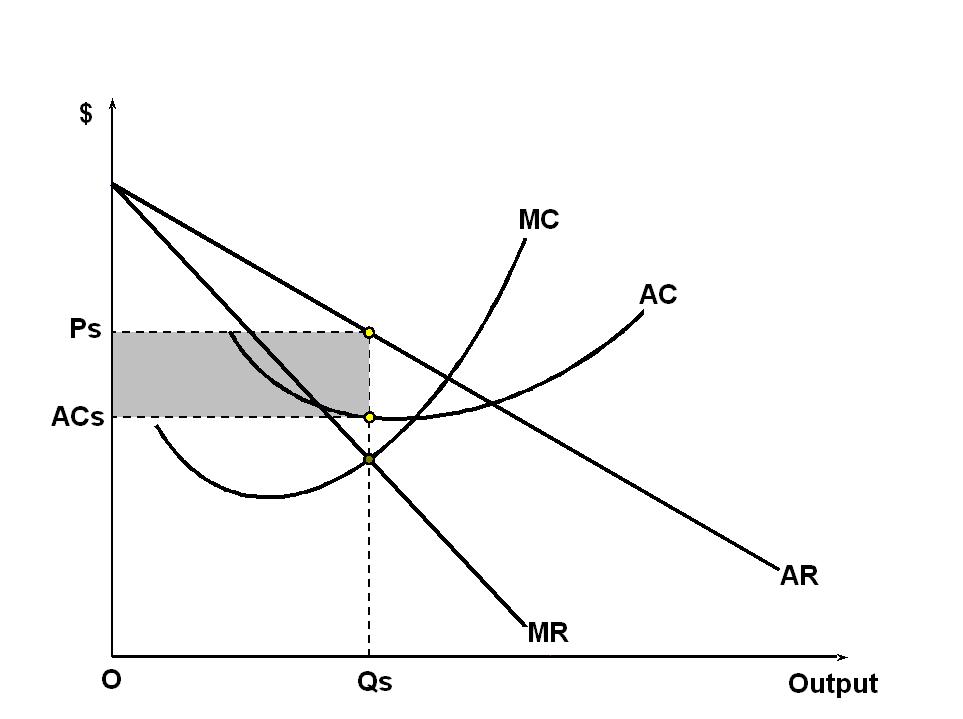
The figure shows a monopolistically competitive firm earning economic profit in the short run. In the long run:
Firms exit and demand shifts right
Price rises further
The firm becomes a monopolist
Entry shifts each firm's demand left until profit is zero
Profit attracts entrants offering close substitutes, so each existing firm loses customers and its demand shifts left until price equals average cost.
Image: Sheitan (English Wikipedia), CC BY-SA 3.0, via Wikimedia Commons.
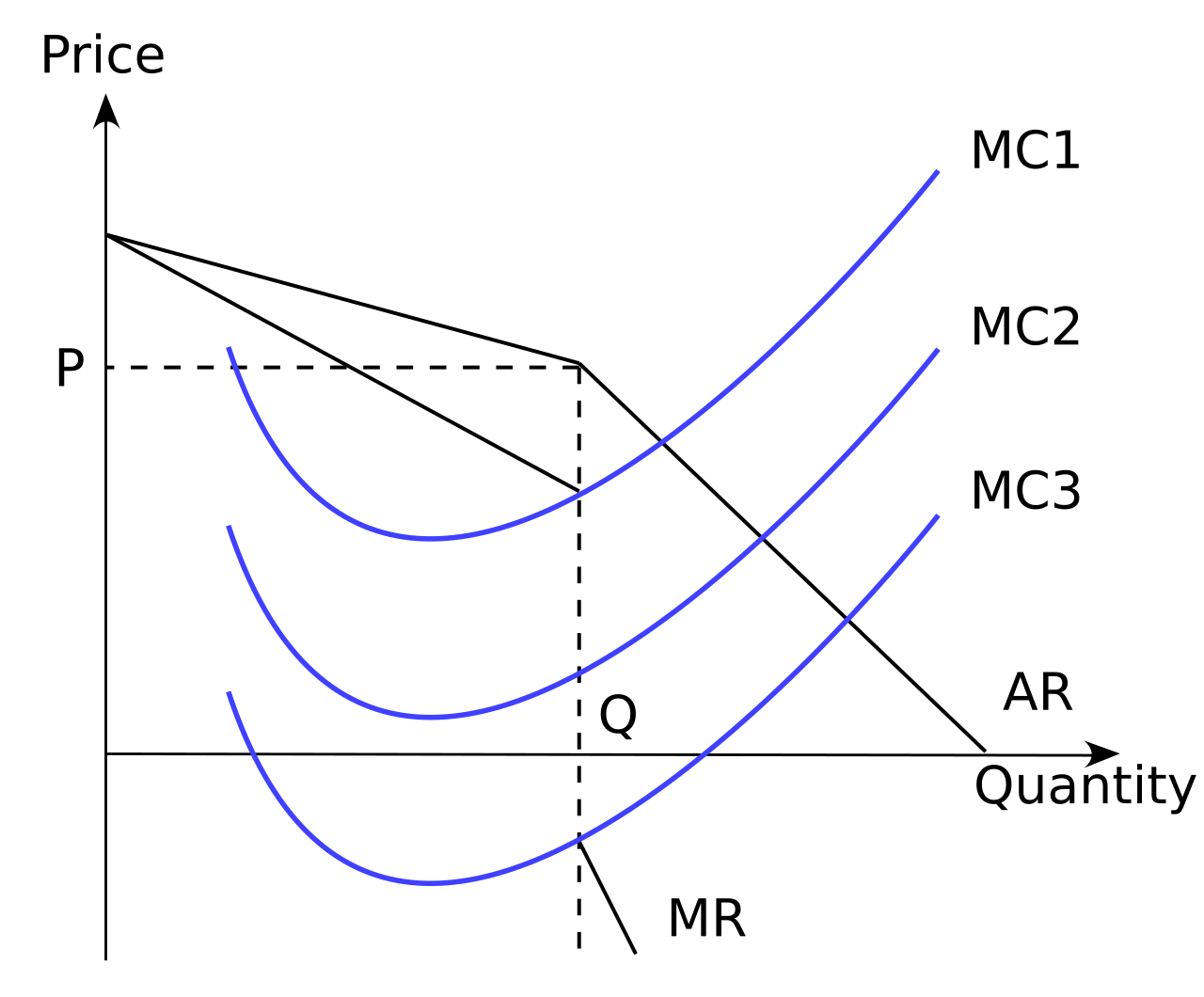
In the kinked demand model, a small rise in marginal cost typically causes:
No change in price or quantity
A large price rise
A price cut
Exit of the firm
MC passes through the vertical gap in MR, so the profit-maximizing output and price stay the same. This is the model's explanation of price rigidity.
Image: Sheitan (English Wikipedia) and Jarry1250, CC BY-SA 3.0, via Wikimedia Commons.
Which of these is a characteristic of oligopoly?
Firms are price takers
No barriers to entry
Firms are interdependent
A single seller
In oligopoly each firm's best choice depends on rivals' reactions, which is why game theory is used.
Four firms hold 40%, 30%, 20% and 10% of a market. The HHI is:
100
1,000
3,000
10,000
1,600 + 900 + 400 + 100 = 3,000. The sum of market shares is 100 (the CR4), which is not the HHI.
In the payoff matrix, if both players know the game is played once, the outcome is:
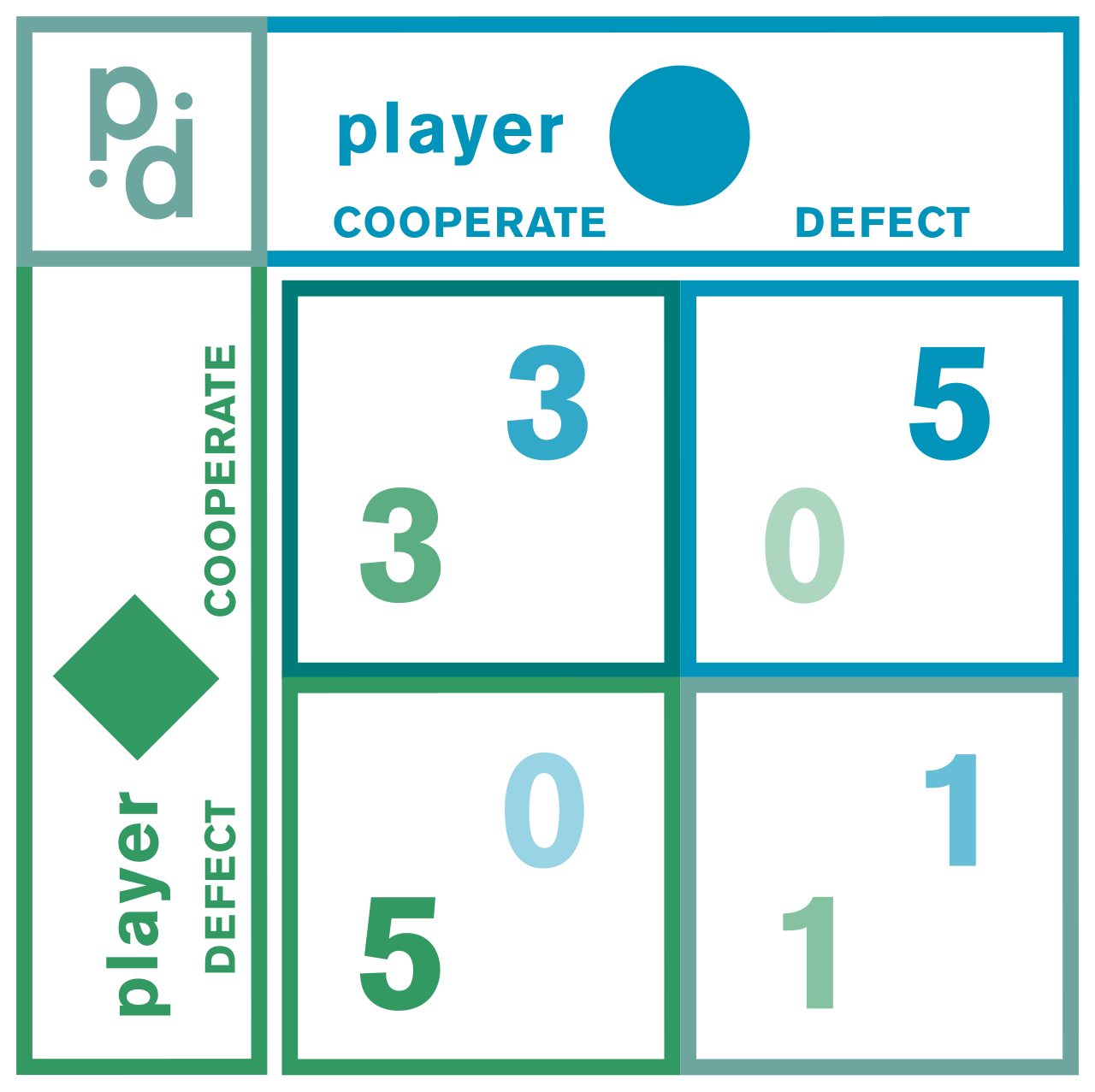
Both cooperate (3,3)
Both defect (1,1)
One defects, one cooperates
Cannot be determined
Defecting gives a higher payoff whatever the other does, so it is a dominant strategy. The Nash equilibrium (1,1) is worse for both than (3,3).
Image: Christopher X Jon Jensen and Greg Riestenberg, CC BY-SA 3.0, via Wikimedia Commons.
Two Cournot duopolists face with MC = 10. Each firm's output is:
22.5
45
60
30
Each produces . 45 is the monopoly output and 22.5 is what each firm would produce with three firms.
Bertrand duopolists sell identical products with the same constant MC. In equilibrium:
Price equals marginal cost
Price equals the monopoly price
Price is between MC and monopoly price
Profits are the same as under a cartel
Any firm charging above MC would be undercut by its rival, so prices fall to MC even with just two firms.
A cartel agrees to restrict output. Why does it tend to break down?
Demand rises
Each member can profit by secretly producing more
Costs rise
Barriers to entry fall
At the cartel price, the marginal revenue of one extra unit sold by a single member exceeds its MC, so each firm is tempted to cheat. If all cheat, the price falls.
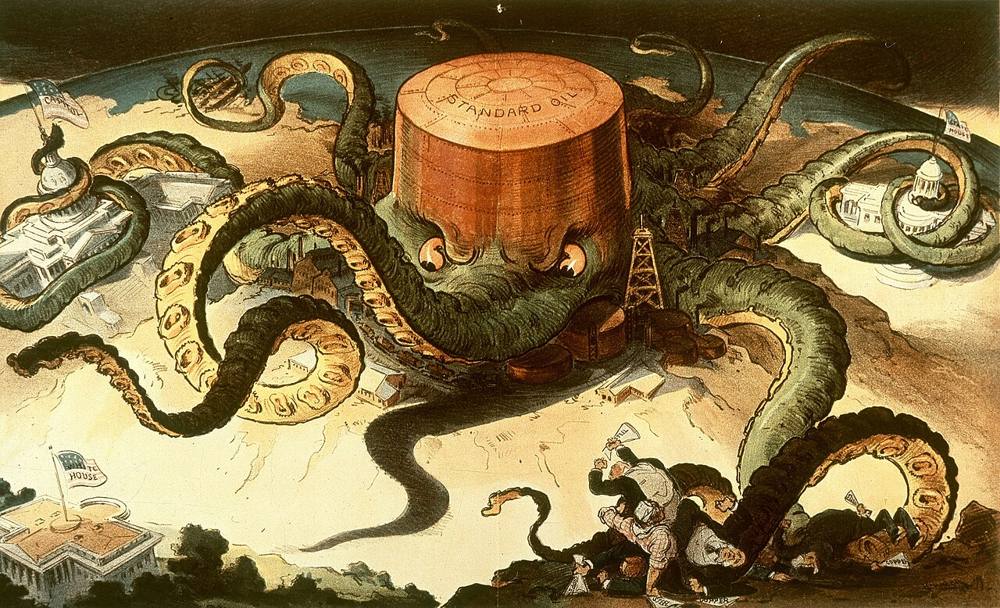
The cartoon shown depicts a giant monopoly. The 1911 Supreme Court ruling concerned:
Microsoft
AT&T
Alcoa
Standard Oil
The Court ordered the Standard Oil Trust dissolved under the Sherman Antitrust Act (1890) in Standard Oil Co. of New Jersey v. United States (1911).
A regulator forces a natural monopoly to set . The result is:
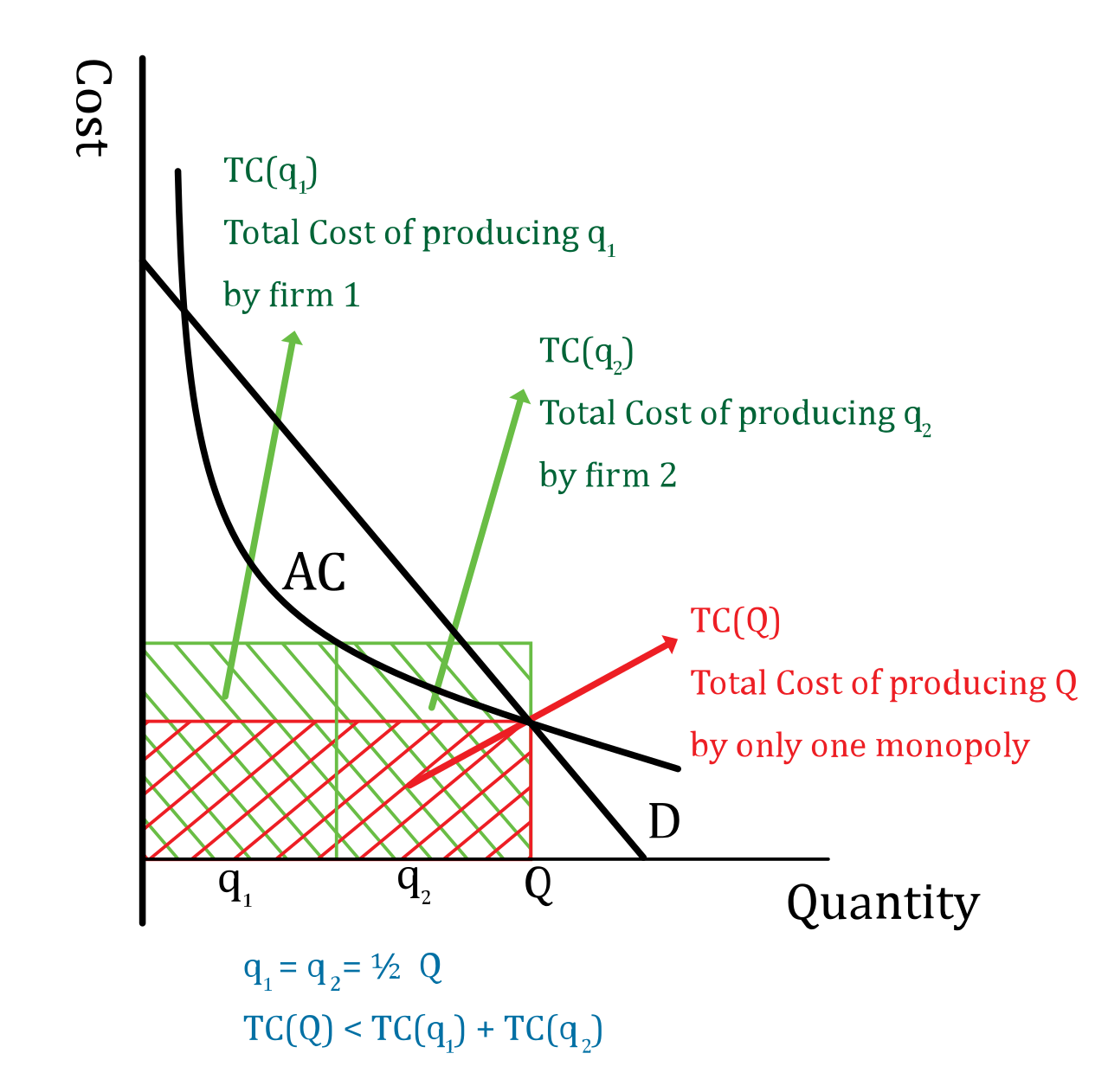
Allocative efficiency but a loss for the firm
Economic profit for the firm
A higher price than the monopoly price
Productive efficiency at minimum ATC
Because ATC is falling, MC is below ATC, so P = MC means a loss. It is allocatively efficient, but needs a subsidy.
Image: CoolKoon, CC BY-SA 4.0, via Wikimedia Commons.
Which structure is associated with excess capacity in the long run?
Perfect competition
Monopoly only
Monopolistic competition
Natural monopoly only
Monopolistically competitive firms end up on the falling part of ATC because their demand curves slope downward.
A merger raises the HHI from 1,500 to 2,000. This rise in concentration is:
20 points
3,500 points
500 points
Impossible
The increase is 2,000 - 1,500 = 500. Authorities look at both the level and the change.
In which market structure is price equal to marginal cost in the long run?
Monopolistic competition
Perfect competition
Oligopoly (Cournot)
Monopoly
Only perfect competition has P = MC (together with P = minimum ATC). In the other structures firms have some market power and P > MC.
A monopolist faces demand with at its current price. It should:
Keep the price
Cut the price
Shut down
Raise the price
With inelastic demand MR is negative, so it is below MC. Raising price raises revenue and cuts costs, so profit rises.
