Quiz · Medium
Mixed intro-level questions on fieldwork, key theorists, subsistence, exchange, political systems and kinship.
Who is most closely associated with establishing long-term fieldwork as the core method of cultural anthropology through study of the Trobriand Islands?
Franz Boas
Claude Lévi-Strauss
Bronislaw Malinowski
Marvin Harris
Malinowski's Argonauts of the Western Pacific (1922) set the fieldwork standard. Boas trained American anthropologists but is linked to historical particularism.
An insider's own categories for understanding their culture are known as:
Etic
Emic
Syncretic
Ethnocentric
Emic = insider view; etic = outside analytic view. Ethnocentric describes judging by one's own standards.
Which kinship terminology calls mother's sister 'mother' and uses the same term for all cousins as siblings?
Sudanese
Hawaiian
Omaha
Eskimo
Hawaiian terminology is generational. Eskimo (used in the US) distinguishes the nuclear family and lumps aunts, uncles and cousins.
An anthropologist lives for a year in a village, joins daily work and ceremonies, and records what she sees. Which method is this?
Participant observation
Survey research
Archival research
Content analysis
Participant observation means taking part in daily life while observing. Surveys and content analysis do not involve long-term immersion.
Which statement best defines cultural relativism as an anthropological method?
Culture is determined by biology
Other cultures should adopt Western norms
All cultural practices are morally equal
Practices should be understood within their own cultural context
Relativism is a method for understanding, not an endorsement of every practice. The first option confuses it with moral relativism.
Geertz's idea of 'thick description' means:
Describing behavior together with its meanings and context
Using several researchers on one project
Recording everything on video
Collecting large amounts of quantitative data
Thick description interprets what actions mean to participants, not just what happens.
In a rite of passage, the in-between stage when a person has left an old status but not yet joined a new one is called:
Separation
Incorporation
Liminality
Redistribution
Van Gennep identified three phases; Victor Turner developed the idea of liminality.
This diagram shows which three phases?
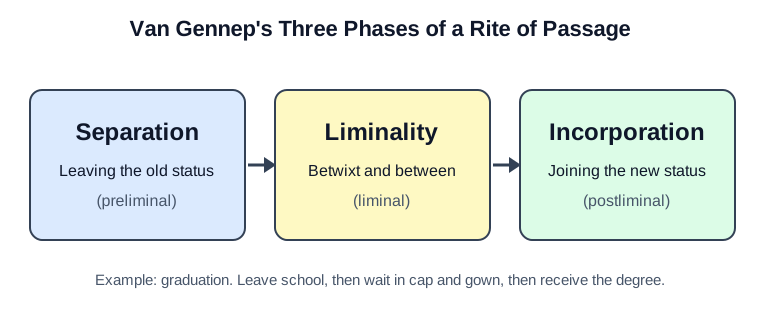
Separation, liminality, incorporation
Band, tribe, chiefdom
Reciprocity, redistribution, market
Foraging, pastoralism, horticulture
Van Gennep's three phases of rites of passage.
Which subsistence strategy involves slash-and-burn cultivation with hand tools?
Intensive agriculture
Horticulture
Foraging
Pastoralism
Horticulture uses hand tools and shifting plots. Intensive agriculture uses plows and irrigation.
Which exchange pattern is shown by a parent feeding a child without expecting repayment?
Negative reciprocity
Balanced reciprocity
Market exchange
Generalized reciprocity
Generalized reciprocity has no expectation of immediate or equal return (Sahlins).
The Kula ring is an exchange system of which society?
Kwakwaka'wakw
Trobriand Islanders
Nuer
Azande
Studied by Malinowski. The potlatch belongs to the Pacific Northwest Coast; the Nuer and Azande are African societies studied by Evans-Pritchard.
Which political organization has a hereditary, ranked leader who controls redistribution but no formal bureaucracy?
State
Tribe
Chiefdom
Band
Chiefdoms have ranked kin and chiefs. States add bureaucracy and a monopoly on legitimate force.
In a kinship diagram, a triangle represents:
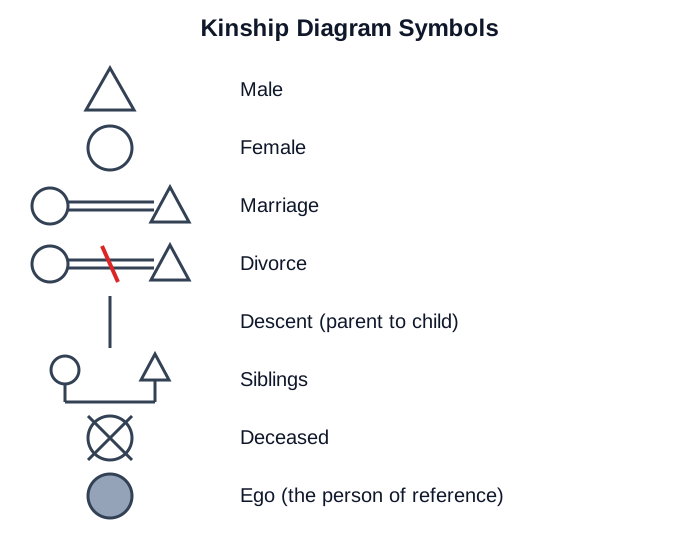
Ego
Deceased person
Female
Male
Triangle = male, circle = female.
In the kinship chart, which relationship does the double horizontal line represent?
Siblings
Divorce
Marriage
Descent
A double line is marriage; a slash through it shows divorce.
Your mother's brother's daughter is your:
Sibling
Cross cousin
Affinal cousin
Parallel cousin
Cross cousins are children of opposite-sex siblings. Parallel cousins are children of same-sex siblings.
A society traces descent only through the mother's line. This is:
Ambilineal
Matrilineal
Patrilineal
Bilateral
Matrilineal descent is unilineal through women.
A newly married couple lives with the husband's father's family. This is:
Avunculocal
Matrilocal
Patrilocal
Neolocal
Patrilocal is the most common residence pattern worldwide.
Which marriage form is a woman married to several men at once?
Levirate
Polyandry
Polygyny
Endogamy
Polyandry is rare. Polygyny is one man with several wives.
Marvin Harris's cultural materialism holds that:
Language determines thought
Ideas drive technology and economy
Material conditions shape social organization and beliefs
Cultures are unique and incomparable
Harris argued infrastructure shapes structure and superstructure. The third option is historical particularism.
Which concept, associated with Said, describes Western representations of 'the East' as exotic and inferior?
Syncretism
Glocalization
Hegemony
Orientalism
Edward Said's Orientalism (1978) links representation to colonial power. Hegemony is Gramsci's concept.
Evans-Pritchard's study of the Azande showed that witchcraft beliefs:
Were irrational superstition
Formed a logical system that explained misfortune
Were unrelated to daily life
Disappeared after colonialism
He argued the beliefs make sense within their own assumptions, an example of relativism.
Which is NOT one of Appadurai's five scapes?
Financescapes
Kinscapes
Ethnoscapes
Mediascapes
The scapes are ethno, media, techno, finance and ideo.
