Quiz · Hard
Calculation-heavy questions on elasticity, surplus, tax incidence, deadweight loss, subsidies and price controls.
Price falls from $10 to $8 and quantity demanded rises from 100 to 130. Using the midpoint method, what is |PED|?
About 1.17
About 1.30
About 0.77
About 0.85
Quantity change = 30 / 115 = 26.1%. Price change = 2 / 9 = 22.2%. The ratio is 1.17. The 0.85 answer inverts the ratio.
|PED| = 0.5 and the seller raises price by 10%. What happens to total revenue?
It falls, by about 5%
It stays the same
It rises, by about 10%
It rises, by about 4.5%
Quantity falls about 5%. Revenue becomes 1.10 x 0.95 = 1.045 of the old level, so it rises 4.5%.
Supply is perfectly inelastic and demand is downward sloping. A per-unit tax is placed on sellers. Who bears the burden?
They split it evenly
Buyers bear all of it
Sellers bear all of it
The government bears it
Sellers can't reduce quantity, so they can't pass any of the tax on: the price buyers pay doesn't change.
Demand: P = 20 - Q. Supply: P = 4 + Q. A $4 per-unit tax is put on sellers. What is the deadweight loss?
$8
$12
$24
$4
The new quantity is 6 (from 20 - Q = 8 + Q). DWL = 1/2 x 4 x (8 - 6) = 4. The $24 is the tax revenue (4 x 6).
In the same market (P = 20 - Q, P = 4 + Q) with a $4 tax on sellers, how much do buyers pay and sellers keep?
Buyers pay $12, sellers keep $8
Buyers pay $14, sellers keep $12
Buyers pay $14, sellers keep $10
Buyers pay $16, sellers keep $12
New supply: P = 8 + Q, so Q = 6. Buyers pay 20 - 6 = 14. Sellers keep 14 - 4 = 10. The tax wedge is 14 - 10 = 4.
Demand: P = 20 - Q. Supply: P = 4 + Q. What is total surplus at equilibrium?
96
64
32
48
Equilibrium: Q = 8, P = 12. Consumer surplus = 1/2 x 8 x 8 = 32. Producer surplus = 1/2 x 8 x 8 = 32. Total = 64.
Demand: P = 20 - Q. Supply: P = 4 + Q. The government pays producers a $4 per-unit subsidy. What is the cost to the government?
$40
$16
$24
$32
The subsidy shifts supply to P = Q. Then 20 - Q = Q, so Q = 10. Cost = 4 x 10 = 40. The efficient quantity is only 8.
The cross-price elasticity of demand between two goods is -0.8. The goods are...
complements
substitutes
both inferior
unrelated
Negative cross-price elasticity means a price rise in one reduces demand for the other.
Income rises 10% and quantity demanded of a good rises 15%. This good is...
a normal necessity
a Giffen good
a normal luxury
an inferior good
Income elasticity = 1.5 > 1, so it is income elastic (a luxury).
A bumper harvest lowers the price of wheat. Total farm revenue falls. This implies demand for wheat is...
unit elastic
inelastic
elastic
perfectly elastic
A price fall that lowers revenue means the percentage rise in quantity is smaller than the percentage fall in price: inelastic.
On a straight-line demand curve, total revenue is maximized at the point where demand is...
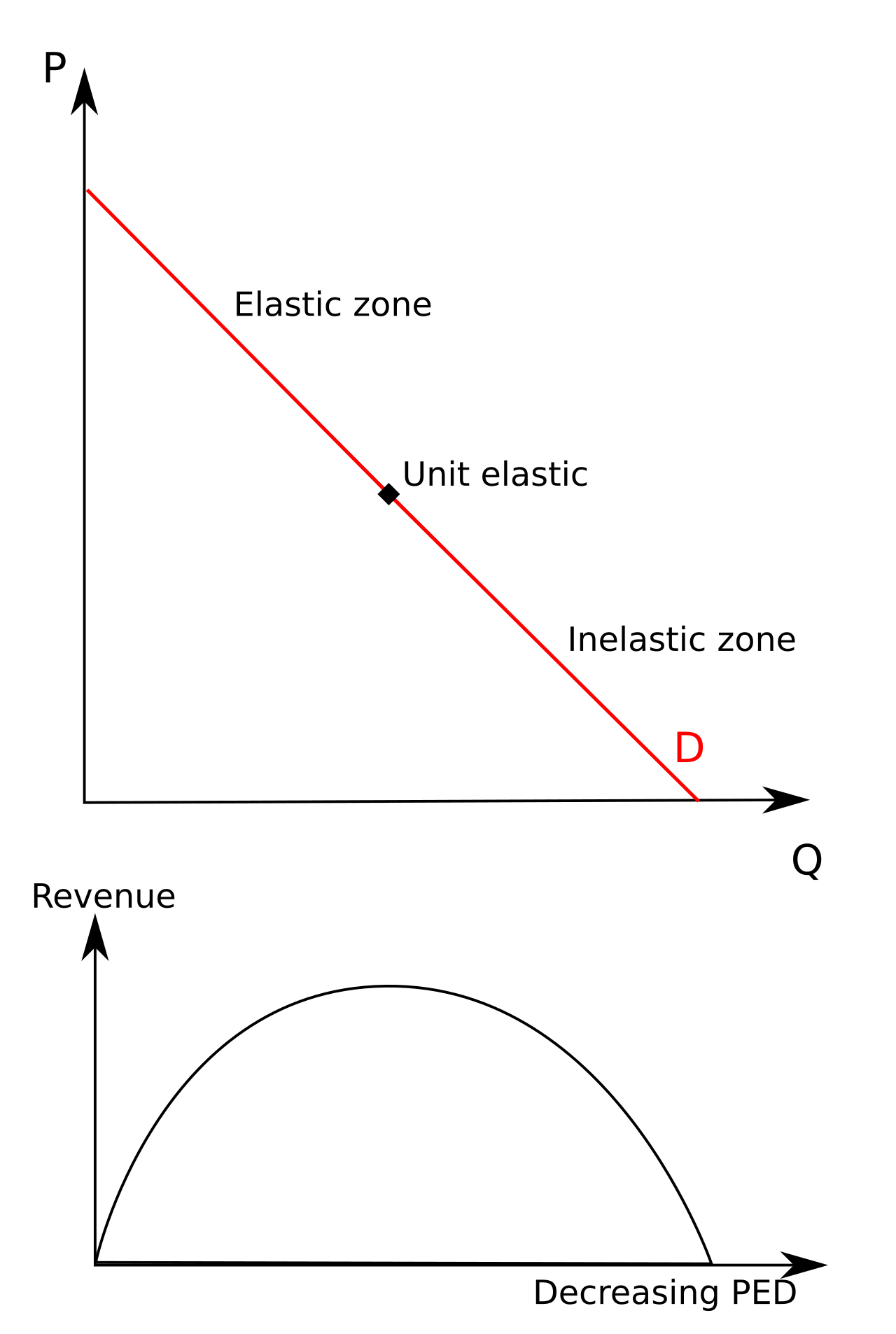
perfectly elastic
most elastic
unit elastic
perfectly inelastic
Above the point, demand is elastic and revenue rises as price falls. Below it, demand is inelastic and revenue falls.
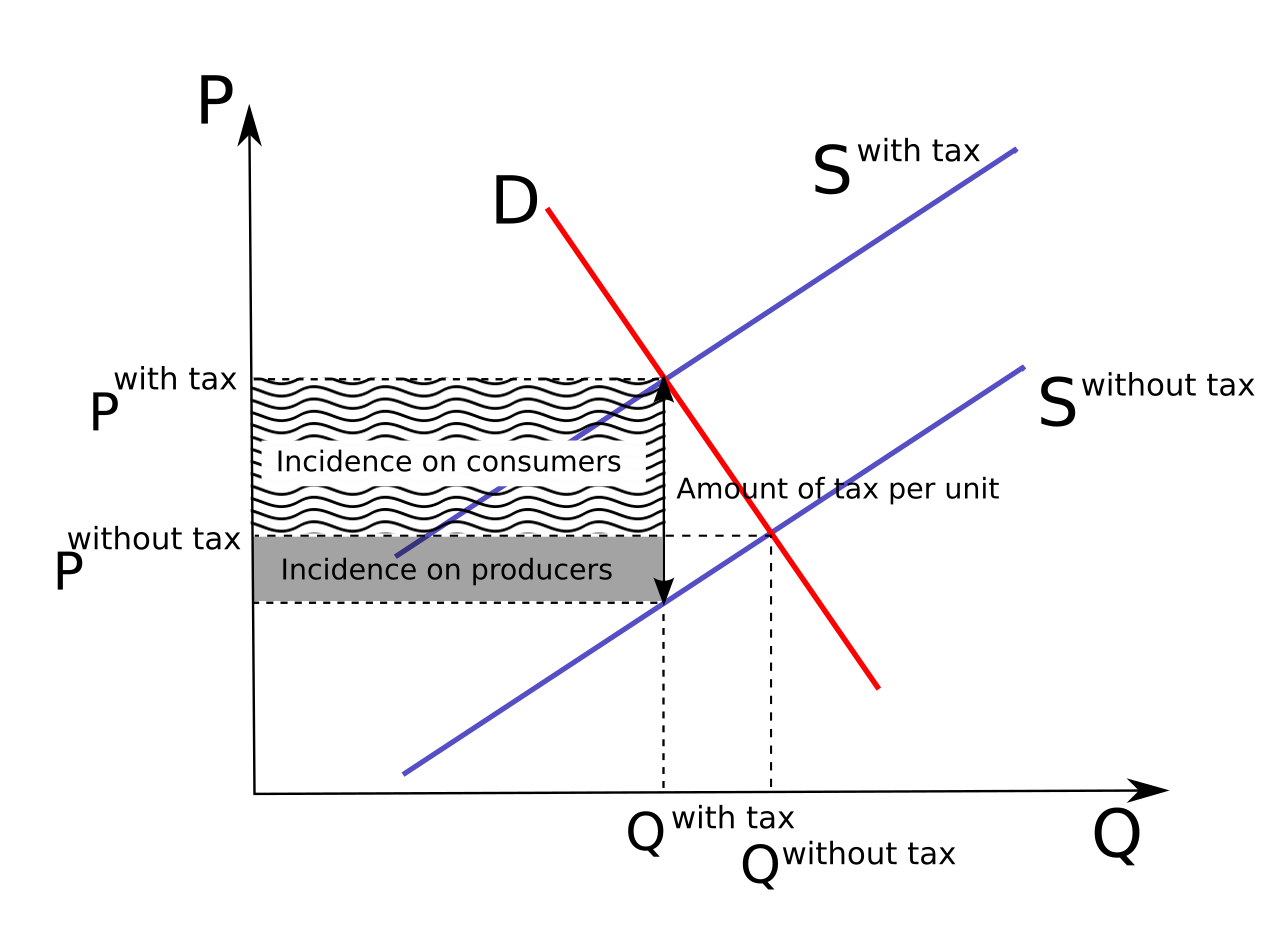
Image: RedWordSmith (English Wikipedia) and Jarry1250, CC BY-SA 3.0, via Wikimedia Commons.
Qd = 100 - 2P and Qs = 20 + 3P. The government sets a price floor of $20 and buys all the surplus. What does it spend?
$80
$200
$400
$1,200
At P = 20: Qd = 60, Qs = 80, so the surplus is 20 units. The government buys them at the floor price: 20 x 20 = 400. Using the equilibrium price (16) instead would give 320.
Qd = 100 - 2P and Qs = 20 + 3P. A price ceiling of $10 is imposed. What quantity is traded?
30
50
68
80
At P = 10: Qd = 80 and Qs = 50. Trade is limited by the short side, supply, so 50 units. The shortage is 30.
In the same market with a $10 ceiling, what is the highest price buyers would pay for the 50th unit?
$16
$25
$10
$50
From demand: 50 = 100 - 2P, so P = 25. This gap between 10 and 25 is the incentive for a black market.
Demand is elastic and supply is inelastic. A tax is imposed. Who bears most of the burden?
Sellers
The burden is always even
Buyers
Neither
The less elastic side bears more. Sellers have fewer alternatives than buyers.
In this diagram demand is steep and supply is flatter, and a per-unit tax is imposed. Who bears most of the burden?
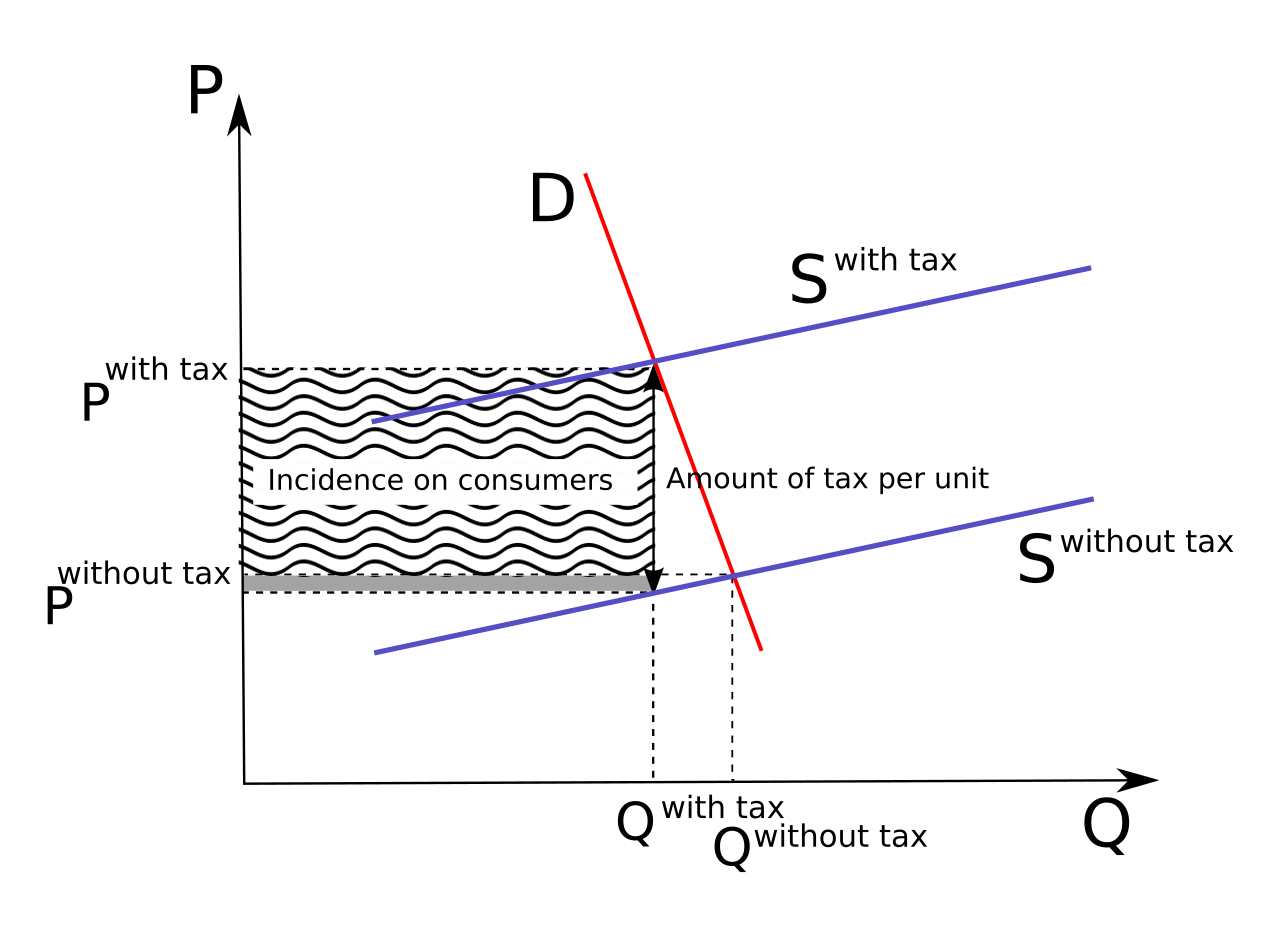
The burden is split evenly
Consumers
The government
Producers
When buyers can't easily change quantity, the price they pay rises by almost the full tax. This diagram is public domain.
At which quantity is total surplus maximized in a competitive market?
Where marginal benefit equals marginal cost
Where consumer surplus is largest
Where price equals zero
Where total revenue is highest
Surplus grows as long as marginal benefit exceeds marginal cost. Maximizing consumer surplus alone would mean a price of zero and no supply.
The yellow triangle in the diagram represents...
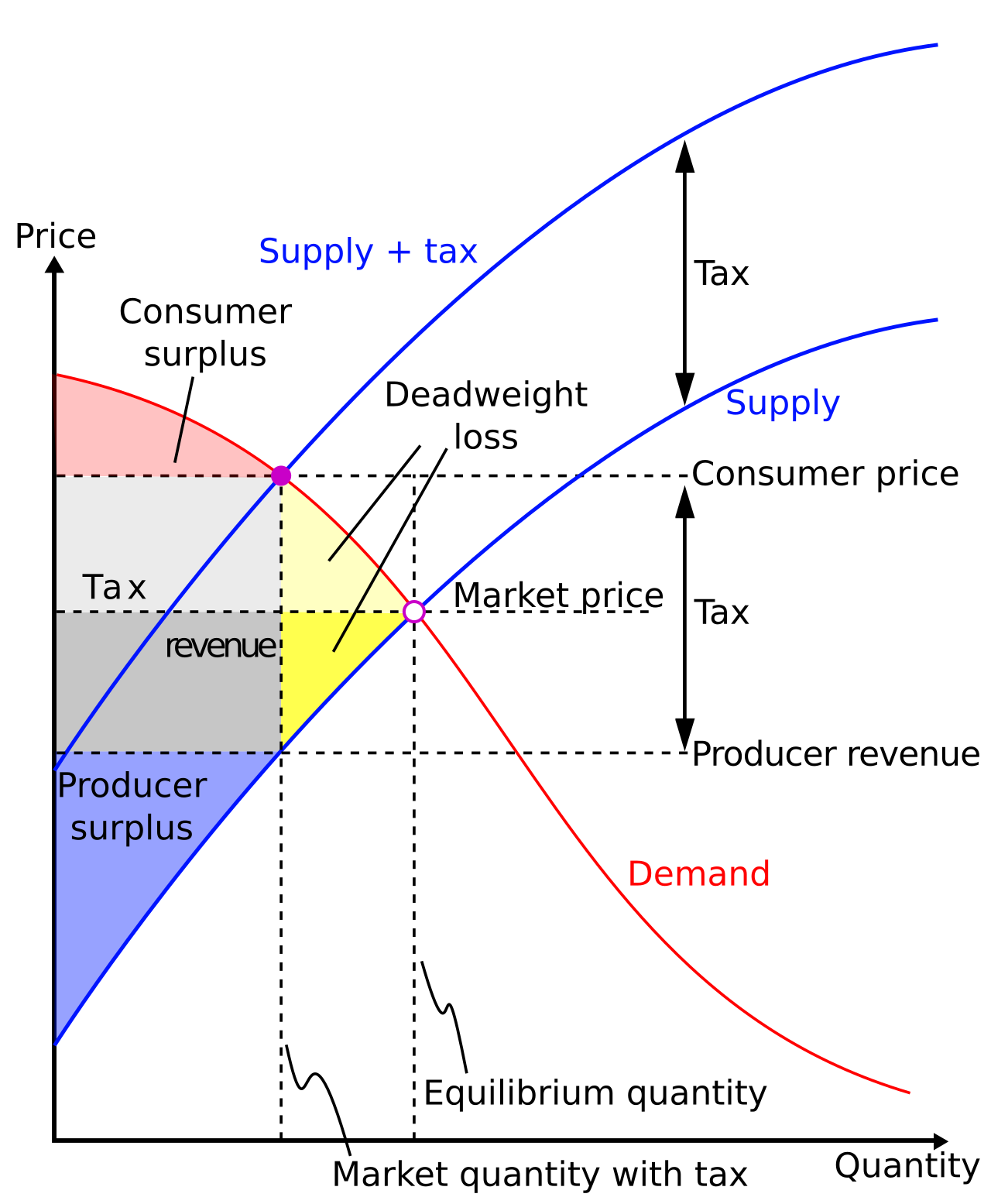
deadweight loss from the tax
producer surplus
consumer surplus
tax revenue
It is the surplus on trades that no longer occur because of the tax. The grey rectangle is the tax revenue.
Image: SilverStar and Evan Derickson, CC BY-SA 3.0, via Wikimedia Commons.
Demand increases and supply decreases. What is certain?
Equilibrium price falls
Equilibrium price rises
Equilibrium quantity rises
Equilibrium quantity falls
Both shifts push price up. The quantity change depends on the relative sizes of the shifts.
Total surplus falls when a binding price ceiling is imposed. True or False?
True
False
Units that would have traded at mutually beneficial prices don't get produced, so there is a deadweight loss.
A firm facing inelastic demand wants to maximize revenue. What should it do?
Raise quantity
Keep price constant
Lower price
Raise price
With |PED| < 1, price rises outweigh the loss in quantity, so revenue goes up.
Which diagram shows a tax whose burden falls almost entirely on producers (steep supply, nearly flat demand)?
Steep demand
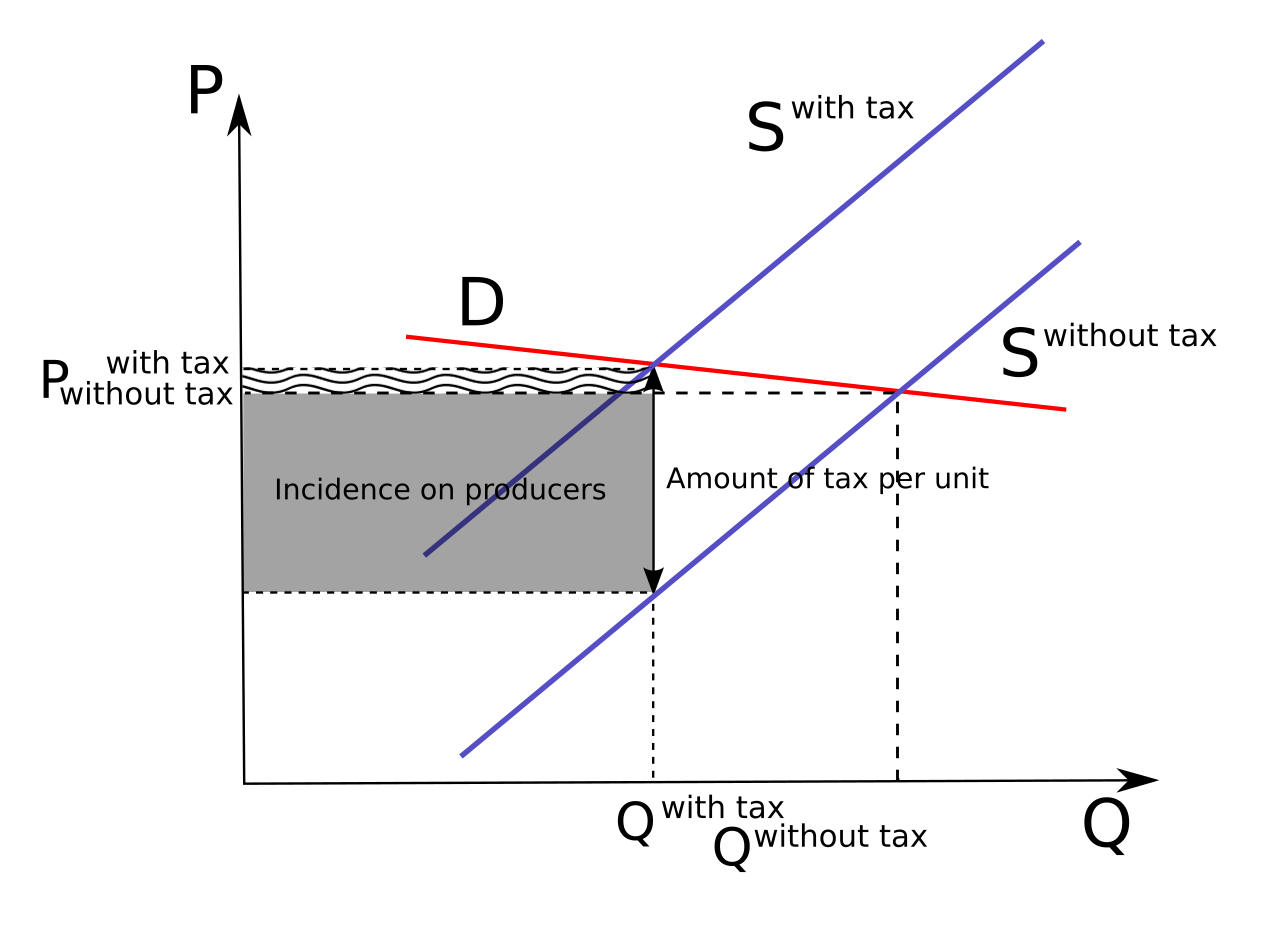
Steep supply, flat demand
Both moderately steep
In the second diagram demand is nearly flat, so buyers barely change what they pay. Producers absorb the tax.
