Quiz · Hard
Scenario questions on federalism, enumerated and implied powers, incorporation and checks and balances, at AP Gov free-response level.
Congress passes a law ordering state and local police to enforce a new federal registration program, with no federal funding. Which doctrine most directly supports a state's challenge to the law?
The Supremacy Clause
The anti-commandeering doctrine under the 10th Amendment
The Necessary and Proper Clause
The Full Faith and Credit Clause
Printz v. United States (1997) held that Congress cannot force state officers to administer federal programs. The Supremacy Clause makes valid federal law supreme but does not let the federal government commandeer state officials.
Congress passes a law banning guns within 1,000 feet of schools, relying on its power to regulate interstate commerce. The Court strikes it down in United States v. Lopez (1995). What was the central reasoning?
Guns are protected by the Second Amendment from federal regulation
Education is an enumerated power of the states
Congress may regulate only goods that cross state lines
Possessing a gun near a school is not economic activity substantially affecting interstate commerce
Lopez set limits on the Commerce Clause: the law neither regulated an economic activity nor required a link to commerce. It was not decided on the 2nd Amendment (that came in Heller, 2008).
The president signs an agreement with a foreign leader that is not submitted to the Senate. Which statement is correct?
It is an executive agreement, which does not need Senate approval but may be overridden by later federal statute
It is invalid because all international agreements need a two-thirds Senate vote
It is valid only if the House of Representatives approves it
It is a treaty and takes effect automatically after 10 days
Only treaties need two-thirds of the Senate. Presidents use executive agreements for many arrangements. Congress can limit them by statute, and the Court has treated them as valid in many cases.
A federal law says states must raise the drinking age to 21 or lose a share of federal highway funds. The Court upheld this in South Dakota v. Dole (1987). This is an example of:
Congress commandeering state legislatures
Preemption under the Supremacy Clause
Congress using its spending power with conditional grants
A concurrent power to regulate alcohol
The law does not order states to act; it attaches a condition to money. The Court found the condition reasonably related to the purpose of the funds and not coercive. Trap: the 21st Amendment gave states power over alcohol, but Congress used the spending power.
Which situation is the best example of a check by the judicial branch on the executive branch?
The Senate rejects a cabinet nominee
The House impeaches a federal judge
A federal court blocks an executive order as exceeding the president's authority
Congress passes a law over a veto
Judicial review of executive actions is the courts' check. The Senate's rejection and the veto override are legislative checks on the executive; impeaching a judge is a legislative check on the judiciary.
Why can Congress not pass a law that sentences a named individual to prison without a trial?
It would be a bill of attainder, banned by Art. I, Sec. 9
It would violate the Third Amendment
It would be an ex post facto law in every case
It would exceed the Commerce Clause
A bill of attainder is a legislative punishment without a judicial trial. An ex post facto law is a different thing: retroactive criminalization. A law could be both, but the best answer is the bill of attainder.
Which of the following correctly describes concurrent powers?
Declaring war and coining money
Regulating public schools and issuing marriage licenses
Making treaties and conducting foreign policy
Collecting taxes, building roads and setting up courts, exercised by both the federal and state governments
Taxing, borrowing, building roads and establishing courts are shared. War, coinage and treaties are exclusive federal powers; schools and marriage licenses are state powers.
In McCulloch v. Maryland (1819), the Court ruled that:
Congress had no power to create a bank because it is not enumerated
Congress had implied power to create a national bank and Maryland could not tax it
States may tax any federal agency within their borders
The Bank was valid but could be taxed by states if the tax was fair
Marshall relied on the Necessary and Proper Clause and the Supremacy Clause. 'The power to tax involves the power to destroy,' so states cannot tax federal institutions.
The Senate has 100 members. How many votes are needed to convict an impeached president, assuming all senators are present?
51
67
60
75
Conviction needs two-thirds of the senators present, 67 of 100. 51 is a simple majority. 60 is the cloture threshold for ending a filibuster, a common confusion.
How many votes are needed in the House to override a presidential veto if all 435 members vote?
218
261
290
300
Two-thirds of 435 is 290, and the Senate must also reach two-thirds (67). 218 is the majority of the House, and 261 is three-fifths.
The Framers gave federal judges life tenure primarily to:
Insulate judges from political pressure and protect judicial independence
Ensure the judiciary would be the most powerful branch
Allow judges to remove presidents who violate the Constitution
Prevent Congress from ever changing the number of judges
Federalist 78 explained that independence comes from tenure during good behavior and protected salaries. Congress can still change the size of courts and impeach judges.
Which situation illustrates the principle of selective incorporation?
The Court applies the Fifth Amendment to the Library of Congress
Congress extends a federal law to the territories
A state adopts a copy of the federal Bill of Rights in its constitution
The Court applies the 2nd Amendment to state and city gun laws through the 14th Amendment
McDonald v. Chicago (2010) incorporated the 2nd Amendment. Incorporation is how the Bill of Rights, written to limit the federal government, came to bind the states.
A person is tried and acquitted in state court for a crime, then tried in federal court for the same conduct under a federal statute. Which doctrine allows this?
The incorporation doctrine
The Guarantee Clause
Dual sovereignty: states and the federal government are separate sovereigns
The Full Faith and Credit Clause
The Double Jeopardy Clause does not bar successive prosecutions by different sovereigns. The Court confirmed this in Gamble v. United States (2019).
Which statement about the Necessary and Proper Clause is correct?
It gives Congress power over any subject that is useful to the nation
It expands Congress's power only to means that carry out its enumerated powers
It lets Congress override the Bill of Rights in an emergency
It gives the president implied powers equal to Congress
It is not a free-standing grant. The means must be tied to an enumerated power (and not violate the Constitution). That is why the Commerce Clause and the Tax and Spend Clause are the usual vehicles.
What was the main purpose of the Supremacy Clause?
To make the president supreme over Congress
To make the Supreme Court the final authority over every state judge
To prohibit states from having their own constitutions
To make federal law prevail over conflicting state law
States keep their own constitutions and powers; the clause applies when valid federal and state laws conflict. Trap: it does not make federal law superior outside constitutional powers.
The president wants to remove a federal judge for a ruling he dislikes. The Constitution allows removal by:
Impeachment by the House and conviction by the Senate
A presidential order approved by the Senate
A majority vote of the Supreme Court
A two-thirds vote of the state governors
Judges serve during good behavior; only impeachment and conviction (Art. II, Sec. 4 and Art. I, Sec. 3) can remove them. This protects judicial independence.
Which of the following is NOT an enumerated power of Congress?
Create public schools in every state
Coin money
Declare war
Establish post offices
The Constitution says nothing about education, so it belongs to the states (10th Amendment). Congress influences schools through spending conditions such as the No Child Left Behind Act.
Which of the following shows the system of checks and balances working as designed?
The president appoints a justice who then rules for him
The Supreme Court writes a law to replace one it struck down
Congress passes a law, the president vetoes it, and Congress overrides the veto
A state ignores a federal court order
Each branch checks the others in sequence. In the other answers, one branch dominates or the system is bypassed.
The 'Lemon test' and 'Free Exercise' disputes both arise from which amendment?
The Fourth Amendment
The First Amendment
The Ninth Amendment
The Fourteenth Amendment
The First Amendment contains both religion clauses: Establishment and Free Exercise. The Court in Kennedy v. Bremerton (2022) moved away from the Lemon test toward history and tradition.
Which clause of the Constitution did the Court rely on in Gibbons v. Ogden (1824) to give Congress broad power over interstate navigation?
The Necessary and Proper Clause only
The Guarantee Clause
The Establishment Clause
The Commerce Clause
Marshall defined 'commerce' broadly to include navigation, so New York's steamboat monopoly could not block federal licenses.
A governor refuses to return a fugitive to the state that charged him. Which provision is the state violating?
The Privileges and Immunities Clause of the 14th Amendment
The extradition clause of Article IV
The Supremacy Clause
The Contracts Clause
Art. IV, Sec. 2 requires return on demand. In practice the Court held in Puerto Rico v. Branstad (1987) that federal courts can enforce it.
Which pair is correctly matched?
Federalist No. 51: the need for a bill of rights
Federalist No. 78: the weakness of the executive
Brutus No. 1: the case for a strong national government
Federalist No. 10: the dangers of factions in a large republic
No. 51 is about checks and balances; No. 78 about the judiciary; Brutus No. 1 argued against a strong national government.
In the diagram, which power belongs to the Executive but is also checked by the Legislature?
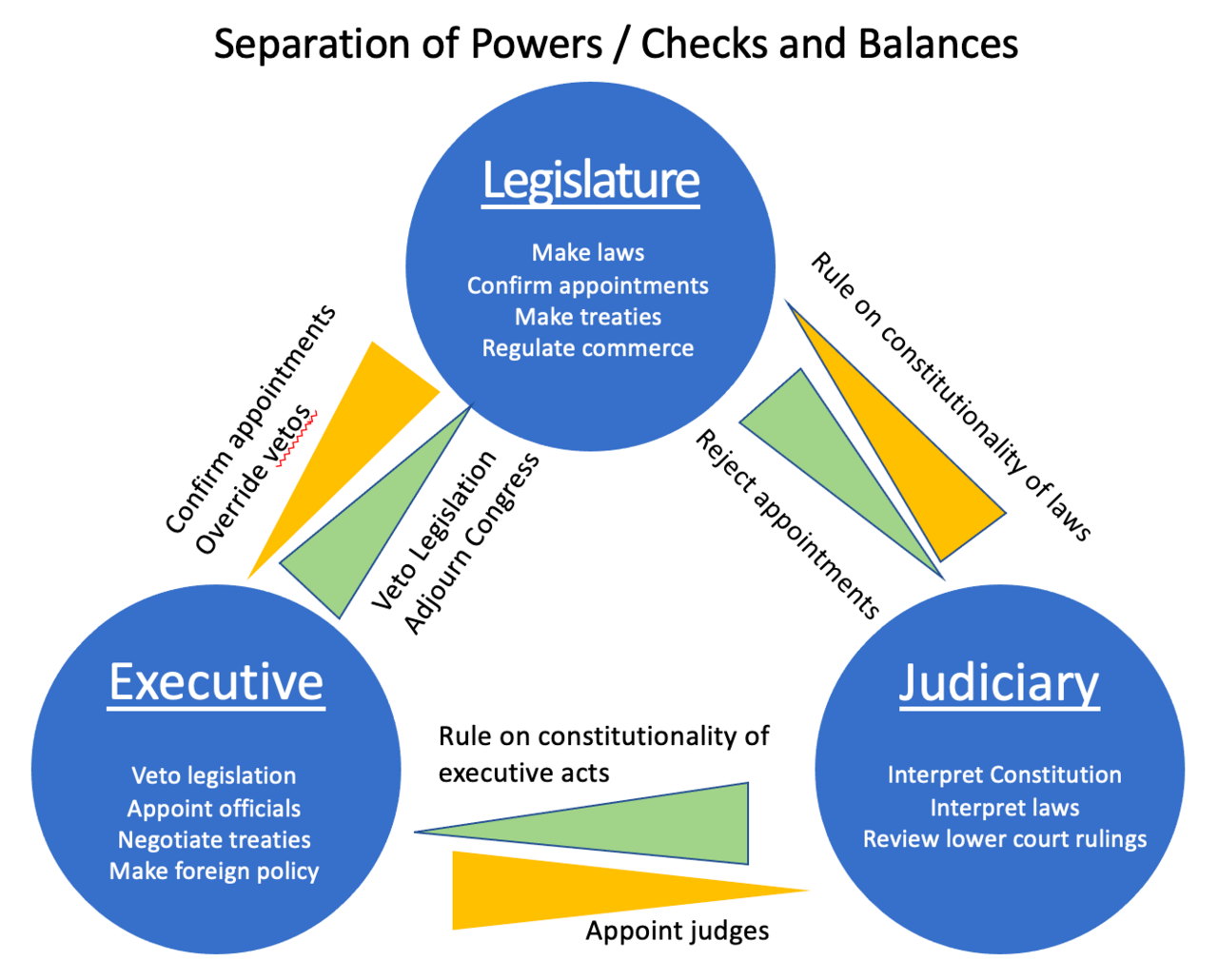
Making treaties and appointments: the Senate confirms or ratifies
Interpreting the Constitution: the Senate approves rulings
Making laws: the president can overrule Congress alone
Regulating commerce: the courts approve every regulation
The diagram lists Executive powers such as appointing officials and negotiating treaties; the Legislature checks them by confirming appointments and ratifying treaties.
