Quiz · Easy
Ocean zones, tides, currents, the water cycle, time zones and Earth's size.
Which of the Great Lakes is the largest by area?
Lake Michigan
Lake Huron
Lake Superior
Lake Erie
Michigan is the only one entirely in the United States.
Earth rotates by how many degrees of longitude per hour?
10
24
15
30
360 degrees divided by 24 hours.
About what percentage of Earth's surface is covered by oceans?
About 51%
About 81%
About 71%
About 91%
Most of the Southern Hemisphere is ocean.
What is the average salinity of the ocean?
About 3.5%
About 0.35%
About 10%
About 35%
That is 35 parts per thousand.
Which sea is the saltiest, so that people float easily?
The Red Sea
The Baltic Sea
The Black Sea
The Dead Sea
It has roughly 34% salinity, nearly ten times the ocean's.
The ocean's 'twilight zone' (200-1,000 m deep) is called the:
Epipelagic zone
Mesopelagic zone
Bathypelagic zone
Hadal zone
Little light reaches it, so photosynthesis cannot happen.
Tides are caused mainly by the gravitational pull of the:
Sun
Wind
Moon
Ocean currents
The Sun contributes a smaller part.
Spring tides, with the greatest tidal range, occur when:
It is spring
The Moon is at first quarter
The Sun, Moon and Earth are aligned
Earth is farthest from the Sun
This happens at new and full moon.
Ocean gyres in the Northern Hemisphere rotate:
Clockwise
Counterclockwise
In straight lines
They do not rotate
The Coriolis effect turns currents to the right in the Northern Hemisphere.
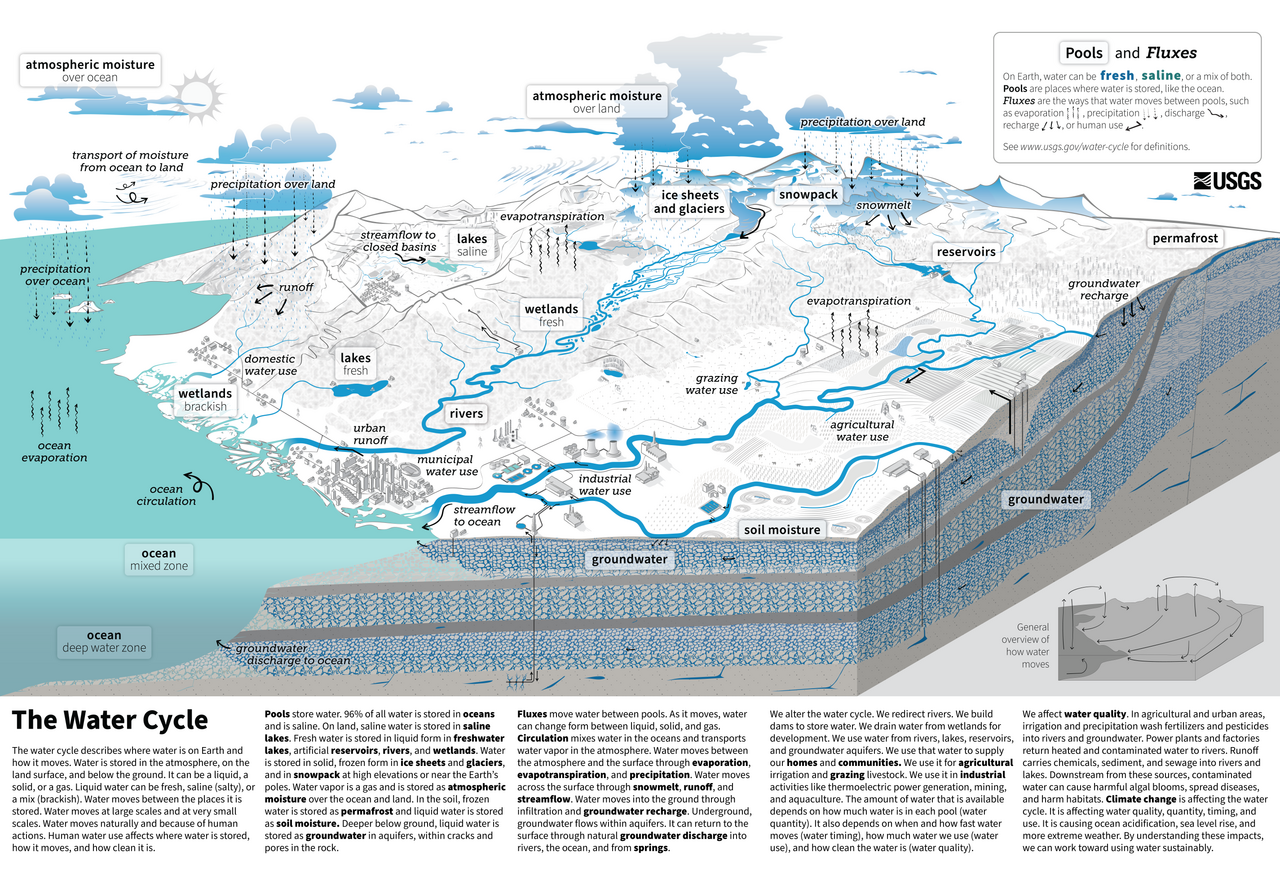
What does the term 'evapotranspiration' include?
Only evaporation from the ocean
Evaporation from water and soil, and transpiration from plants
Only rain and snow
Only groundwater flow
Plants release water vapour through small pores in their leaves.
Image: U.S. Geological Survey (Corson-Dosch et al.), Public domain, via Wikimedia Commons.
A rock layer that holds and yields usable groundwater is a(n):
Watershed
Levee
Aquifer
Estuary
The upper boundary of the saturated zone is the water table.
When you cross the International Date Line from west to east, you:
Go forward one day
Gain one hour
Go back one calendar day
Do not change date
Traveling east you re-live a day; traveling west you skip one.
Why do we always see the same side of the Moon?
It does not rotate
Earth blocks sunlight from the far side
It is tidally locked to Earth
It orbits Earth in 24 hours
Its rotation period equals its orbital period.
About how long is Earth's circumference at the equator?
About 40,000 km
About 4,000 km
About 400,000 km
About 12,000 km
The metre was originally defined so that this would be exactly 40,000 km, from a quarter meridian of 10 million metres.
Who calculated Earth's circumference around 240 BCE using shadows?
Eratosthenes
Ptolemy
Galileo
Columbus
He measured the difference in shadow angle between Alexandria and Syene.
Which strait separates Spain from Morocco?
Bosphorus
Strait of Hormuz
Bering Strait
Strait of Gibraltar
It connects the Atlantic to the Mediterranean.
Tropical cyclones rarely form on the equator because:
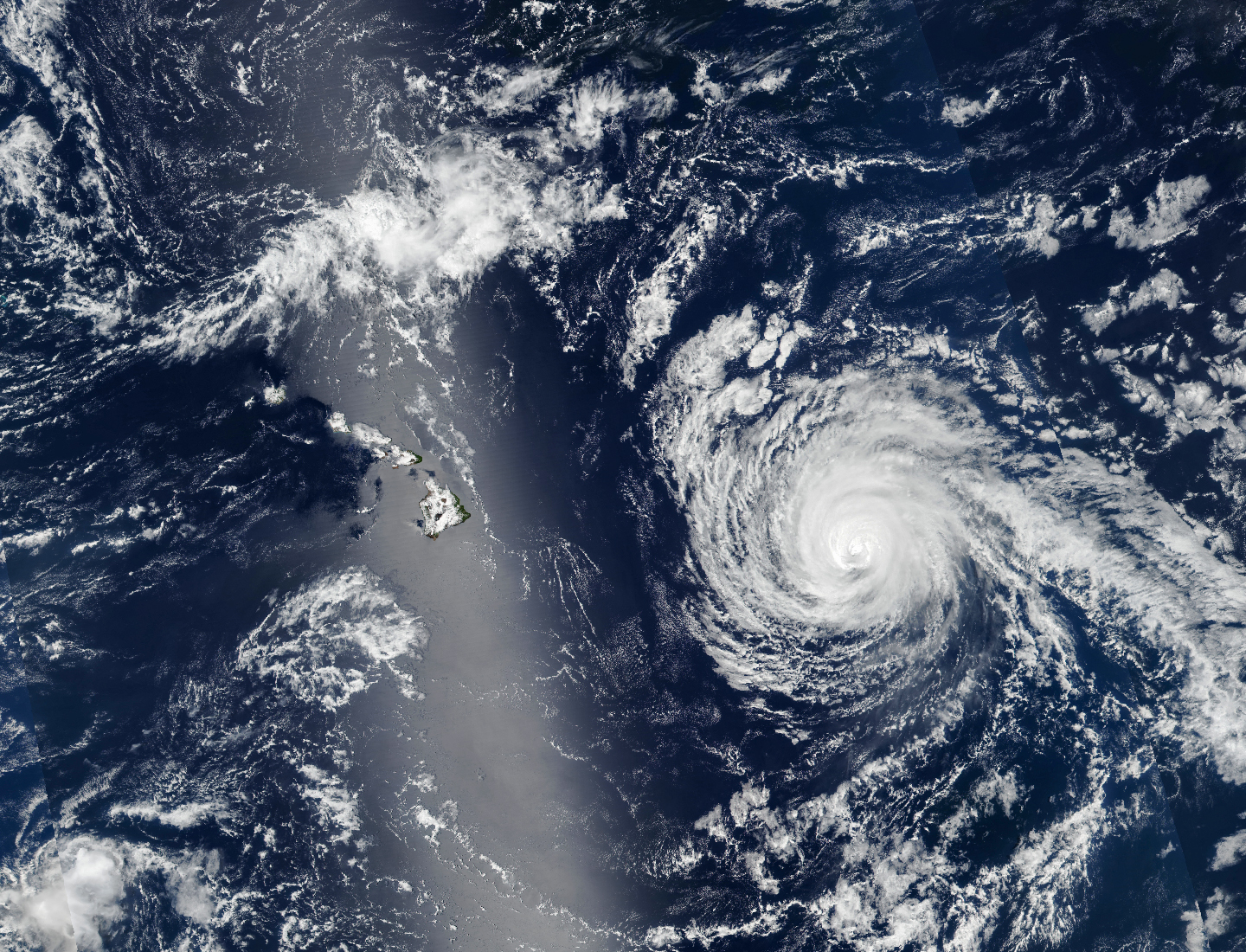
There is no Coriolis effect there to start rotation
The water is too cold
Winds are too strong
Land blocks them
They need to be at least about 5 degrees from the equator.
Image: NASA Earth Observatory (Michala Garrison), Public domain, via Wikimedia Commons.
The Bay of Fundy is famous for:
Its giant coral reef
The world's greatest tidal range
The saltiest water
Its volcanoes
The tide can rise and fall by up to about 16 m.
