Quiz · Medium
Foundational questions on mens rea, larceny vs embezzlement vs false pretenses, homicide, attempt, conspiracy and accomplices, and the basic defenses and Miranda rules.
Which pair correctly identifies the two basic elements of a crime?
Corpus delicti and habeas corpus
Mens rea and stare decisis
Actus reus and mens rea
Actus reus and res ipsa loquitur
Actus reus is the guilty act (or omission with a duty), and mens rea is the guilty mind. The other terms are unrelated Latin phrases from other areas of law.
A passerby watches a stranger drown in a shallow pond and does nothing, though he could easily throw a rope. He is
not criminally liable, because there is no general legal duty to rescue a stranger
guilty of involuntary manslaughter
guilty of murder, because he knew the stranger would die
liable only if he had a moral duty
An omission is a crime only if there is a legal duty (statute, contract, relationship, assumption of care, creation of the peril). A moral duty alone is not enough.
D intends to kill A and fires at him, but the bullet misses and kills B. D is most likely guilty of
only attempted murder of A
involuntary manslaughter of B
no crime as to B because he did not intend to kill him
the murder of B, under transferred intent
Under transferred intent, D's intent to kill A is transferred to B. D may also be guilty of the attempted murder of A.
D is charged with burglary, a specific intent crime. D entered a house drunk and believed it was his own. The best argument is that
intoxication is never a defense
D lacked the intent to commit a felony inside, because voluntary intoxication may negate specific intent
D committed a mistake of law
burglary is a strict liability offense
Voluntary intoxication can negate the specific intent required for burglary. It is not a defense to general intent crimes.
Which of the following is a requirement of common-law larceny?
The defendant obtained title by a false statement
The defendant took the property with intent to permanently deprive the owner
The defendant lawfully possessed the property before taking it
The defendant used force or fear
Larceny requires a trespassory taking and carrying away of the personal property of another with intent to permanently deprive. Title by false statement is false pretenses, and lawful possession followed by conversion is embezzlement.
An accountant is lawfully entrusted with a client's funds to pay the client's bills. He deposits them in his own account and spends them. He has committed
larceny
robbery
false pretenses
embezzlement
Embezzlement is the fraudulent conversion of property that the defendant already lawfully possesses. Larceny requires a trespassory taking, and false pretenses requires a lie that passes title.
D convinces V to hand over title to his car by falsely claiming to be a licensed dealer. D has committed
false pretenses
larceny by trick
embezzlement
robbery
V passed title because of a misrepresentation of existing fact. If V had only handed over possession (for example, a test drive) it would be larceny by trick.
D quietly slips a wallet out of V's coat pocket while V is unaware, intending to keep it. D is most likely guilty of
robbery
embezzlement
larceny
false pretenses
Taking by stealth is larceny. Robbery requires force or a threat of imminent force against the victim, and embezzlement requires prior lawful possession.
D breaks into an unoccupied warehouse at noon intending to steal. Which statement is correct under the modern approach?
D is not guilty of burglary because it was daytime
D is not guilty of burglary because the structure was not a dwelling
D is guilty only of attempted burglary
D is guilty of burglary, because modern statutes cover any structure at any time
Common-law burglary required a dwelling at night. Modern statutes drop those requirements, but the intent to commit a crime inside is still needed at entry.
A kills B in a sudden quarrel after B slaps him and A has no time to cool off. The most likely charge is
first-degree murder
voluntary manslaughter
involuntary manslaughter
self-defense, leading to acquittal
A slap is typically adequate provocation if the killing is in the heat of passion. Provocation mitigates murder to voluntary manslaughter. Deadly force in response to a slap is not justified as self-defense.
D commits an armed robbery during which a bystander has a fatal heart attack from fright. Under the felony murder rule D is
not guilty because he had no intent to kill
guilty only of involuntary manslaughter
probably guilty, because the death was a foreseeable result of the dangerous felony
guilty only if he had intent to kill
Felony murder dispenses with intent to kill if the death is a proximate result of the felony. Foreseeability and the inherently dangerous nature of armed robbery support liability.
The Model Penal Code term for being aware of a substantial and unjustifiable risk and consciously disregarding it is
recklessness
negligence
knowledge
purpose
Recklessness is conscious disregard. Negligence is a failure to perceive a risk that a reasonable person would have perceived.
To prove attempt, the prosecution must show
intent to commit the target crime and an act beyond mere preparation
only an act of preparation
only the intent to commit the crime
that the crime was nearly completed
Mere preparation is not enough, and neither is mere intent. The MPC requires a substantial step corroborating the criminal purpose.
A and B agree to rob a bank. A buys masks and a gun; B drives by the bank to scout. They are arrested. Which crime is already complete?
Robbery
Burglary
Conspiracy (in a jurisdiction requiring an overt act)
Solicitation only
The agreement plus an overt act (buying masks, scouting) completes conspiracy. Robbery requires a taking from a person by force.
Which statement about the relationship between conspiracy and the completed target offense is correct?
Conspiracy merges into the completed offense
A defendant may be convicted of both conspiracy and the completed offense
The defendant may only be convicted of the greater
Conspiracy requires the target offense to be completed
Conspiracy does not merge. Attempt and solicitation do.
D lends his car to a friend knowing the friend plans to use it as a getaway vehicle and wants the robbery to succeed. D is
only an accessory after the fact
not liable because he was not present
liable for conspiracy only
an accomplice to the robbery
An accomplice aids with the intent to promote the crime. Presence at the scene is not required.
D shoots V after V punches D in a fistfight. V had no weapon. D's claim of self-defense most likely
succeeds because V started the fight
succeeds because D feared bodily harm
fails, because deadly force was disproportionate to a non-deadly threat
fails because self-defense is never available against a punch
Deadly force is justified only to repel a threat of death or serious bodily harm. A proportionate non-deadly response would have been allowed.
The defense of necessity would most likely succeed where
a hiker breaks into a cabin during a blizzard to avoid freezing
a defendant kills an innocent person to save his own life
a defendant commits a crime on a friend's threat of future harm
a defendant causes the emergency and then claims necessity
Necessity requires choosing the lesser evil, and it generally is not available for intentional killing of an innocent (Dudley and Stephens). A threat of future harm is not imminent.
Under the M'Naghten test, a defendant is not guilty by reason of insanity if
he could not control his actions
his act was the product of mental illness
he suffered from any mental disorder
because of a mental disease, he did not know the nature of his act or that it was wrong
M'Naghten is purely cognitive. The irresistible impulse test is volitional, and the product test is the Durham rule.
In the subjective test for entrapment the key question is
how a normally law-abiding person would respond
whether the defendant was predisposed to commit the crime
whether police used deception
whether the crime was initiated by an informant
The subjective test (federal) looks at predisposition. The objective test looks at the police conduct.
A search warrant is typically required unless an exception applies. Which is an exception?
The officer has a hunch
Exigent circumstances such as hot pursuit
The suspect is a convicted felon
The search is at night
Recognized exceptions include consent, plain view, exigent circumstances, search incident to arrest, automobile, stop and frisk, and inventory. A hunch is not even enough for a stop.
Under Miranda, which of these situations requires warnings before questioning?
A driver stopped for speeding
A witness voluntarily at a police station
A person detained briefly for a Terry stop
A suspect under arrest in a police station being asked about the crime
Warnings are needed only when custody and interrogation both exist. A routine traffic stop and a Terry stop are not custody for Miranda.
In the diagram of homicide grades, which offense is an intentional killing in the heat of passion after adequate provocation?
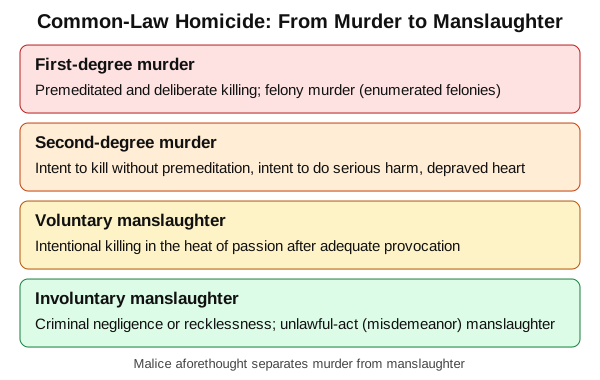
Voluntary manslaughter
Second-degree murder
Involuntary manslaughter
First-degree murder
Adequate provocation negates malice and mitigates murder to voluntary manslaughter. Involuntary manslaughter is an unintended killing from recklessness or criminal negligence.
In the MPC ladder shown, which mental state requires conscious disregard of a substantial and unjustifiable risk?
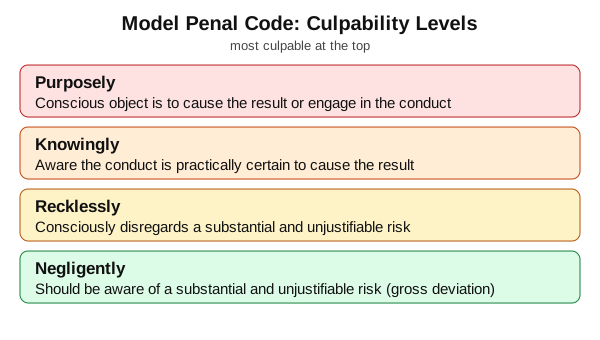
Knowingly
Negligently
Recklessly
Purposely
Recklessness is subjective awareness of the risk. Negligence is failing to see a risk that a reasonable person would see.
