Quiz · Medium
Polling, turnout, party systems, PACs, lobbying, the media, state and local government and the bureaucracy in AP-style questions.
Which of these best defines political socialization?
The process of nominating candidates
A method of measuring public opinion
The process by which people acquire their political beliefs and values
The movement of voters between parties
Family, school, peers and media are agents of political socialization.
Which of the following is the most important reason the US has a two-party system?
Single-member, winner-take-all districts discourage third parties
The Constitution requires two parties
Third parties are banned from ballots
Voters dislike multiple choices
Duverger's law: plurality rule in single-member districts tends to produce two parties. The Constitution does not mention parties.
A poll of 1,000 randomly selected voters shows a candidate at 52 percent with a margin of error of plus or minus 3 points. This means:
The candidate has exactly 52 percent
The candidate certainly leads
The poll is biased by 3 points
The candidate's true support is probably between 49 and 55 percent
The margin of error reflects sampling variation (normally at 95 percent confidence). It does not measure bias in question wording.
Super PACs differ from traditional PACs in that Super PACs:
May give unlimited money directly to candidates
May raise and spend unlimited funds on independent expenditures but may not coordinate with candidates
Are run by candidates
Must disclose no spending
They arose from SpeechNow.org v. FEC and Citizens United v. FEC (2010).
The 'free-rider problem' for interest groups means that:
Lobbyists get free travel
People may benefit from group lobbying without paying dues
Groups cannot lobby for free
Members avoid voting
Groups solve it with selective benefits such as insurance, magazines and discounts (e.g. AARP).
Which of the following is an example of an iron triangle?
President, Senate and House
The three branches of government
A congressional committee, an agency and an industry lobby that support one another
Two parties and a third party
Each side provides something: committee gives funds, agency gives rules, lobby gives votes and information.
The cartoon 'Bosses of the Senate' (1889) criticized:
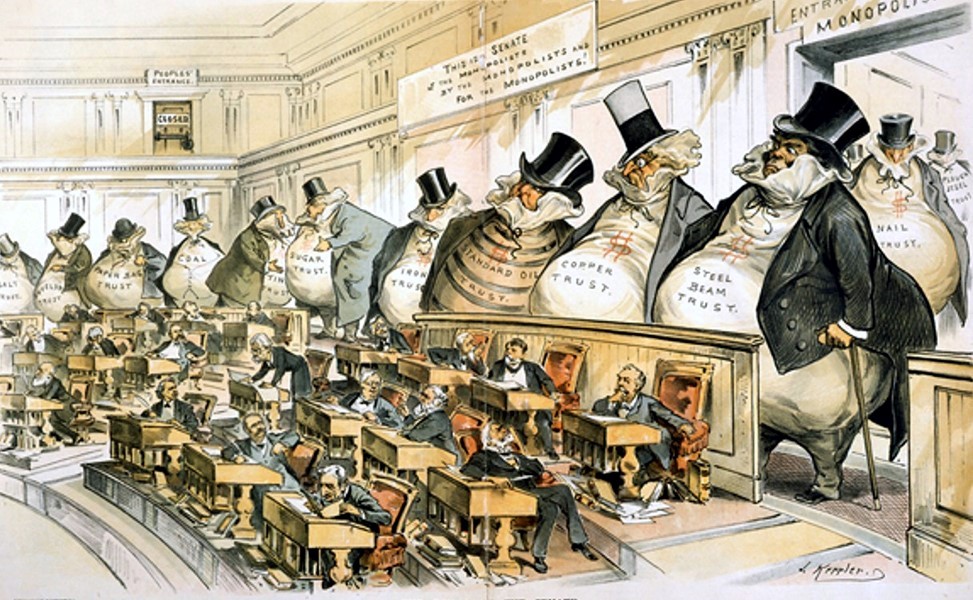
The influence of large business trusts over Congress
The president's veto
The press's power over Senate debates
The influence of labor unions
Progressives used cartoons like this to push for direct election of senators (17th Amendment).
Which of these is an example of a critical election or realignment?
A president winning a second term
A third party getting 5 percent
A decrease in turnout
The 1932 election of Franklin Roosevelt and formation of the New Deal coalition
Realignments are lasting shifts in group loyalties to parties.
What is the main effect of New York Times v. Sullivan (1964)?
Newspapers can never be sued
Prior restraint is always legal
Public officials must show actual malice to win libel suits
Libel is no longer a crime for private persons
It protects robust criticism of public officials. Private persons need to meet a lower standard.
Which statement about turnout is accurate?
Turnout is highest among the youngest voters
Turnout is usually higher in presidential election years than in midterms
Turnout is higher in primaries than in general elections
Income has no effect on turnout
Older, more educated and wealthier citizens tend to turn out more. Primary turnout is usually lower.
Which of these is an example of a government corporation?
The Department of Defense
The Securities and Exchange Commission
The White House Office
The US Postal Service
Government corporations (USPS, Amtrak) provide services that could be private. The SEC is an independent regulatory commission.
Which fact is true about mandatory spending?
It is spending required by existing law, such as Social Security and Medicare
It is set each year in appropriations bills
It is mostly defense spending
It is capped by the Constitution
Mandatory (direct) spending is the largest share of the federal budget. Defense is discretionary.
A state allows voters to put a proposed law on the ballot by collecting signatures. This is:
The initiative
The recall
Home rule
Preemption
The recall removes officials. Home rule gives local self-government.
Which statement about the Federal Reserve is correct?
It sets the federal budget
It prints bills for Congress to spend
It sets monetary policy to promote stable prices and maximum employment
It regulates elections
Congress sets fiscal policy; the Fed conducts monetary policy independently of day-to-day political control.
A local government has only the powers its state explicitly grants. This is known as:
Home rule
Dillon's Rule
Cooperative federalism
Reserved powers
Home rule is the opposite: broad local autonomy under a charter.
Which describes the media function of 'agenda setting'?
Writing laws
Conducting scientific polls
Appointing editors
Deciding which issues the public sees as important by choosing what to cover
Gatekeeping and framing are related media effects.
The Pendleton Civil Service Reform Act came after:
The Civil War
The assassination of President Garfield by a disappointed office seeker
The Great Depression
The Spanish-American War
Garfield was shot in 1881 by Charles Guiteau. The 1883 law ended the spoils system for many jobs.
Which of these is a federalism example of cooperative federalism?
States and the federal government acting in separate spheres
A state refusing to enforce federal law
A federal ban on state taxation
Medicaid funded jointly by federal and state governments with federal rules
Cooperative (marble-cake) federalism features shared programs and grants.
What is the main reason lobbyists are protected under the Constitution?
The First Amendment right to petition the government
The Tenth Amendment
The Commerce Clause
The Fifth Amendment
Lobbying disclosure laws regulate but do not prohibit it.
Loper Bright Enterprises v. Raimondo (2024) most directly changed:
How many justices sit on the Court
How elections are funded
How courts review agency interpretations of statutes
How treaties are ratified
The Court overruled Chevron deference; judges now use independent judgment on statutory meaning.
Which of these is a function of the bureaucracy?
Declaring war
Ratifying treaties
Writing detailed regulations to implement statutes
Choosing electors
Agencies are part of the executive branch and implement laws passed by Congress.
