Quiz · Medium
Check your grasp of feudal society, the medieval Church, the Investiture Controversy and the Crusades, with maps and primary images.
Which statement best describes the relationship between a lord and his vassal in feudalism?
The vassal paid rent in coin and owed no other duty.
The vassal was the lord's slave and owned nothing.
The lord granted land (a fief) and protection; the vassal owed loyalty and military service.
The lord was elected by his vassals and ruled with their consent.
Feudal ties were personal and reciprocal: land for service. Serfs, not vassals, owed labor. Rent in coin and elections were not the basis of the system.
In the medieval model of three orders, which group made up the large majority (about 80 percent) of the population?
Laboratores (those who work)
Bellatores (those who fight)
Oratores (those who pray)
Burghers (townspeople)
The peasants worked the land. Burghers were a fourth, growing group not part of the old three-orders scheme.
What is the main difference between manorialism and feudalism?
Manorialism applied only in cities, feudalism in the countryside.
Manorialism was a Church system, feudalism a royal one.
They are two names for the same system.
Manorialism organized peasant labor on estates, while feudalism organized military and political obligations among nobles.
A lord could be both a feudal vassal of his own lord and the manorial lord of serfs. Students often merge the two, but they describe different relationships.
In the three-field system, what was done with one of the three fields each year?
It was reserved for the church's tithe crops.
It was left fallow so the soil could recover.
It was used only to grow flax and hemp.
It was kept as the lord's private hunting ground.
Rotation of winter crop, spring crop and fallow raised yields. The two-field system left half the land idle, so three fields increased productive land from 50 to about 67 percent.
Which event is shown in this scene from the Bayeux Tapestry?
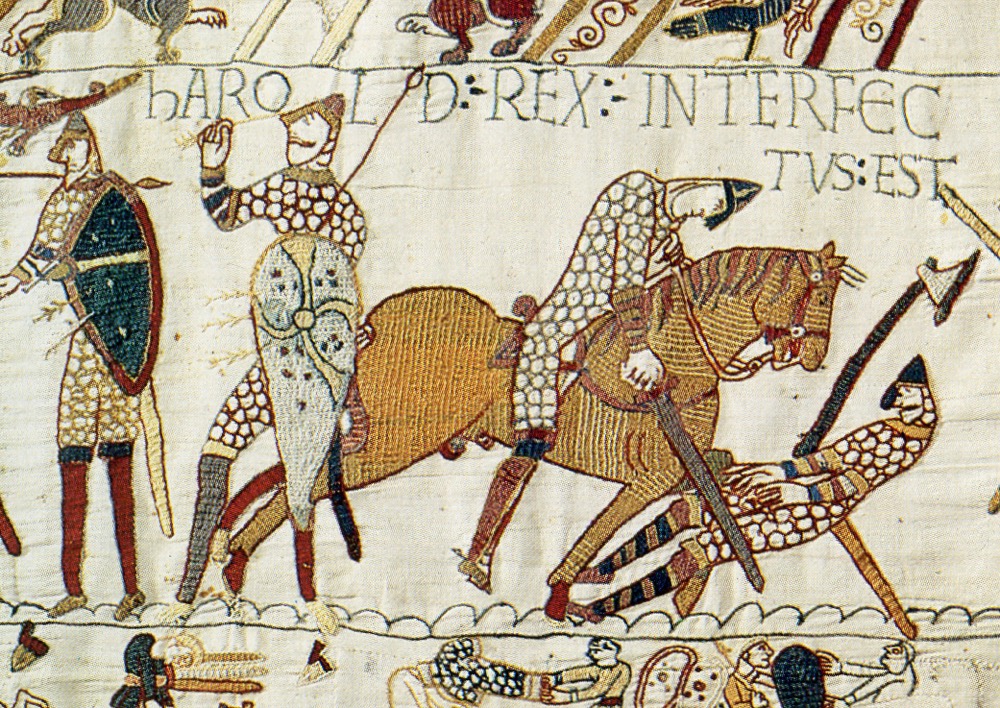
The coronation of William the Conqueror
The death of King Harold at Hastings in 1066
The surrender of Harold Hardrada at Stamford Bridge
Harold's oath to William
The Latin inscription reads 'Harold rex interfectus est' (King Harold is killed). The tapestry also shows Harold's oath and Halley's comet, but this panel shows his death.
What did Charlemagne's coronation on Christmas Day 800 signify?
The creation of the Holy Roman Empire as a German state
The conversion of the Franks to Christianity
The end of the Byzantine Empire
A revival of the imperial title in the West through an alliance between the Franks and the papacy
Pope Leo III crowned him. The Franks had been Christian since Clovis, and the Byzantine Empire continued. The term Holy Roman Empire and the German-led empire date from Otto I in 962.
Which treaty split Charlemagne's empire among his three grandsons?
Treaty of Verdun (843)
Treaty of Troyes (1420)
Concordat of Worms (1122)
Treaty of Brétigny (1360)
Verdun gave the west to Charles the Bald, the east to Louis the German and the middle strip to Lothair. The other treaties are from later conflicts (Hundred Years' War and the Investiture Controversy).
What was the main issue in the Investiture Controversy?
Whether the pope could marry
Whether the Eucharist changed into the body of Christ
Who had the right to appoint bishops: the pope or secular rulers
Whether monks could own property
Gregory VII banned lay investiture in 1075. Henry IV resisted, was excommunicated, and did penance at Canossa (1077). The Concordat of Worms (1122) compromised.
What was the effect of Henry IV's penance at Canossa (1077)?
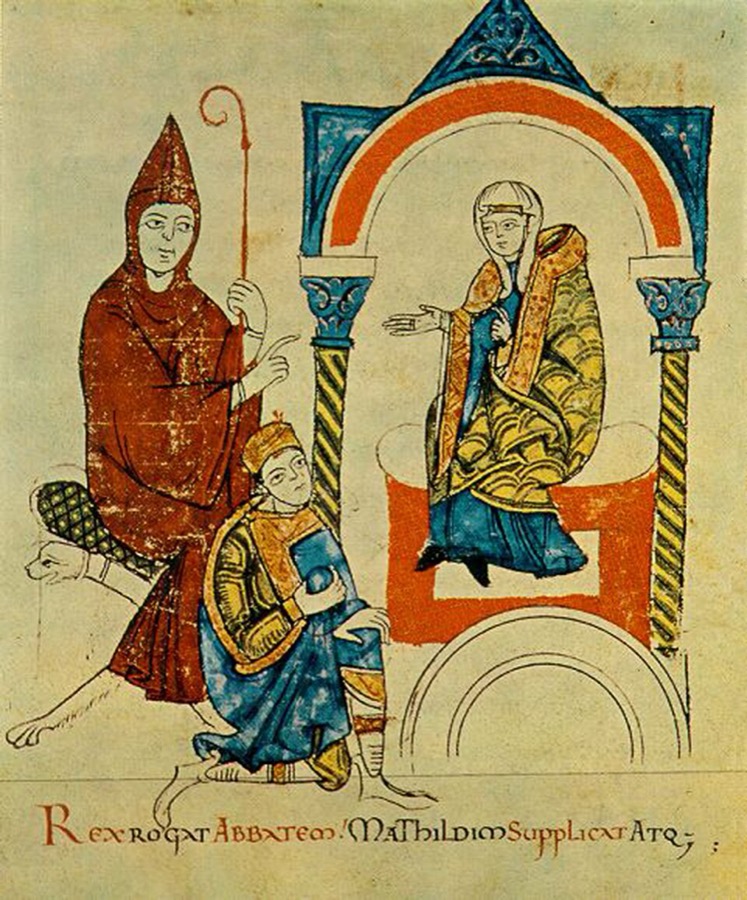
Henry IV renounced the throne.
The papacy agreed to lay investiture.
Gregory VII lifted the excommunication, but the conflict continued.
Henry IV was permanently reconciled with the Church.
Canossa showed the pope's moral power over kings, but Henry later invaded Rome and installed an antipope. The issue was not settled until 1122.
Which pope called the First Crusade?
Gregory VII
Urban II
Innocent III
Boniface VIII
Urban II preached at Clermont in 1095 after an appeal from Alexios I. Innocent III called the Fourth Crusade, and Gregory VII and Boniface VIII are known for clashes with emperors and kings.
Which of these was NOT one of the crusader states set up after the First Crusade?
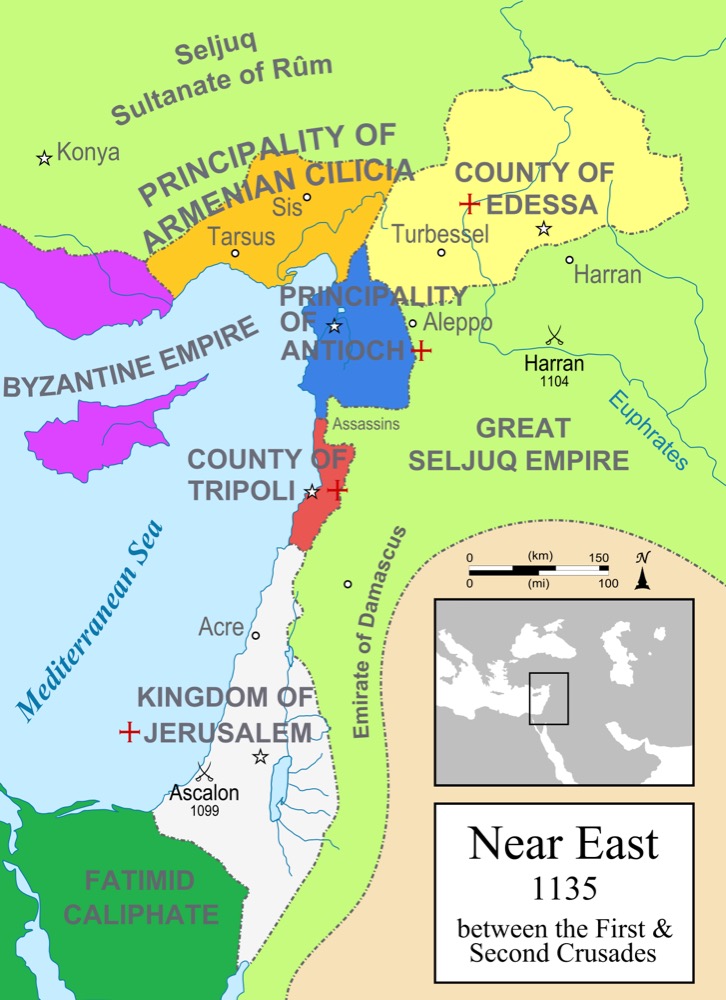
Armenian Cilicia
County of Edessa
Principality of Antioch
County of Tripoli
Armenian Cilicia was a separate Christian state, allied with but distinct from the crusaders. The four crusader states were Jerusalem, Antioch, Edessa and Tripoli. Image: MapMaster, CC BY-SA 3.0, via Wikimedia Commons.
What was unusual about the Fourth Crusade (1202-1204)?
It captured Jerusalem for the first time.
It was led entirely by peasants.
It defeated Saladin at Hattin.
It sacked the Christian city of Constantinople.
Debts to Venice and a claimant to the Byzantine throne diverted the crusaders. The sack of 1204 left lasting bitterness between Greek and Latin Christians.
Which document did King John seal in 1215, accepting limits on royal power?
Domesday Book
Constitutions of Clarendon
Magna Carta
Dictatus Papae
Barons forced John to accept Magna Carta at Runnymede. The Constitutions of Clarendon (1164) were Henry II's attempt to limit church courts. Dictatus Papae was Gregory VII's statement of papal claims.
Which statement about the medieval guild system is accurate?
Craft guilds regulated quality and prices and trained apprentices into journeymen and masters.
Guilds were run by the Church and open to all peasants.
Guilds forbade the use of money.
Guilds were only for nobles who owned land.
Guilds protected members and limited competition. Membership was typically restricted, especially for outsiders and women.
What did the phrase 'town air makes you free' mean?
Townspeople did not have to pay any taxes.
Cities were governed by the Church alone.
Nobles could not enter towns.
A serf who lived in a chartered town for a year and a day gained freedom.
Towns grew with trade and offered an escape from manorial obligations. Townspeople still paid taxes and fees to their lords or kings.
Which features are characteristic of Gothic cathedrals?
Round arches, thick walls and small windows
Pointed arches, ribbed vaults and flying buttresses
Domes, mosaics and a central plan
Flat roofs and timber frames
Round arches and thick walls describe Romanesque churches. Domes and mosaics are typical of Byzantine churches such as Hagia Sophia.
Why was Thomas Aquinas important?
He founded the Franciscan order.
He synthesized Aristotle's philosophy and Christian theology in the Summa Theologiae.
He led the Albigensian Crusade.
He invented movable type.
Aquinas was a Dominican. Francis of Assisi founded the Franciscans, and Simon de Montfort (the elder) led the Albigensian Crusade.
What was the main cause of the Hundred Years' War?
Disagreement over papal authority in Avignon.
A dispute over the Black Death's origins.
French invasion of Scotland.
English kings claimed the French throne and held lands in France.
Edward III claimed the throne through his mother, Isabella. The conflict also involved Gascony and Flemish wool. The papal move to Avignon was unrelated to the war's origins.
Which weapon is credited with major English victories at Crécy and Agincourt?
The longbow
The crossbow
Gunpowder cannons
The pike
English and Welsh longbowmen could fire many arrows a minute. The French used crossbowmen (especially Genoese mercenaries at Crécy), and cannons became decisive later, such as at Castillon in 1453.
What reaction followed the Black Death in many parts of Western Europe?
Peasants lost their rights and serfdom spread.
Cities shrank for centuries because of a lack of trade.
Labor shortages raised wages and weakened serfdom.
The Church's authority grew stronger.
With fewer workers, survivors could demand better pay or move. Landlords' attempts to hold wages down helped trigger revolts in 1358 and 1381. Serfdom, however, grew stronger in parts of Eastern Europe.
What was the Western Schism (1378-1417)?
The split between the Catholic and Orthodox Churches.
The period when the popes lived in Avignon.
A period in which rival popes in Rome and Avignon (and later Pisa) all claimed legitimacy.
The division of Charlemagne's empire.
The East-West Schism was in 1054, and the Avignon Papacy (1309-1377) came before the Western Schism. It ended with the election of Martin V at the Council of Constance in 1417.
Who was killed at Smithfield in 1381 during the Peasants' Revolt?
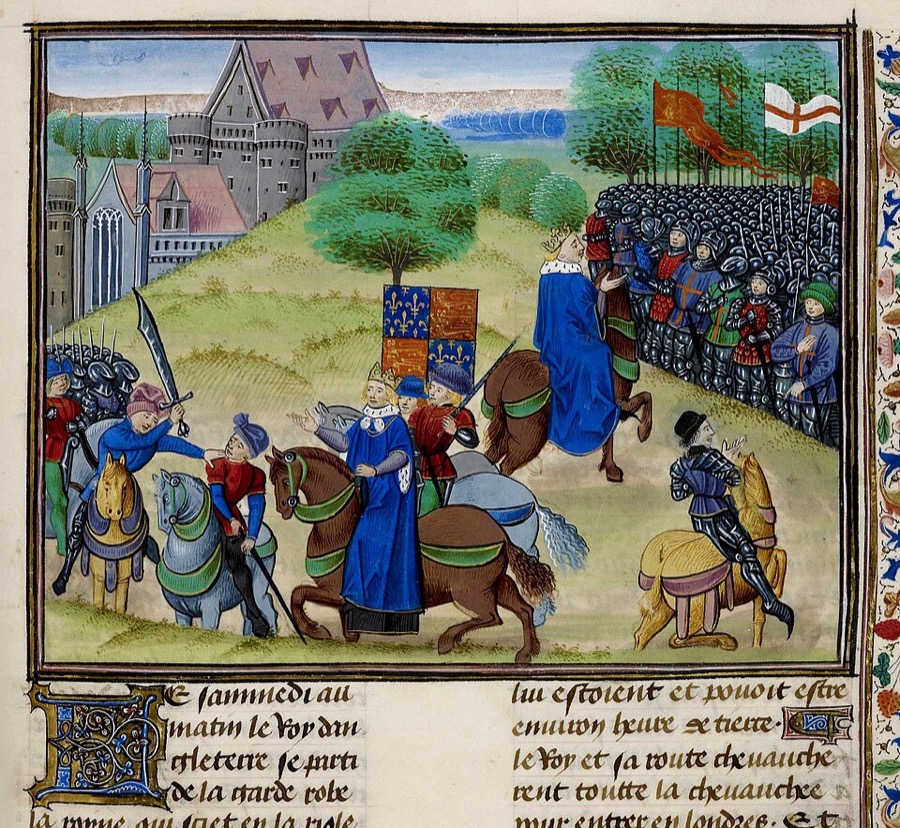
Thomas Becket
Wat Tyler
Jan Hus
Richard II
Tyler was struck down by the Lord Mayor of London, William Walworth, in front of the young Richard II. Becket was killed in 1170 and Hus was burned in 1415. Richard II was deposed later, in 1399.
