Quiz · Hard
APUSH-style questions that ask you to compare, connect, and explain turning points from the Progressive Era through the end of the Cold War.
Which statement best compares the New Deal's First and Second phases?
Both ended in 1933
The First added the Wagner Act; the Second created the AAA
The First focused on relief and recovery; the Second added Social Security, the Wagner Act, and the WPA
The Second repealed the First
The Second New Deal (1935) emphasized reform and security.
Which pair is correctly matched?
Ida Tarbell -- Standard Oil
Lincoln Steffens -- tenements
Upton Sinclair -- railroads
Jacob Riis -- politics
Tarbell exposed Standard Oil; Steffens wrote about city corruption; Sinclair's The Jungle was about meatpacking; Riis photographed tenements.
A historian arguing that 1920s America was a period of both change and conflict would most likely cite which pair?
The Bonus Army and the CCC
The Sherman Act and the Square Deal
The Hepburn Act and the Pure Food Act
Consumer culture and the Scopes Trial
Mass consumer culture and modernism contrasted with fundamentalist backlash such as the Scopes Trial.
Which was a major long-term effect of the GI Bill and postwar suburbanization?
Elimination of racial inequality
Expansion of the white middle class while redlining limited Black homeownership
A decline in college enrollment
Reduced demand for housing
Federal housing policies and local discrimination meant benefits were unevenly shared.
Which statement about the Cuban Missile Crisis is accurate?
Kennedy ordered an invasion of Cuba
It led to a hotline and the 1963 Limited Test Ban Treaty
The US lost the war
Khrushchev kept the missiles
Both sides saw how close they came to war; a hotline and the Limited Test Ban Treaty followed.
How did Brown v. Board of Education relate to Plessy v. Ferguson?
They were decided in the same year
Brown affirmed Plessy
Plessy overturned Brown
Brown overturned the "separate but equal" doctrine in public education
Plessy (1896) allowed segregation; Brown (1954) rejected it for schools.
Which was the central goal of the civil rights movement's nonviolent direct-action strategy in Birmingham (1963)?
Expose segregation to national television audiences to build support for federal legislation
Win a Supreme Court case
Create a new political party
Organize a boycott of all Northern businesses
Images of police violence against children shifted opinion and helped pass the 1964 Civil Rights Act.
The Pentagon Papers (1971) mattered because they
Ended the draft
Proved Nixon ordered Watergate
Showed that officials had misled the public about Vietnam and tested press freedom
Revealed the Gulf of Tonkin Resolution did not exist
The New York Times v. United States decision protected publication. The Tonkin Resolution did exist (1964).
Which pair of events best illustrates the limits of presidential power after Vietnam and Watergate?
The Square Deal and Hepburn Act
The Marshall Plan and NATO
War Powers Resolution and Nixon's resignation
The Emergency Banking Act and the CCC
Congress reasserted authority through the War Powers Resolution, and Nixon resigned under threat of impeachment in August 1974.
Which of the following is the most accurate cause-and-effect pairing about the end of the Cold War?
Gorbachev's reforms and Eastern European revolutions led to the collapse of Soviet control
Reagan's SDI immediately destroyed the USSR
The Vietnam War ended the Cold War
NATO dissolved in 1989
Historians debate Reagan's role, but the internal reforms and revolutions of 1989 were central.
Which of these is an example of the Supreme Court limiting government action in wartime?
Plessy v. Ferguson
Schenck v. United States
Korematsu v. United States
New York Times v. United States (1971)
The Pentagon Papers case limited prior restraint. Schenck and Korematsu upheld government restrictions.
The Great Migration contributed most directly to
The end of segregation in the South by 1920
Growth of Black communities and political power in Northern and Western cities
Decreased Black voting
Reduced industrial employment
Migration created large Black urban communities, the Harlem Renaissance, and later political influence, though discrimination continued.
What was a major consequence of Executive Order 8802?
It desegregated the armed forces
It opened defense jobs to Black workers and created the Fair Employment Practices Committee
It interned Japanese Americans
It created the GI Bill
Truman desegregated the military in 1948. EO 9066 was the internment order.
Which statement best explains why Nixon's trip to China (1972) was surprising?
The US had recognized China in 1949
He was a liberal Democrat
China had joined NATO
Nixon had built his career as an anti-communist
Nixon's long anti-communist record made the opening to China more credible and politically possible.
Which pair best shows increasing federal involvement in the economy from 1900 to 1940?
Hepburn Act (1906) and Social Security Act (1935)
Sherman Act (1890) and Dawes Act (1887)
Pendleton Act and Compromise of 1850
Homestead Act and Morrill Act
Regulation of railroads and later the creation of a safety net show growing federal roles.
In the 1980s, supply-side economics (Reaganomics) predicted that
Government spending would reduce inflation
Higher taxes would increase investment
Tax cuts would spur growth that would offset lost revenue
A larger Fed would reduce unemployment
Supply-side theory said lower taxes would increase investment and growth. Deficits actually grew.
A student analyzing this political cartoon about delegates at the Bull Moose Convention would connect it most directly to
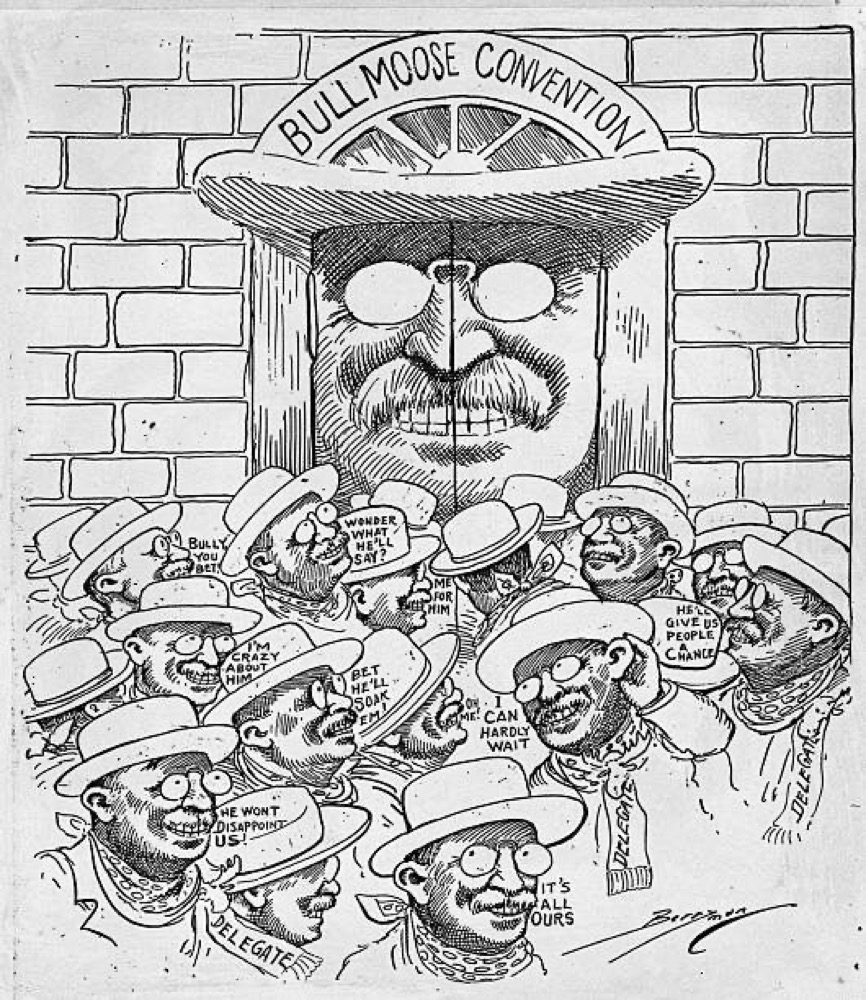
The Populist movement
The Compromise of 1850
The 1912 split in the Republican Party
The Nixon-Kennedy debate
The Bull Moose Party was Theodore Roosevelt's 1912 Progressive Party, formed after he lost the Republican nomination to Taft. Image: cartoon signed Berryman, public domain, via Wikimedia Commons.
