Quiz · Medium
Foundational questions on communication models, media effects theories, nonverbal communication and logical fallacies.
Hearing and listening are the same process.
True
False
Hearing is automatic and physical; listening is a deliberate process of attending to and interpreting messages.
According to Watzlawick, silence cannot communicate anything.
True
False
His first axiom is that one cannot not communicate; silence conveys meaning in context.
Which model includes 'noise' and was designed originally to describe telephone signal transmission?
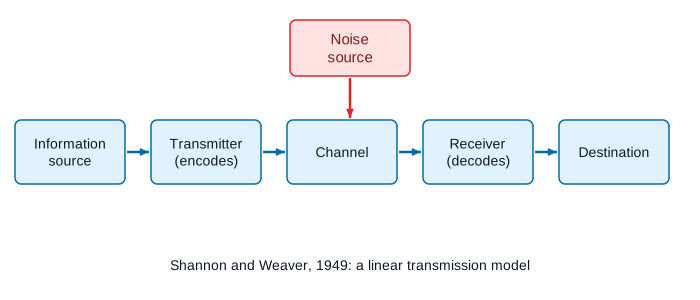
Transactional model
Shannon-Weaver model
Two-step flow model
Cultivation theory
Shannon and Weaver (1949) described a linear transmission process with a noise source. The transactional model is about simultaneous mutual influence.
What is the main difference between linear and transactional models of communication?
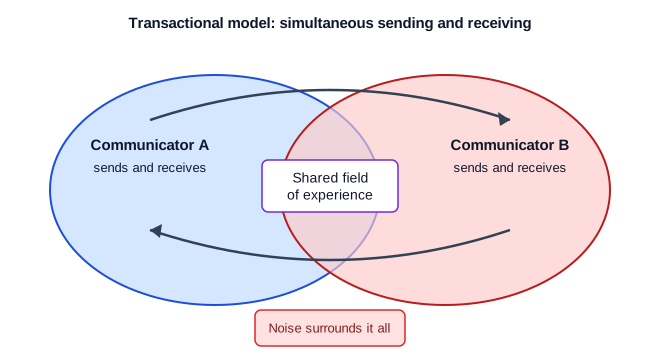
Transactional models show both people sending and receiving simultaneously and creating meaning together
Transactional models ignore feedback
Linear models include noise but transactional models do not
Linear models are for mass communication only
Linear models treat communication as one-way; transactional models stress simultaneity and shared fields of experience.
Lasswell's formula asks 'Who says what in which channel to whom with what ...?'
Noise
Feedback
Meaning
Effect
Lasswell (1948) ended with 'effect', pointing to media effects research.
Which theory claims that heavy television viewers come to see the world as more dangerous than it is?
Spiral of silence
Uses and gratifications
Cultivation theory
Agenda-setting
Gerbner's 'mean world syndrome' is a cultivation effect. Spiral of silence concerns minority opinions and agenda-setting concerns issue salience.
A person who believes their opinion is unpopular stays quiet in a group. Which theory explains this?
Cognitive dissonance
Hypodermic needle
Framing
Spiral of silence
Noelle-Neumann argued fear of isolation silences perceived minorities. Cognitive dissonance concerns conflict between beliefs and actions.
Which model suggests that opinion leaders interpret media messages for others?
Hypodermic needle
Two-step flow
Shannon-Weaver
Cultivation
Lazarsfeld and Katz found personal influence mattered; the hypodermic needle model assumed direct effects on passive audiences.
Uses and gratifications theory focuses on:
What people do with media to satisfy their needs
What media do to people
How governments regulate media
Which media are most profitable
It treats audiences as active; the older effects models treated them as passive.
Aristotle's 'ethos' refers to:
Emotional appeal
Logic and evidence
The speaker's credibility and character
The timing of the message
Pathos is emotion, logos is logic, kairos is timing.
A politician says 'My opponent hates freedom, so ignore his tax plan.' This is an example of:
Slippery slope
Ad hominem
Red herring
Appeal to authority
It attacks the opponent's character rather than the plan. A red herring would introduce an unrelated issue.
Which fallacy presents only two options when others exist?
Straw man
False dilemma
Hasty generalization
Circular reasoning
'Either we ban it or the country collapses' is a false dilemma.
Which of the following is an example of paralanguage?
A thumbs-up gesture
A sarcastic tone of voice
Standing very close
Wearing a uniform
Paralanguage covers vocal qualities. A thumbs-up is an emblem, closeness is proxemics and uniform is appearance.
According to Hall, personal distance (for conversations between friends) is roughly:
0 to 18 inches
4 to 12 feet
1.5 to 4 feet
More than 12 feet
Intimate is up to about 18 inches, social 4-12 feet and public over 12 feet.
In a high-context culture, meaning is mostly conveyed by:
Explicit words only
Context, relationships and implied cues
Written contracts
Loud volume
Low-context cultures rely on explicit verbal messages.
Which element of the Johari window contains information known to others but not to oneself?
Blind area
Open area
Hidden area
Unknown area
Open: known to both. Hidden: known to self only. Unknown: known to neither.
Which conflict mode shows high concern for both one's own and others' needs?
Avoiding
Collaborating
Competing
Accommodating
Collaborating seeks a win-win; competing prioritizes oneself; accommodating prioritizes the other; avoiding neither.
In the elaboration likelihood model, a person who thinks carefully about the evidence is using the:
Central route
Peripheral route
Heuristic route
Noise route
Peripheral route relies on cues like attractiveness or celebrity endorsement.
McLuhan's 'the medium is the message' means:
Content is the only thing that matters
Messages must be short
Mass media cannot carry messages
The form of a medium shapes society as much as the content it carries
McLuhan argued that technologies such as print or television alter perception and social organization.
Which of these is NOT a stage in Tuckman's original four stages?
Adjourning
Forming
Storming
Performing
Adjourning was added in 1977. The original four were forming, storming, norming and performing.
