Quiz · Hard
Exam-style scenarios applying theories of learning, motivation and measurement, including z-scores, reliability vs validity and cognitive load.
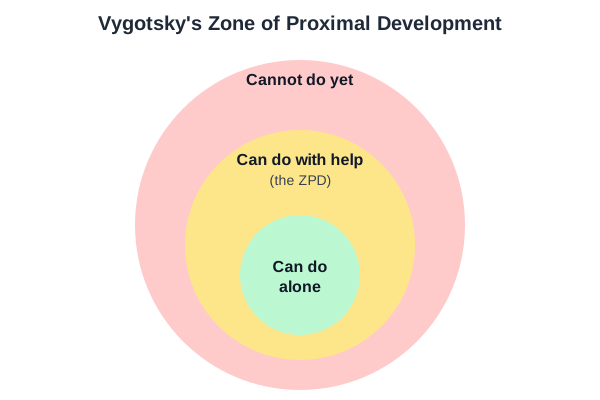
A teacher hands students sentence frames at first, then removes them as skill grows. Which theory best explains why this works?
Skinner's operant conditioning
Vygotsky's zone of proximal development
Piaget's equilibration
Maslow's hierarchy
Scaffolds support performance within the ZPD and are faded as competence increases.
A student studies the same notes for three hours the night before. Which principle predicts a poor result for long-term retention?
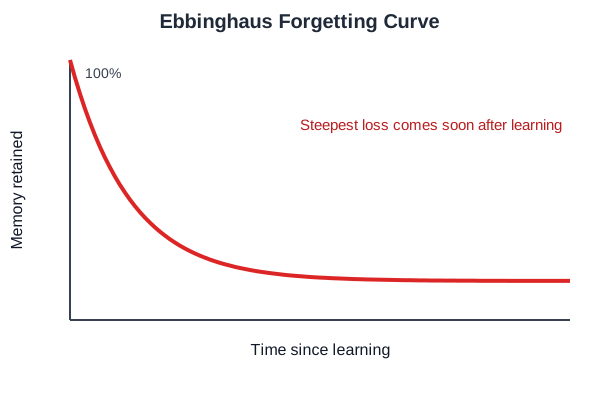
The spacing effect: massed practice leads to faster forgetting
Levels of processing: it is deep
Retrieval: she recalled everything
Chunking: she grouped the content
Cramming produces quick forgetting; spreading practice over days gives better retention. Ebbinghaus's curve shows rapid loss without review.
A fourth-grader is promised a treat for every book read. Months later she reads less when the treat stops. Which is the best explanation?
Extinction of a classical association
Negative punishment
Fixed ratio reinforcement
Overjustification: the reward replaced her intrinsic reason for reading
The extrinsic reward undermined intrinsic interest. It is not classical conditioning.
A child is yelled at for failing a quiz and later feels sick whenever he sees any quiz paper. Which concept explains seeing any paper, not just that one?
Spontaneous recovery
Discrimination
Stimulus generalization
Shaping
The conditioned fear spread from the original quiz to similar stimuli.
A teacher wants to teach a student to fully take part in a group discussion starting with one-word contributions and gradually longer ones. Which technique?
Negative reinforcement
Shaping through successive approximations
Modeling only
Extinction
Shaping reinforces steps that move closer to the target.
A student who scores 85 on a test with mean 70 and SD 10 has a z-score of:
+1.5
+15
+0.15
+1.0
z = (85 - 70)/10 = 1.5.
A test has a mean of 50 and SD of 10 (T-score). About what percentage of students score between 40 and 60?
About 50 percent
About 95 percent
About 34 percent
About 68 percent
40 to 60 is mean plus or minus 1 SD, covering about 68 percent. 34 percent is one side only.
A school sees large mean differences between two sections on a test, but the test has a very low reliability coefficient. What is the best conclusion?
The sections certainly differ
The test is valid
The scores may reflect measurement error and should be interpreted cautiously
The standard error of measurement is small
Low reliability means large SEM, so observed differences may be noise.
Which statement accurately describes the relationship between reliability and validity?
A reliable test must be valid
A valid test must be reliable, but a reliable test is not necessarily valid
Validity is a type of reliability
They are unrelated
Inconsistent scores cannot be accurate measures, but consistent scores can be consistently wrong.
A student believes, 'I can improve my writing if I try new strategies.' Which framework does this match?
Growth mindset and self-efficacy for a specific task
Learned helplessness
Fixed mindset
Performance-avoid goals
Believing ability can develop through strategy use is the growth mindset.
Which classroom practice best uses research on working memory limits?
Giving a long list of rules on the first day
Providing text-heavy slides read aloud word for word
Presenting all content before any practice
Introducing a few new items at a time and using worked examples with visuals plus narration
Chunking and reducing extraneous load protect limited working memory. Redundant text and narration add load.
A middle school teacher assumes a new student will do poorly and unconsciously gives less feedback. The student does worse. This illustrates:
The overjustification effect
Observational learning
The self-fulfilling prophecy (Pygmalion/Rosenthal effect in reverse: the Golem effect)
Stimulus discrimination
Low expectations can reduce opportunities and feedback, producing the predicted outcome (the Golem effect).
Which pair is correctly matched?
Gardner: g factor; Spearman: eight intelligences
Cattell: fluid and crystallized intelligence; Sternberg: analytical, creative, practical
Cattell: triarchic theory; Sternberg: crystallized
Flynn: multiple intelligences; Gardner: Flynn effect
Spearman proposed g; Gardner proposed multiple intelligences; Flynn described rising IQ scores.
A teacher finds a student works best when tasks are slightly above current skill, with clear goals and immediate feedback, and loses track of time. Which concept applies?
Flow
Learned helplessness
Overlearning
Stereotype threat
Flow occurs when challenge and skill are in balance.
A student who answered a question correctly in class cannot answer it on a test in a different room. Which principle is most likely involved?
Proactive facilitation
Automaticity
Elaborative rehearsal
Encoding specificity (context-dependent memory)
Retrieval is better when the retrieval context matches the encoding context; varied practice contexts improve transfer.
Which is the best description of the Yerkes-Dodson law for a difficult task?
Performance increases as arousal rises
Arousal has no effect
Performance is best at low to moderate arousal
Performance is best at the highest arousal
The relationship is an inverted U, with the optimum arousal lower for complex tasks.
