Quiz · Hard
Harder, exam-style questions on the Investiture settlement, papal crisis, Hundred Years' War, Black Death and medieval learning.
The Concordat of Worms (1122) is best described as:
A compromise in which the Church chose bishops and the emperor kept the right to grant them secular authority.
A complete victory for the pope, who gained all power over bishops.
A victory for the emperor, who kept the right to appoint bishops.
A treaty dividing the empire between the pope and the emperor.
Bishops received ring and staff from the Church, and the scepter (secular rights) from the emperor. Neither side won entirely, though the emperor's control over Italy weakened.
Which development best explains the growth of European population and towns between c. 1000 and 1300?
Large-scale immigration from the Byzantine Empire.
The end of all warfare in Europe.
The introduction of the potato from the Americas.
Improved farming (heavy plow, three-field rotation) and a warmer climate raised food output.
Better yields supported more people and trade. Potatoes came after 1492. Warfare continued, and there was no large migration from Byzantium.
Why did Boniface VIII's Unam Sanctam (1302) fail to establish papal supremacy over kings?
The Holy Roman Emperor won a war against the papal army.
The Council of Constance deposed him.
Philip IV of France was backed by his own clergy and people, and his agents attacked the pope at Anagni.
The College of Cardinals refused to publish it.
Boniface had issued Unam Sanctam after Philip taxed the clergy. The Anagni attack (1303) and the move to Avignon showed that national monarchies had become stronger than the papacy.
Which statement about the Avignon Papacy (1309-1377) is correct?
The popes were French and seen as under French royal influence.
The popes lived in Avignon to escape the Black Death only.
It began after the Council of Constance.
It ended when the Ottomans conquered Avignon.
Seven successive popes were French. Gregory XI returned to Rome in 1377, and the Western Schism followed after his death. Avignon was not in Ottoman reach.
On this 1429 map, the purple lands (Burgundy, Flanders and Picardy) were ruled by a duke who was then allied with which side?
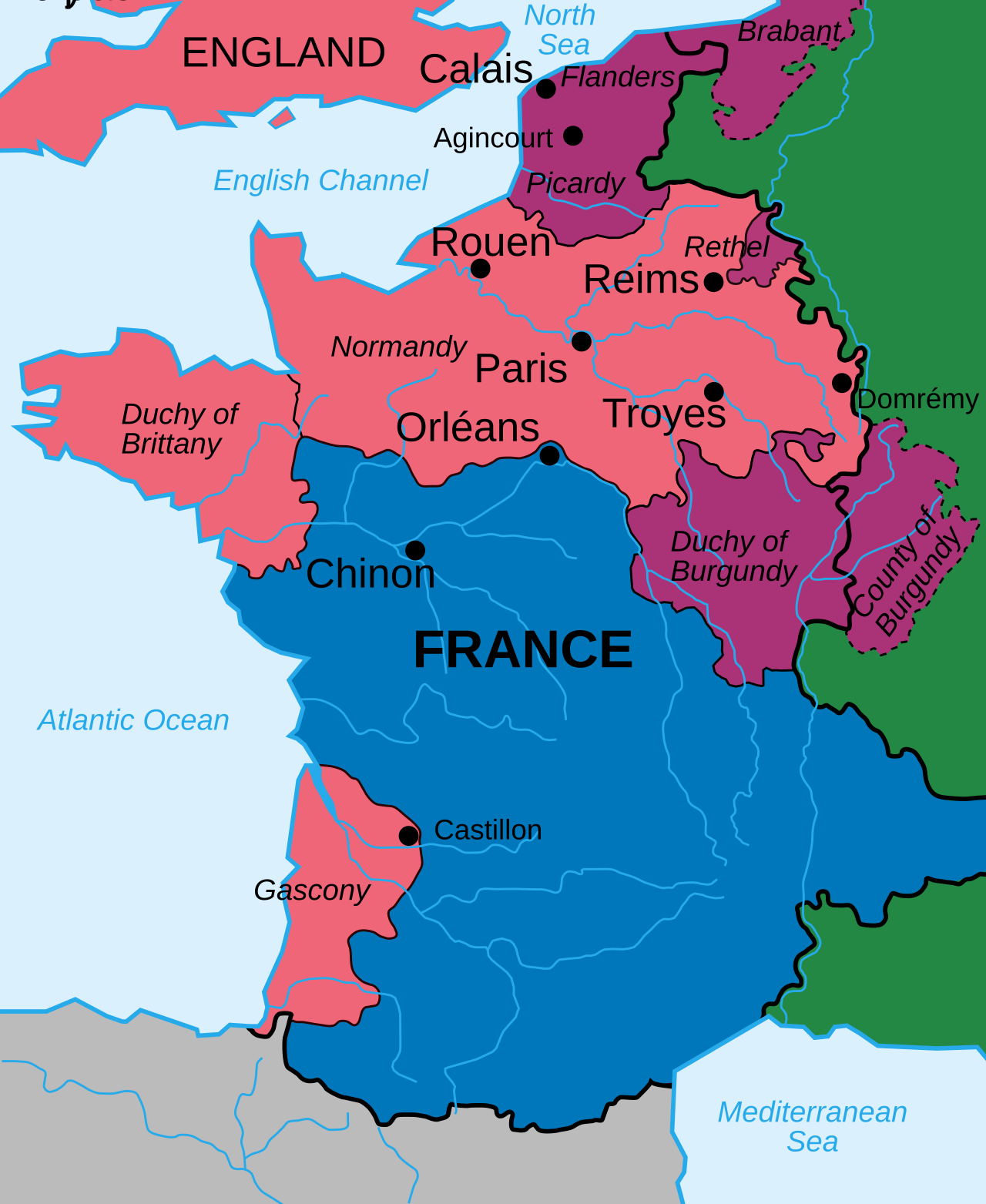
The French crown of Charles VII
The Holy Roman emperor against both kings
The pope, as a crusader state
England
The Duke Philip the Good of Burgundy backed England after the murder of his father by Armagnac partisans in 1419 and the Treaty of Troyes (1420). Burgundy later switched sides at the Treaty of Arras (1435). Image: Wtfiv, CC BY 4.0, via Wikimedia Commons.
What did the Treaty of Troyes (1420) provide?
Edward III would give up his claim to France.
Henry V of England would marry Catherine of Valois and become heir to Charles VI of France, disinheriting the Dauphin.
France would be divided between Burgundy and England as equals.
Joan of Arc would command the French army.
The treaty was a high point of English fortunes, but Henry died in 1422 (two months before Charles VI), and Charles VII's supporters never accepted it.
Which description of Gregory VII's Dictatus Papae (1075) is most accurate?
A treaty with Henry IV granting him lay investiture.
A list of claims including that the pope alone could depose emperors and that he should be judged by no one.
A decree launching the First Crusade.
A statement ending the Filioque dispute.
It was a list of assertions of papal supremacy, which Henry IV rejected. The crusade came under Urban II, 20 years later.
Which of these was a consequence of the Crusades for Italian trade cities?
Italian cities were blocked from Eastern markets for centuries.
The Hanseatic League replaced them in Mediterranean trade.
They were conquered by crusader kings.
Venice and Genoa gained commercial privileges and trading posts in the eastern Mediterranean.
Crusaders needed ships and supplies, and Italian cities obtained quarters in crusader ports and later in Byzantine lands (especially after 1204).
How did the Black Death most directly affect English landlords and peasants?
A labor shortage let peasants demand higher wages, and landlords responded with laws to freeze wages (the Statute of Labourers).
Landlords gained more workers and lowered wages.
The Church took over all land.
The king abolished all manorial duties immediately.
Resistance to these laws, plus the poll taxes, helped cause the 1381 Peasants' Revolt, although serfdom declined only slowly afterward.
Which statement about the Albigensian Crusade is correct?
It was aimed at Muslims in Spain.
It was called by Gregory VII to end the Investiture Controversy.
It was a crusade against fellow Christians (Cathars) in southern France, and it increased French royal control of the south.
It was led by the Teutonic Knights in Prussia.
Innocent III called it in 1209. The northern French nobility and, later, Louis VIII and Louis IX gained Languedoc. The Spanish Reconquista and the Northern Crusades were separate.
Which description of Scholasticism is most accurate?
Rejecting reason to rely on faith alone
Copying manuscripts in monasteries
Using logical argument, especially from Aristotle, to reconcile faith and reason in universities
A system of landholding by knights
Scholastics such as Abelard and Aquinas used dialectic. Fideism (faith alone) and monastic copying were not what scholasticism meant, and landholding was feudalism.
Which of these was NOT an outcome of the Council of Constance (1414-1418)?
The end of the Western Schism
The condemnation of Martin Luther
The condemnation and burning of Jan Hus
The election of Martin V
Constance ended the schism by electing Martin V in 1417 and burned Hus in 1415. Luther was condemned in 1520-21, a century later, by Pope Leo X and the Diet of Worms.
What was a key weakness of the late medieval Church that fed calls for reform before Luther?
Papal power fell during the Avignon Papacy and the Western Schism, and wealth and abuses such as simony drew criticism.
The Church was banned from owning land.
Most priests were illiterate peasants who were barred from preaching.
The Church stopped holding councils after 1215.
Wycliffe, Hus and conciliarism challenged papal authority a century before 1517. Councils continued, as Constance and Basel show.
Which pair is correctly matched?
Magna Carta: Henry II
Constitutions of Clarendon: King John
Model Parliament: Henry III
Domesday Book: William the Conqueror
Domesday was William's survey of 1085-86. Magna Carta was sealed by John (1215), the Constitutions of Clarendon by Henry II (1164), and the Model Parliament by Edward I (1295).
Which statement about medieval universities is accurate?
They were founded by the Byzantine emperors.
They admitted only nobles.
They arose from guilds of masters or students, and Bologna was famous for law and Paris for theology.
They taught only Latin grammar.
Their corporate status gave them privileges. Courses were organized into faculties of arts, law, medicine and theology.
True or false: Christians held Jerusalem continuously from the First Crusade in 1099 until the fall of Acre in 1291.
True
False
Saladin took Jerusalem in 1187. Frederick II regained it by treaty in 1229 and it was lost for good in 1244. Acre, the last major crusader stronghold, fell in 1291.
