Quiz · Medium
Test whether you can apply utilitarian, Kantian and virtue theories to cases and distinguish the main metaethical positions.
In the footbridge case, pushing the large man is widely judged wrong even though it saves five. Which principle best captures a Kantian explanation?
It produces less total happiness than the switch case
It is forbidden by the doctrine of double effect only because the man is large
It treats the man merely as a means to an end
It fails the felicific calculus because of its duration
Kant's Formula of Humanity forbids treating a person merely as a means. A utilitarian would not find it worse than the switch case, since outcomes are identical, so the happiness explanation is wrong.
Which statement correctly describes Hume's is-ought problem?
Moral conclusions cannot be validly derived from purely factual premises
Moral claims are never true because nobody feels obliged
What is natural is always good
Only what is the case can be morally relevant
The gap is logical: a valid argument cannot contain a conclusion with 'ought' unless an 'ought' is in the premises. It does not say moral claims are false.
Emotivism holds that 'Stealing is wrong' primarily...
states that stealing causes harm
reports the speaker's belief about divine law
is a true description of a moral fact
expresses disapproval and tries to influence others
For Ayer and Stevenson moral language is expressive, not descriptive. A report of the speaker's feelings would be subjectivism, a different view.
J. L. Mackie's error theory claims that...
moral judgments are true relative to a culture
moral judgments claim objective truth, but no objective values exist
people make mistakes applying correct moral rules
morality is a social convention that sometimes errs
Error theory is anti-realist but cognitivist: it takes moral claims at face value and says they are systematically false.
Which is an example of an imperfect duty in Kant's ethics?
Not making a false promise
Helping others in need
Not committing suicide
Not breaking a contract
Imperfect duties set an end (beneficence, self-development) with latitude. Perfect duties such as not lying admit no exceptions.
A rule utilitarian would most likely resist the surgeon who kills one patient to save five because...
the patient has a right that overrides utility
the act treats the patient as a means
killing is forbidden by divine command
a general rule allowing it would produce worse results overall by destroying trust in medicine
Rule utilitarians evaluate rules by their general consequences. The other options are deontological or theological reasons.
Aristotle's 'mean' in virtue theory is best understood as...
the appropriate response, relative to the situation and agent, between excess and deficiency
the arithmetic average of two vices
what most people do in a society
a compromise between self-interest and duty
It is not a fixed midpoint; finding it takes practical wisdom (phronesis). Courage, for example, depends on what is at stake.
Which of these is the standard objection to divine command theory raised by the Euthyphro dilemma?
God cannot know what is good
Commands have no truth value
If goodness is whatever God commands, morality seems arbitrary
Religion and ethics have no connection
If an act is good merely because commanded, God could command cruelty. If God commands it because it is good, goodness exists independently of God.
Nozick's experience machine is used as an objection to which view?
Kantian deontology
Virtue ethics
Divine command theory
Hedonism: that only pleasant experiences matter
Most would refuse to plug in even if guaranteed pleasure, suggesting we also value reality and doing things. It leaves virtue and Kantian views untouched.
Which is NOT one of Beauchamp and Childress's four principles of biomedical ethics?
Fidelity
Autonomy
Non-maleficence
Justice
The four are autonomy, beneficence, non-maleficence and justice. Fidelity is one of Ross's prima facie duties, not part of the four-principle approach.
Peter Singer's drowning child argument is mainly meant to show that...
we have no duty to help strangers
charity is always supererogatory
distance is not morally relevant to our duty to help
animals have rights
If we must save a child in front of us at small cost, we must also help distant strangers at similar cost, since geography does not change need. Singer says charity is a duty, not supererogatory.
Which pair correctly matches an ethical view with its core idea?
Moral intuitionism: moral facts are discovered by empirical science
Prescriptivism: moral judgments are universalizable commands
Error theory: moral statements express attitudes
Cultural relativism: moral truths are objective and universal
Prescriptivism is Hare's view. Intuitionists say basic truths are known directly. Error theory says moral claims are false. Relativism denies universal truth.
Psychological egoism is a normative claim about what people ought to do.
True
False
It is descriptive: it says people always do act from self-interest. Ethical egoism is the normative version.
The doctrine of double effect would permit which action?
Giving pain relief that foreseeably, but not intentionally, hastens a dying patient's death
Killing one patient to take organs for five
Torturing a suspect for information
Lying to avoid a small embarrassment
The doctrine requires the harm to be a side effect rather than a means or an intended end. The other cases use harm as a means or have no good proportionate to the harm.
Which thinker developed the ethics of care in 'In a Different Voice'?
Nel Noddings
Philippa Foot
Carol Gilligan
Elizabeth Anscombe
Gilligan (1982) responded to Kohlberg's justice-oriented stages of moral development. Noddings's Caring (1984) is a related but separate work.
In the 'murderer at the door' case, Kant held that...
lying is permitted if the consequences are good
one must not lie, even to a murderer asking where a friend hides
one may lie only to save a life
truth-telling is an imperfect duty
Kant treated the prohibition on lying as a perfect duty that exception-making would destroy. Many see it as an embarrassment for strict deontology.
Which view would hold that an animal's capacity to suffer gives it moral standing?
Kant's view of rational agency as the ground of dignity
Divine command theory
Contractualism that requires agents who can agree to principles
Utilitarianism in the tradition of Bentham and Singer
Sentience-based views extend consideration to animals. Kant ties dignity to rationality; contractualism ties wrongdoing to principles agents could accept, which makes animals harder to include.
Williams' 'Jim and the Indians' case is used to argue that utilitarianism...
ignores the future
permits too many rights
undermines personal integrity by demanding we set aside our deepest commitments
cannot compare pleasures
Williams (1973) claims utilitarianism treats agents as mere channels for producing good outcomes.
W. D. Ross's prima facie duties differ from Kant's duties because...
they can be overridden in a particular situation by a weightier duty
they are all derived from one supreme principle
they apply only to rulers
they are purely consequentialist
Ross is a pluralist with no fixed ranking; judgment decides. Kant derives duties from the categorical imperative, treating perfect duties as exceptionless.
Which pair is correctly matched?
Naess: act utilitarianism
Rachels: care ethics
Scanlon: ethical egoism
Leopold: land ethic
Aldo Leopold's land ethic (1949) is ecocentric; Naess founded deep ecology; Rachels argued that active and passive euthanasia are morally alike; Scanlon defended contractualism.
Which of these images shows the classic collection of trolley problem variants?
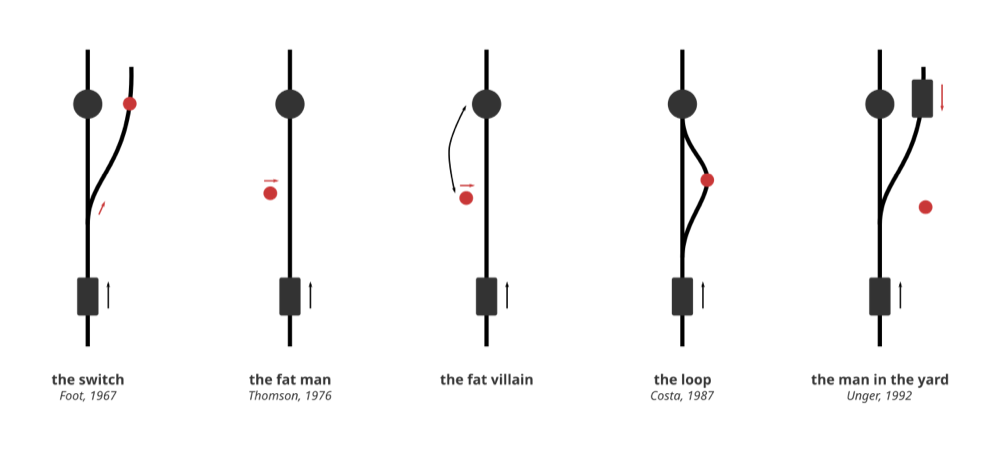
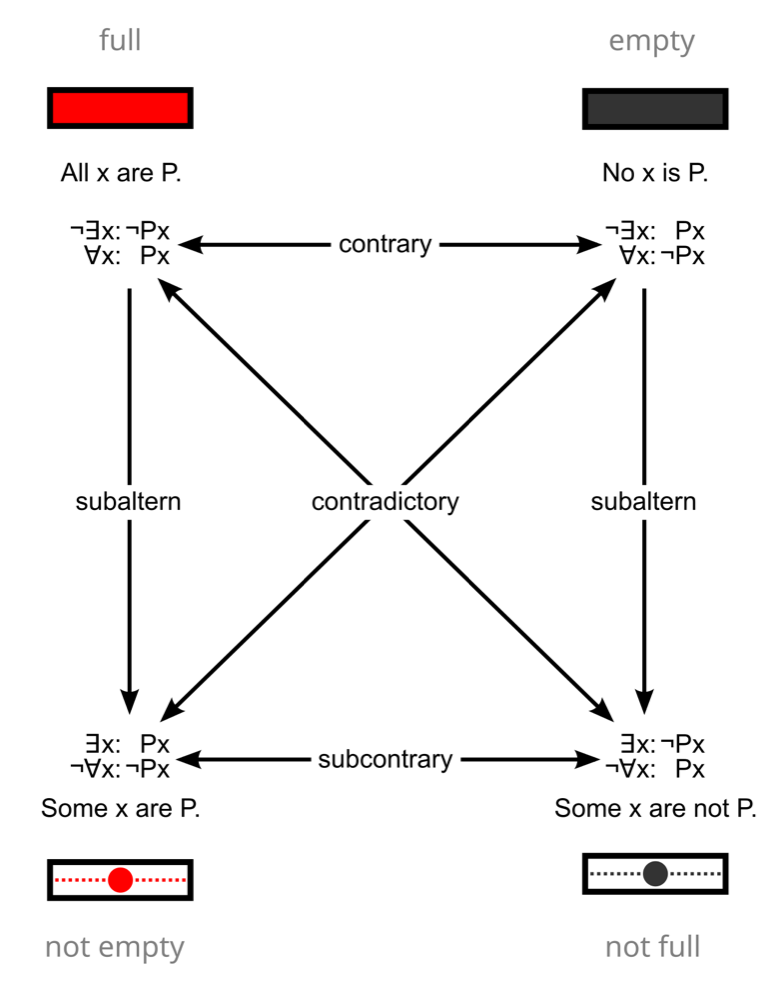
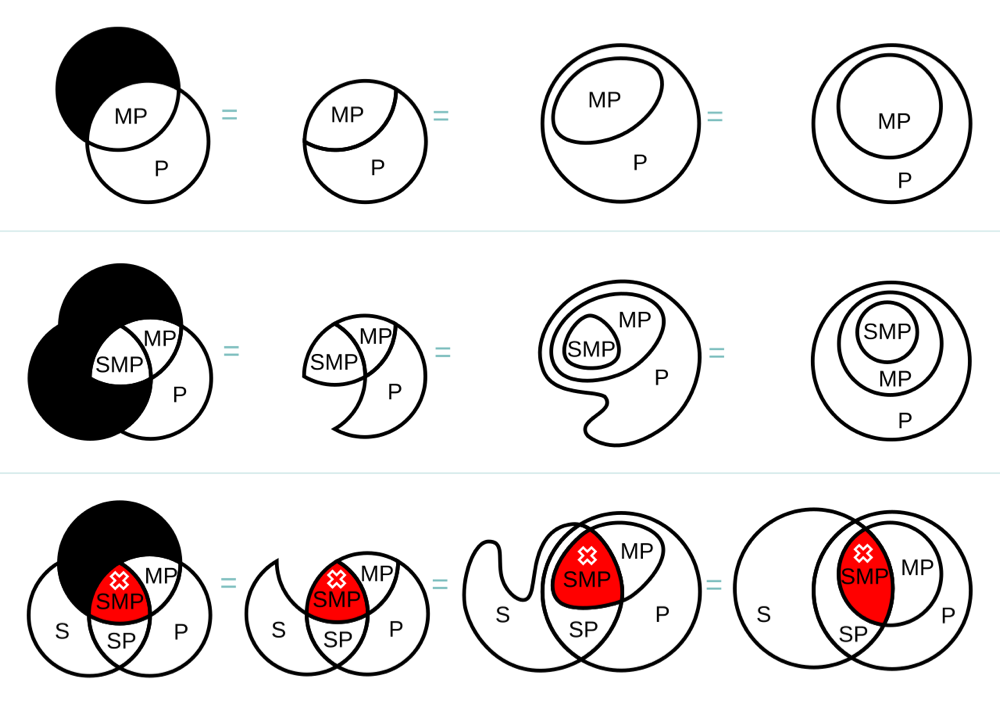
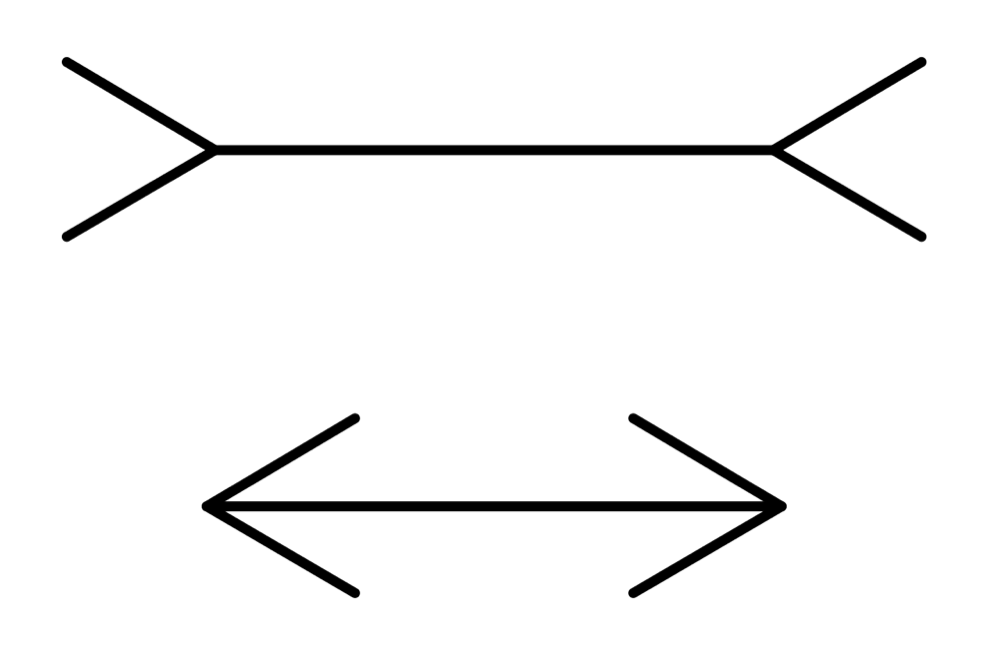
The correct image shows tracks, a trolley and labels such as the switch, the fat man and the loop. The distractors are a square of opposition, syllogism diagrams and the Müller-Lyer illusion.
This figure shows several named variants of one famous thought experiment. What does it illustrate?
The trolley problem
Newcomb's paradox
The prisoner's dilemma
The Gettier problem
The labels (the switch, the fat man, the loop) are all variants of the trolley problem introduced by Philippa Foot and developed by Judith Jarvis Thomson, Michael Costa and Peter Unger. Image: Jonas Kubilius, CC0, via Wikimedia Commons.
