Quiz · Medium
Test your understanding of the causes of the Reformation, the main reformers, the English break with Rome and the Catholic response.
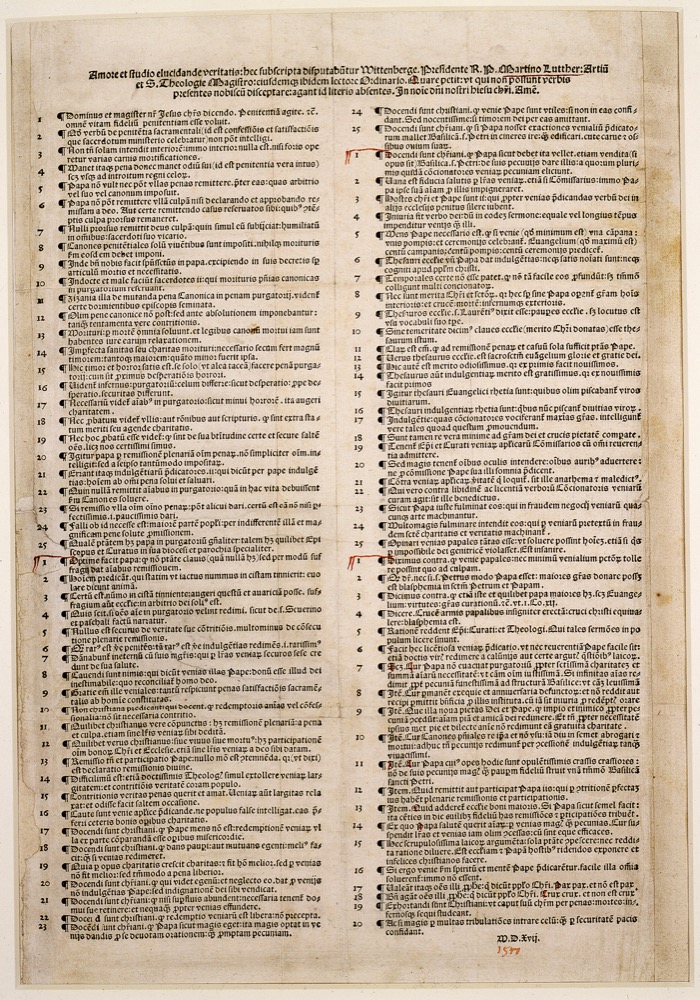
What was the immediate spark for Luther's Ninety-Five Theses in 1517?
Henry VIII's request to annul his marriage
The calling of the Council of Trent
The sale of indulgences by Johann Tetzel to help fund St. Peter's and repay Albert of Mainz's debts
The Edict of Worms
Luther's theses attacked the idea that indulgences could remit punishment for sin. The Council of Trent and the Edict of Worms came later, and Henry VIII's divorce dispute began in the late 1520s.
Which idea is at the center of Luther's theology?
Justification by faith alone
Predestination of the elect
Papal infallibility
Adult baptism only
Luther taught that salvation comes through faith in Christ by grace, not through works. Predestination is the emphasis most associated with Calvin, and adult baptism with Anabaptists.
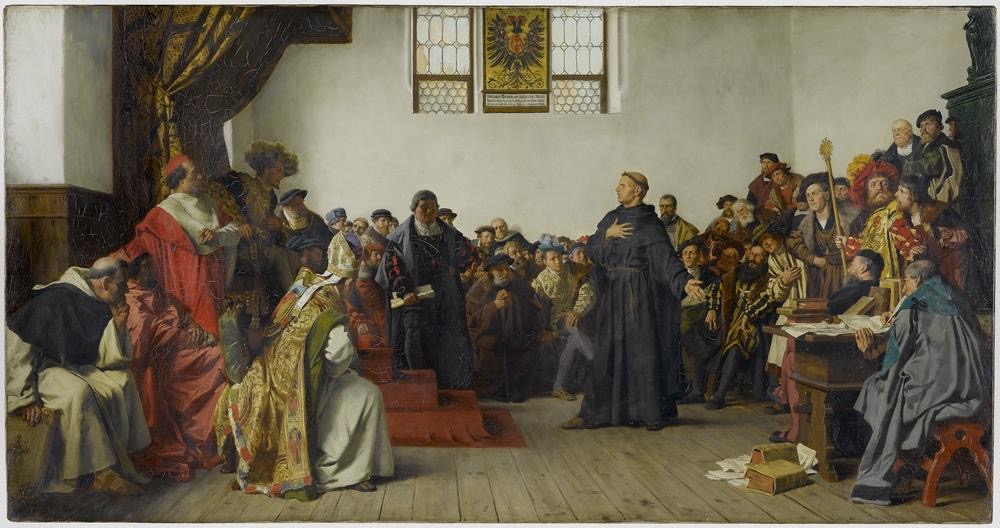
What did Luther do at the Diet of Worms (1521)?
He agreed to withdraw his criticism of indulgences.
He asked Charles V to join his movement.
He fled before the meeting began.
He refused to recant his writings unless proved wrong from Scripture or reason.
Charles V responded with the Edict of Worms, outlawing him. Frederick the Wise then hid him at the Wartburg.
How did the printing press help Luther's cause?
It was invented by Luther's followers to print the Bible.
It let his pamphlets and German Bible circulate widely and cheaply, beyond the control of church authorities.
It was banned in Protestant lands.
It had little effect because few people could read.
Gutenberg's press dates from about 1450, decades before Luther. Pamphlets and woodcuts reached literate and illiterate audiences alike (the latter through images and reading aloud).
What did the Peace of Augsburg (1555) allow?
Free choice of religion for every individual
Each prince of the Holy Roman Empire could choose Lutheranism or Catholicism for his territory.
Calvinism to be legal in the Empire
Protestants to return church lands to Catholics
The principle was 'cuius regio, eius religio'. Individuals could emigrate, but Calvinism was not recognized until Westphalia (1648).
Which statement best describes Zwingli's view of the Eucharist?
The bread and wine become Christ's body and blood.
Christ is present 'in, with and under' the bread and wine.
The Eucharist should be abolished.
The bread and wine are symbols that commemorate Christ's sacrifice.
This differed from Catholic transubstantiation and Luther's real presence, and led to the failure of the 1529 Marburg Colloquy.
What was John Calvin's main work?
Institutes of the Christian Religion
Ninety-Five Theses
Utopia
The Praise of Folly
Calvin's Institutes (1536, expanded to 1559) systematized Reformed theology. Utopia was by More, and The Praise of Folly by Erasmus.
Why were Anabaptists persecuted by both Catholics and mainline Protestants?
They supported the pope against princes.
They denied that Jesus existed.
They rejected infant baptism and the union of church and state, which threatened social and political order.
They were led by Calvin.
Their idea of a voluntary church of believers and the Münster episode (1534-35) alarmed authorities, though most Anabaptists, such as Mennonites, were peaceful.
What was the main reason for Henry VIII's break with Rome?
Henry converted to Lutheranism.
The pope tried to impose new taxes on England.
The pope would not annul his marriage to Catherine of Aragon.
Parliament voted to end Catholic worship.
Henry wanted a male heir and a marriage to Anne Boleyn. Doctrinally, his church stayed largely Catholic until Edward VI.
What did the Act of Supremacy (1534) do?
It made Anglican worship legal alongside Catholic worship.
It made the English king Supreme Head of the Church of England.
It abolished monasteries.
It created the Book of Common Prayer.
The Dissolution of the Monasteries came after (1536-40), and the Book of Common Prayer was published under Edward VI in 1549.
Which monarch restored Catholicism in England and earned the nickname 'Bloody Mary'?
Mary I
Elizabeth I
Edward VI
Mary, Queen of Scots
Mary I (1553-58) burned nearly 300 Protestants. Elizabeth's settlement (1559) restored a Protestant church, and Mary, Queen of Scots, was Catholic but not queen of England.
What did the Council of Trent do?
It made concessions to Luther's view of justification.
It ended the authority of the pope.
It permitted clergy to marry.
It reaffirmed Catholic doctrines (seven sacraments, transubstantiation, faith and works) and reformed clerical abuses.
Trent refused compromise with Protestants, but required seminaries and curbed abuses such as selling indulgences and bishops living away from their dioceses.
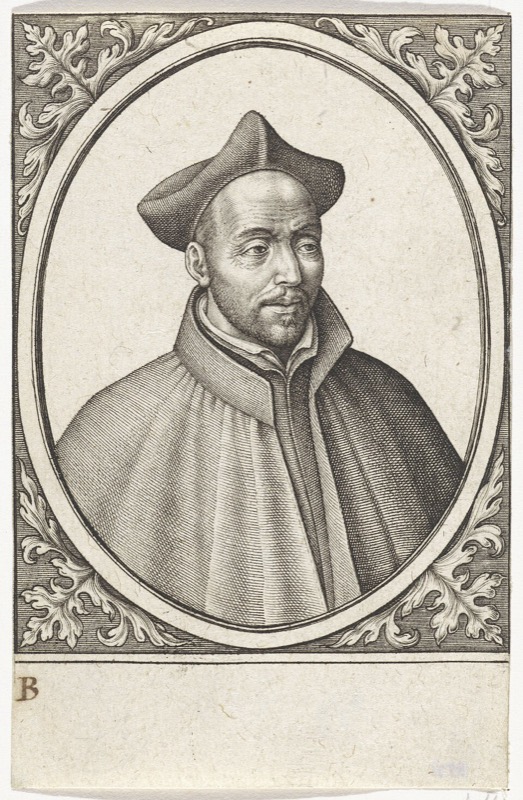
The Society of Jesus (Jesuits) was founded by:
Francis of Assisi
Thomas Aquinas
Ignatius of Loyola
Teresa of Ávila
Ignatius, a Spanish soldier turned priest, founded the Jesuits in 1540. Francis founded the Franciscans, and Teresa reformed the Carmelites.
What was the St. Bartholomew's Day Massacre (1572)?
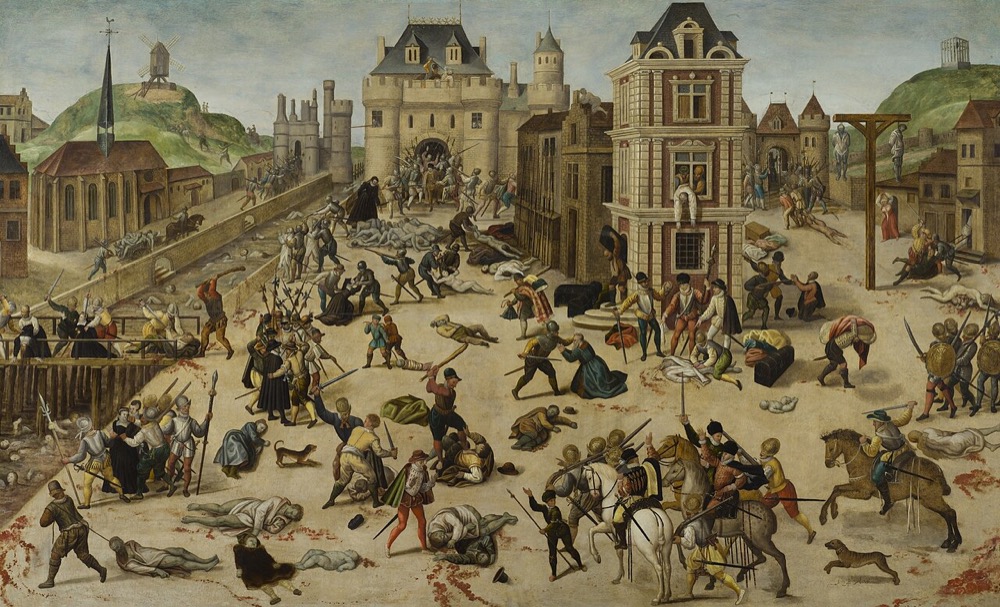
A massacre of Huguenots in Paris and other French cities
A battle between England and Spain
A peasant revolt in Germany
A siege of the city of Münster
Triggered by tension around a royal wedding and Admiral Coligny's attempted assassination, thousands of Huguenots died.
The Edict of Nantes (1598) did what?
It made Calvinism the state religion of France.
It expelled all Protestants from France.
It ended the Dutch Revolt.
It gave French Huguenots limited toleration and legal rights.
Henry IV issued it to end the French Wars of Religion. Louis XIV revoked it in 1685.
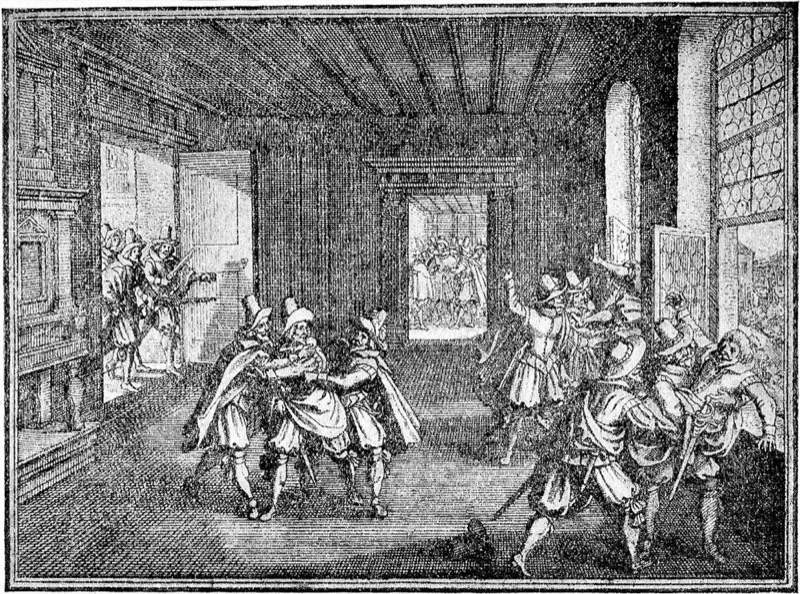
What event began the Thirty Years' War in 1618?
The Sack of Magdeburg
The Defenestration of Prague
The Battle of Lepanto
The Edict of Restitution
Bohemian Protestant nobles threw imperial officials from a window of Prague Castle. Magdeburg was sacked in 1631, Lepanto was fought in 1571, and the Edict of Restitution was issued in 1629.
Which of these was a result of the Peace of Westphalia (1648)?
The Holy Roman Empire became a centralized state.
Calvinism was recognized alongside Lutheranism and Catholicism in the Empire.
The Habsburgs conquered Sweden.
Protestants were forced to return to Catholicism.
Westphalia strengthened the German princes and confirmed Dutch and Swiss independence. The Empire became weaker, not stronger.
Which statement about the Thirty Years' War is accurate?
It was entirely a war between Catholics and Protestants.
It was fought mostly in France and Spain.
It ended in a decisive Catholic victory.
Catholic France supported Protestant powers against the Catholic Habsburgs.
Cardinal Richelieu put state interest ahead of religion. The war was fought largely in Germany, and the settlement was a compromise that weakened the Habsburgs.
Which map feature best shows the effect of the Counter-Reformation on Central Europe by 1618?
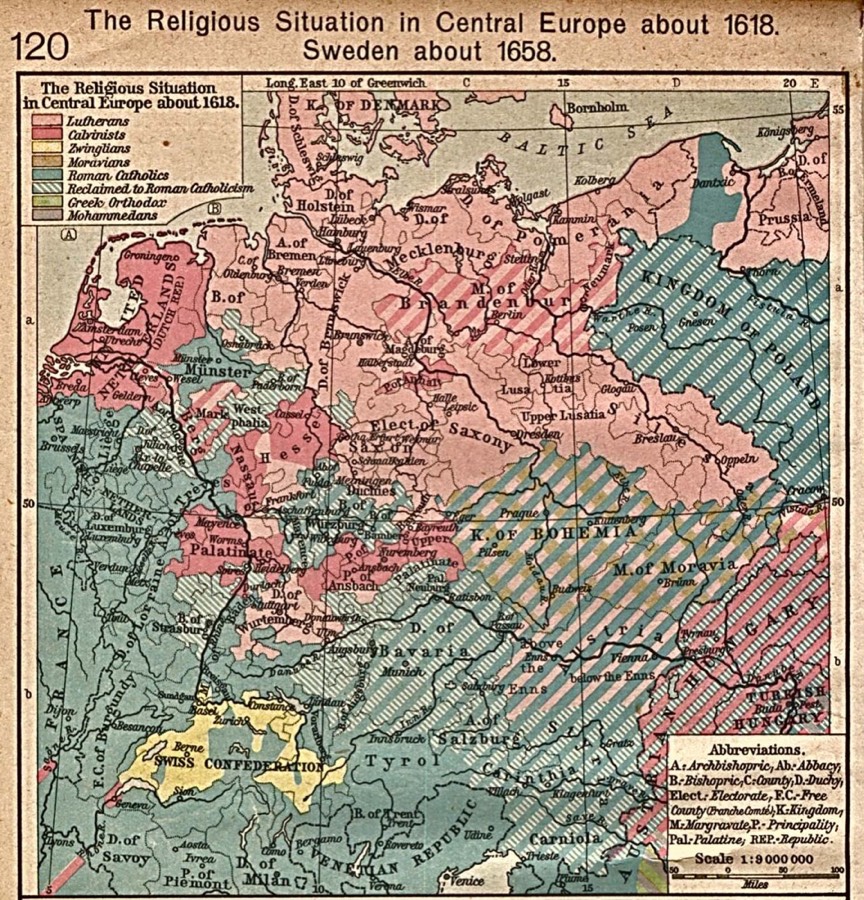
Hatched areas of lands reclaimed to Catholicism in the south and east
A fully Protestant Bohemia
A Calvinist majority in Austria
A Lutheran Poland
The map marks 'reclaimed to Roman Catholicism' lands such as parts of Bavaria and Austria, and a Protestant north. Poland remained largely Catholic.
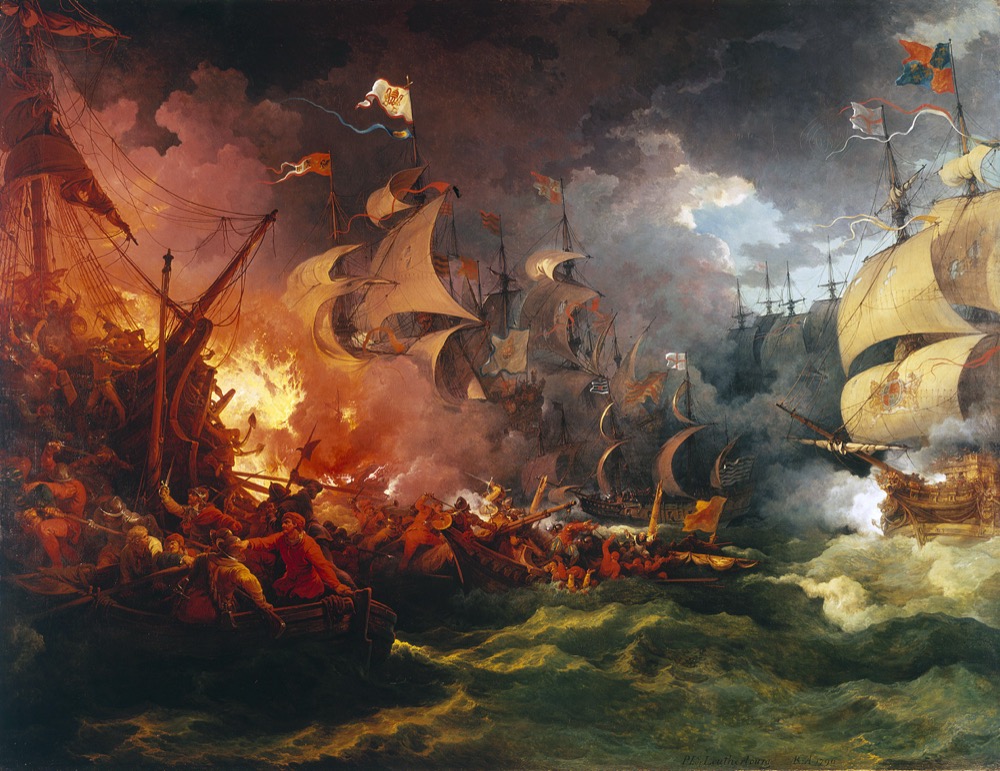
What was the effect of the Spanish Armada's defeat in 1588?
It led Elizabeth I to restore Catholicism.
It destroyed Dutch independence.
It ended Philip II's chance to invade England and boosted English Protestant confidence.
It led to the union of England and Spain.
The Armada was damaged by fireships and storms. Spain remained powerful but English sea power and national feeling grew.
