Quiz · Hard
APUSH-style questions on why the war came, why the Union won and how its aims changed.
Which factor best explains why compromises such as 1820 and 1850 failed to prevent civil war?
They resolved the moral question of slavery
They addressed slavery's expansion without resolving the underlying conflict, and new territories repeatedly reopened the issue
Congress refused to pass them
They banned slavery in the South
Each compromise postponed the question while territorial expansion renewed it. They did not settle the moral conflict, and Congress did pass them.
How did the Kansas-Nebraska Act change the political landscape?
It created the Democratic Party
It ended sectional tension
It destroyed the Whig Party and helped create the Republican Party
It banned slavery in Kansas
Anger over repeal of the Missouri Compromise led antislavery Whigs and Democrats to form the Republicans. The act did not end tension or ban slavery.
Which development best illustrates the concept of 'total war'?
The Battle of Bull Run
The Anaconda Plan
The Gettysburg Address
Sherman's destruction of railroads and property in Georgia and the Carolinas
Total war targeted the enemy's economic resources and civilian morale, not just armies.
Which of the following best describes Lincoln's position on slavery before 1861?
He sought to abolish slavery everywhere immediately
He supported its expansion
He supported popular sovereignty
He opposed its expansion and viewed it as a moral wrong but accepted that the Constitution protected it in existing states
Lincoln promised not to interfere with slavery where it existed but opposed its extension. He did not support immediate abolition at the time.
This map shows territories open to slavery by popular sovereignty. What was the long-term effect of the policy in Kansas?
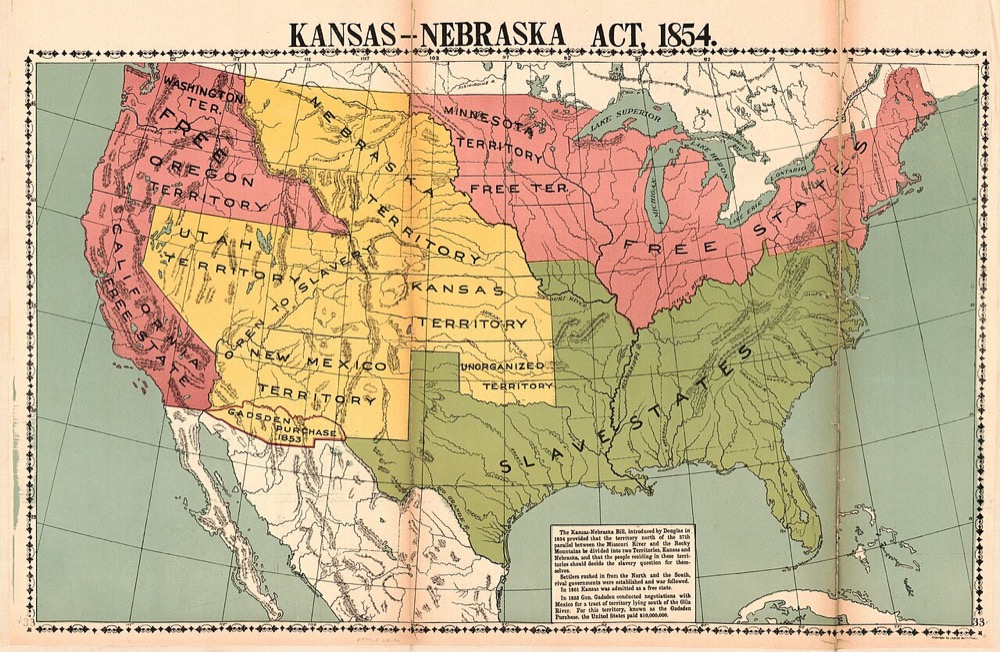
Violent conflict called Bleeding Kansas
Peaceful settlement
Immediate statehood as a slave state
A ban on slavery by Congress
Competing governments and armed groups fought over the territory in 1854-56. Kansas entered the Union as a free state in 1861. Image: McConnell Map Co., public domain, via Wikimedia Commons.
Which argument did Southern secessionists use in their declarations of causes?
That the North had declared war
That Northern states had undermined the protection of slavery and slaveholders' property rights
That Congress had banned cotton exports
That Britain had asked them to leave
Declarations such as South Carolina's and Mississippi's emphasized slavery and the failure of Northern states to enforce the Fugitive Slave Act.
Why was the Union's blockade effective despite early weakness?
It cut Southern exports and imports and reduced revenue, though blockade runners slipped through
It captured Richmond
It prevented all trade
It was unnecessary
The blockade grew stronger as the navy expanded. It did not stop every ship, but it hurt the Confederate economy.
Which statement about Lincoln's use of presidential power is accurate?
He never used executive power
He dissolved Congress
He abolished the Supreme Court
He suspended habeas corpus in some areas without waiting for Congress
In 1861 he suspended habeas corpus, which Taney opposed in Ex parte Merryman. Congress authorized the suspension in 1863.
How did the Emancipation Proclamation affect the war's character?
It ended the war within a year
It freed slaves in the border states
It turned the war into one about ending slavery as well as preserving the Union and discouraged foreign recognition of the Confederacy
It made the Confederacy surrender
Emancipation became a war aim, allowed Black enlistment and made British recognition politically difficult. The border states were exempted.
Which pairing best identifies a Confederate disadvantage and a Union advantage?
More soldiers; fewer railroads
Few factories and railroads; a larger population and industry
A weak army; a strong navy
No cotton; no navy
The South's economy was agrarian and less industrial. The Confederacy did not have more soldiers overall.
Why did the Union victory at Atlanta matter politically?
It ended the draft
It gave Sherman the presidency
It undercut Democratic claims that the war was failing and helped Lincoln win reelection
It led to Lee's surrender
After a summer of heavy casualties, Atlanta shifted opinion. It did not end the war immediately.
Which statement about Black participation in the Union war effort is best supported?
About 180,000 served in the army, many after the Emancipation Proclamation, and their service strengthened claims to citizenship
Black men were barred from service
Few Black men served
Black soldiers received equal pay from the start
Congress authorized equal pay only in 1864. Black soldiers' service became an argument for the 14th and 15th Amendments.
Which statement best explains why Lee's invasions of the North (1862 and 1863) failed?
Lee was captured
Britain intervened
Lee refused to attack
Union forces won at Antietam and Gettysburg, and Lee lacked supplies and reinforcements
Both offensives ended in retreat, ending hopes of foreign recognition and a Northern peace party. Lee was not captured until he surrendered in 1865.
Which of the following best summarizes the Union's economic legislation during the war?
Congress cut spending
Congress refused to tax
Republicans passed laws such as the Homestead Act, Morrill Act and Pacific Railway Act to promote economic growth
The government avoided banks
With Southern Democrats absent, the Republican Congress enacted its programs and created a national banking system.
Which description of the 1867 Reconstruction Acts best matches the map below?
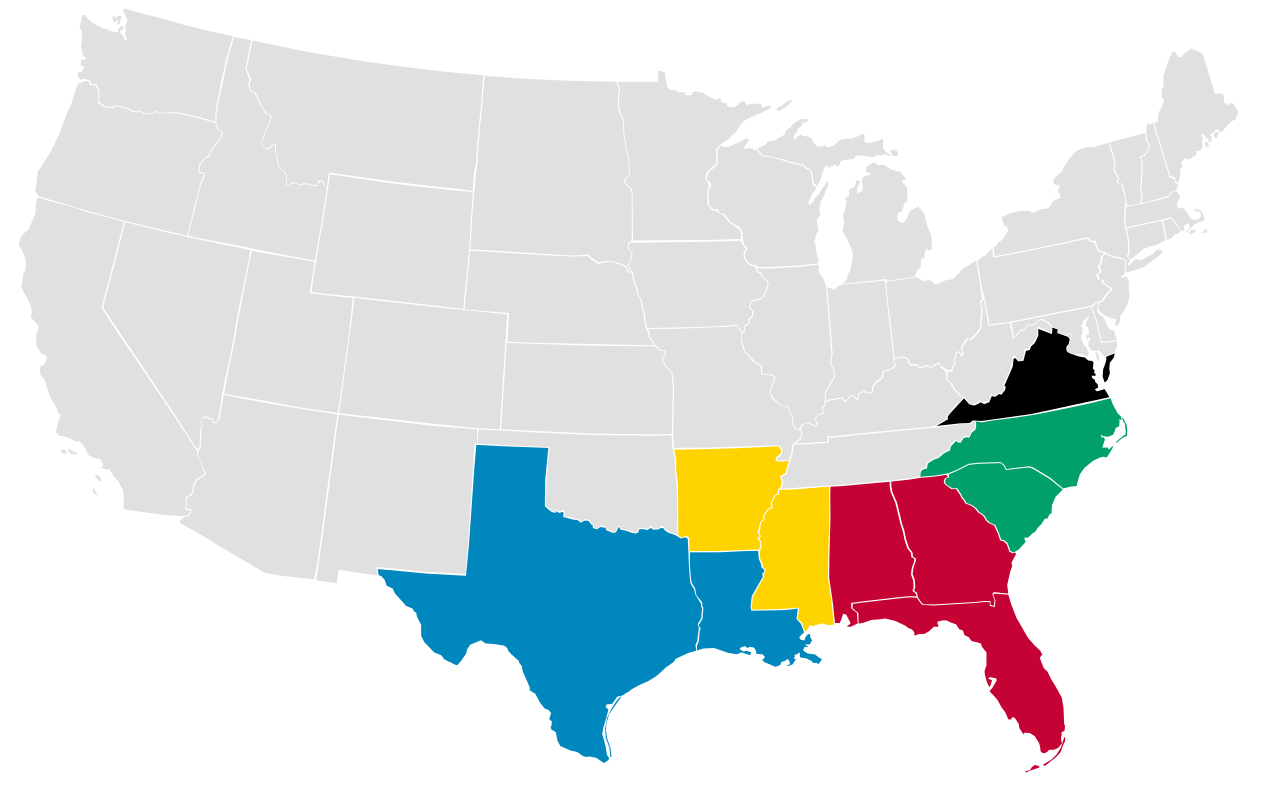
The South was divided into ten zones
The former Confederacy was divided into five military districts (Tennessee had already been readmitted)
Only Virginia was occupied
The North was divided into districts
Congress placed ten ex-Confederate states under five military commanders. Tennessee had been readmitted in 1866. Image: JayCoop, CC0, via Wikimedia Commons.
Which statement best compares the war aims in 1861 and 1865?
In 1861 the Union's main aim was preserving the Union; by 1865 it also meant ending slavery
The aims were the same
In 1865 the aim was only revenge
The Union aimed to conquer Canada
Emancipation and the 13th Amendment broadened the goals of the war.
