Quiz · Medium
Questions on conditionals, truth tables, De Morgan, valid and invalid argument forms and basic predicate logic translations.
A valid argument can have a false conclusion.
True
False
Yes, provided at least one premise is false. Validity says only that if all premises were true, the conclusion would have to be true.
A sound argument must be...
valid and have a conclusion that is merely plausible
inductively strong with true premises
invalid but with a true conclusion
valid and have only true premises
Soundness = validity + true premises. Inductive strength with true premises is called cogency.
Which argument form is valid?
If P then Q; Q; therefore P
If P then Q; not P; therefore not Q
If P then Q; not Q; therefore not P
P or Q; P; therefore not Q
This is modus tollens. Affirming the consequent and denying the antecedent are both invalid. 'P or Q; P; so not Q' wrongly treats inclusive or as exclusive.
When is the conditional false?
When p is true and q is false
When p is false and q is true
When p and q are both false
When p and q are both true
A material conditional is false only when its antecedent is true and its consequent false. If p is false it is true regardless of q.
What is the contrapositive of 'If it is a cat, then it is a mammal'?
If it is a mammal, then it is a cat
If it is not a cat, then it is not a mammal
It is a cat and it is not a mammal
If it is not a mammal, then it is not a cat
The contrapositive flips and negates both parts and is equivalent to the original. 'If it is a mammal, then it is a cat' is the converse and 'If it is not a cat, then it is not a mammal' is the inverse; neither is equivalent to the original.
By De Morgan's laws, is equivalent to...
Negating a conjunction gives a disjunction of negations. The tempting is the negation of a disjunction.
How many rows are needed for a complete truth table with three distinct atomic statements?
3
8
6
9
There are 2 to the power n rows: 2 x 2 x 2 = 8. It is not 3 x 3 or 3 x 2.
Which of these is a tautology?
Either p or not-p is always true (excluded middle). 'p and not-p' and 'p if and only if not-p' are contradictions; 'p implies not-p' is false when p is true and is equivalent to not-p.
What is the negation of 'All swans are white'?
No swan is white
All swans are not white
Some swan is not white
Some swan is white
Negating a universal gives an existential with a negated predicate. 'No swan is white' is the contrary, which is much stronger than needed.
How is 'Some students are lazy' symbolized in predicate logic (S = student, L = lazy)?
Existentials pair with conjunction. is made true by anything that is not a student, so it says almost nothing.
'I will pass only if I study' is correctly symbolized (P = pass, S = study) as...
'A only if B' means A implies B: studying is necessary for passing, not sufficient. would say studying guarantees a pass.
If it rains the match is cancelled; the match was not cancelled; so it did not rain. This argument is...
invalid: it denies the antecedent
invalid: it affirms the consequent
valid (modus tollens)
valid, but only if it is not raining in the stadium
The form is If P then Q; not Q; so not P. If rain guaranteed cancellation, no cancellation means no rain.
If Maria is in Paris she is in France. Maria is in France. So Maria is in Paris. What is wrong?
It denies the antecedent
It affirms the consequent
It is an equivocation
Nothing; it is valid
Being in France does not imply being in Paris. Premises true, conclusion false is possible if she is in Lyon.
Which statement is logically equivalent to ?
A conditional is false only if p true and q false, exactly when is false. The converse and inverse are not equivalent.
Which set of statements is inconsistent?
, ,
,
, ,
, ,
From p and p→q we get q, contradicting not-q. The other sets can all be true together; for example p false and q false makes the set {p→q, not-p, not-q} true.
An argument whose premises are inconsistent is...
invalid, because the premises cannot be true
valid, but never sound
sound only if the conclusion is true
not an argument
If the premises can never all be true, it is impossible for them to be true while the conclusion is false, so the argument is trivially valid. It cannot be sound.
If is true, false and true, what is the truth value of ?
True
Cannot be determined
True, because q is false
False
is true; is false. A true antecedent with a false consequent makes the conditional false.
Which pair is NOT equivalent?
and
and
and
and
A conditional and its converse are not equivalent (p false, q true separates them). The other pairs are contraposition, De Morgan and double negation.
Which statement about Gödel's first incompleteness theorem (1931) is correct?
Any consistent, sufficiently strong formal system of arithmetic contains true statements it cannot prove
All mathematical truths can be proved from a finite set of axioms
Arithmetic is inconsistent
Logic cannot express any arithmetic
The theorem shows a limit on formal provability, not that mathematics is inconsistent.
The logician pictured published the Begriffsschrift in 1879. What did it introduce?
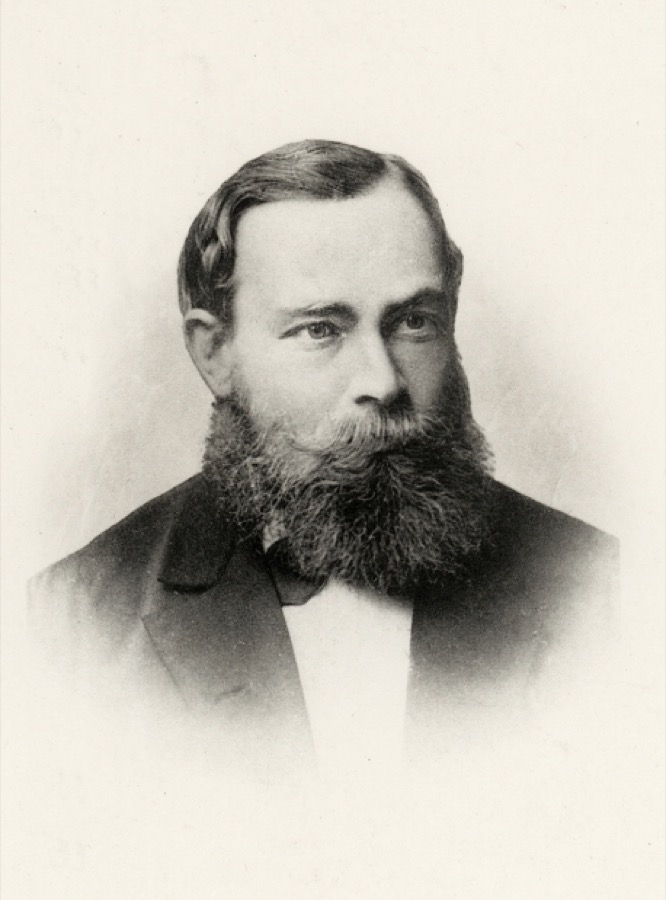
Modern predicate logic with quantifiers
Truth tables
The syllogism
Boolean circuit design
Gottlob Frege's Begriffsschrift introduced quantifiers and variables, which let logic express statements such as 'for every x there is a y'. Truth tables came later (Wittgenstein and Post, around 1920); syllogisms are Aristotle's. Image: public domain, via Wikimedia Commons.
Which gate can build every other logic gate by itself?
AND
XOR
NOT alone
NAND
NAND (and NOR) is functionally complete. AND, OR and XOR need extra gates, and NOT alone cannot form AND.
