Quiz · Medium
Foundational multiple-choice practice on justiciability, the Commerce and Spending powers, state action, scrutiny levels and the First Amendment.
A plaintiff sues to challenge a federal statute but cannot show she personally has been or will be harmed by it. Which justiciability doctrine most directly defeats her suit?
Mootness
Ripeness
Standing (injury in fact)
The political question doctrine
Standing requires an injury in fact that is concrete, particularized, and actual or imminent, plus causation and redressability (Lujan). Mootness and ripeness concern timing, not whether the plaintiff herself is harmed.
Which Supreme Court case established the power of judicial review?
Marbury v. Madison (1803)
McCulloch v. Maryland (1819)
Cooper v. Aaron (1958)
Gibbons v. Ogden (1824)
Marbury held that it is the province of the judiciary to say what the law is and that a statute conflicting with the Constitution is void. Cooper v. Aaron later stressed that the Court's interpretation binds the states.
Congress bans possession of a firearm within 1,000 feet of a school, without a jurisdictional element. Under current doctrine the law is most likely
constitutional, because guns move in interstate commerce
constitutional, because Congress may regulate any public safety problem
unconstitutional, because it violates the Second Amendment
unconstitutional, because possessing a gun near a school is not economic activity and has no clear link to interstate commerce
This is United States v. Lopez (1995). The Commerce power reaches economic activity in the aggregate, not non-economic local conduct. The Second Amendment is not the basis of the holding.
A farmer grows wheat only for use on his own farm. Under Wickard v. Filburn, Congress may regulate it because
the wheat will eventually be sold across state lines
the aggregate effect of many farmers doing the same thing substantially affects the interstate wheat market
farming is a channel of interstate commerce
the farmer used goods that traveled interstate
Wickard rests on aggregation of an economic activity. It does not require that the particular farmer's wheat ever travel in commerce.
Congress passes a law requiring local sheriffs to run background checks on handgun buyers. This law is
constitutional under the Necessary and Proper Clause
unconstitutional commandeering of state executive officials (Printz)
constitutional because the Supremacy Clause makes federal law binding on state officers
unconstitutional under the Eleventh Amendment
Congress cannot conscript state officers to carry out federal programs. The Supremacy Clause does not override the Tenth Amendment structure. The Eleventh Amendment concerns suits against states.
Under South Dakota v. Dole, which of the following is NOT a requirement for conditions Congress places on federal grants to states?
The condition must serve the general welfare
The condition must be stated unambiguously
The condition must relate to the federal interest in the program
The condition must be the least restrictive means of achieving the federal goal
Dole does not require least restrictive means. Conditions must serve the general welfare, be unambiguous, be related to the federal interest, not violate other constitutional provisions, and not be coercive.
A state statute gives in-state wine producers a tax advantage over out-of-state producers. Which doctrine is the strongest challenge?
The dormant Commerce Clause (discrimination against interstate commerce)
The Contracts Clause
The Tenth Amendment
The Establishment Clause
Facially discriminatory state laws are virtually per se invalid. The state must show that the discrimination is necessary to a legitimate local interest that no nondiscriminatory alternative could serve.
President Truman seized steel mills during the Korean War without statutory authority. In Youngstown, the Court held the seizure was
valid, because of his Commander in Chief power
valid, because a national emergency existed
invalid, because the President acted against the implied will of Congress and lacked inherent power to make laws
invalid, because the Takings Clause forbids seizing private property
Jackson's concurrence places this in category three, where presidential power is at its lowest ebb. The Takings Clause was not the basis for the decision.
A state law burdens women but not men in a way that is justified only by the idea that women are better suited to some jobs. What standard of review applies?
Strict scrutiny
Rational basis
No review, because it is a legislative judgment
Intermediate scrutiny
Sex-based classifications get intermediate scrutiny: an important objective and substantially related means, with an exceedingly persuasive justification (United States v. Virginia). Strict scrutiny is for race and national origin.
A city adopts a zoning rule that prohibits group homes for people with intellectual disabilities in a residential zone, based on neighbors' fears. Under Cleburne, a court would
apply strict scrutiny, because disability is a suspect class
strike it down under rational basis, because it rests on irrational prejudice
apply intermediate scrutiny, because disability is quasi-suspect
uphold it, because any legitimate interest suffices
Cleburne refused to treat disability as quasi-suspect but still invalidated the permit denial as based on animus. Rational basis is applied with some teeth when the law reflects irrational prejudice.
Which statement about the First Amendment and a content-based restriction on speech in a traditional public forum is correct?
It is subject to rational basis review
It is valid if it leaves open ample alternative channels
It is subject to strict scrutiny
It is valid if it serves a significant government interest
Content-based restrictions get strict scrutiny (Reed v. Town of Gilbert). The ample-alternatives test applies to content-neutral time, place, and manner restrictions.
Speech that advocates illegal action may be punished consistent with the First Amendment only if it
is directed to inciting imminent lawless action and is likely to produce it
tends to cause a general disrespect for the law
is made with an evil intent
is likely to cause some future unrest
Brandenburg v. Ohio (1969). Advocacy of law violation at some indefinite future time is protected.
A candidate for mayor sues a newspaper for a false article. To win damages for defamation, the candidate must show
actual malice: knowledge of falsity or reckless disregard for the truth
only that the statement was false
negligence by the newspaper
that the newspaper intended to hurt his reputation
New York Times v. Sullivan applies to public officials and candidates. Falsity alone is not enough, and ill will is not the same as actual malice.
Which of the following state actions would most clearly violate the Free Exercise Clause under current doctrine?
A neutral, generally applicable law that incidentally burdens a religious practice
A law that requires all employers to withhold income taxes
A law that bans animal sacrifice and was designed to suppress one particular religion
A neutral drug law applied to everyone
Laws that are not neutral or not generally applicable get strict scrutiny (Church of Lukumi). Neutral and generally applicable laws survive under Employment Division v. Smith.
Which amendment is the textual home of the right against self-incrimination?
The Fourth Amendment
The Fifth Amendment
The Sixth Amendment
The Fourteenth Amendment
The Fifth Amendment provides that no person shall be compelled in a criminal case to be a witness against himself. It applies to the states through the Fourteenth Amendment (Malloy v. Hogan).
The doctrine under which most Bill of Rights guarantees apply to state governments is called
total incorporation under the Supremacy Clause
judicial federalism
preemption under the Commerce Clause
selective incorporation through the Fourteenth Amendment's Due Process Clause
The Court has incorporated most guarantees one by one. Total incorporation (all at once) has never been adopted.
A private shopping mall bans leafleting. A shopper claims a First Amendment violation. Under the state action doctrine, the claim likely fails because
leafleting is not protected speech
private property cannot host any speech
the mall is a private actor and is not exercising a traditional exclusive public function
the First Amendment protects only political speech
The First Amendment constrains government, not private owners. Hudgens v. NLRB held a mall is not a state actor.
In a civil suit, the President is sued for conduct that occurred before he took office. Under Clinton v. Jones, the suit
may proceed during his term, because he has no immunity for unofficial acts
must be dismissed until he leaves office
may proceed only with Senate permission
is barred by absolute presidential immunity
Clinton v. Jones (1997) rejected temporary immunity for unofficial conduct. Absolute immunity from civil damages covers official acts (Nixon v. Fitzgerald).
True or false: Under the Eleventh Amendment, a private citizen may not sue a state in federal court for money damages unless an exception such as consent or valid congressional abrogation applies.
True
False
The Eleventh Amendment, as interpreted, bars citizens (including the state's own) from suing a state for damages in federal court. Suits against state officers for prospective injunctive relief may proceed under Ex parte Young.
True or false: A facially neutral law that has a disparate impact on a racial group automatically receives strict scrutiny.
True
False
Under Washington v. Davis, discriminatory purpose must be shown. Disparate impact is evidence of purpose but is not enough on its own.
The Senate votes on removal after a House impeachment. What vote is needed to convict?
A simple majority of the full Senate
Two-thirds of the members present
Three-fifths of the full Senate
Two-thirds of the full Senate
Article I, §3: no person shall be convicted without the concurrence of two-thirds of the members present.
Which test did the Supreme Court say it had abandoned in Kennedy v. Bremerton (2022), replacing it with a focus on historical practices and understandings?
The strict scrutiny test
The Pike balancing test
The Mathews test
The Lemon test
Lemon asked about secular purpose, primary effect, and entanglement. Kennedy (2022) said the Court had long since abandoned it.
According to the chart, which tier of scrutiny applies to a state law that classifies by sex?
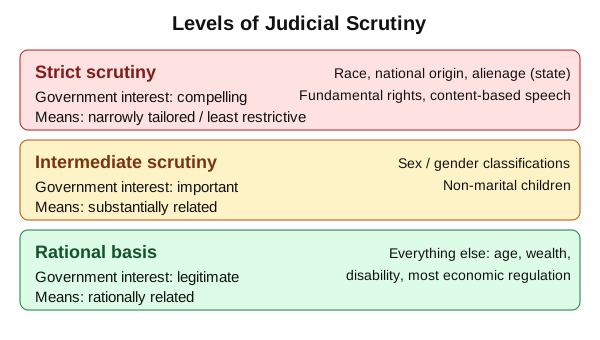
Intermediate scrutiny
Strict scrutiny
Rational basis
Strict scrutiny, unless the law benefits women
Sex-based classifications get intermediate scrutiny: an important objective, substantially related means (Craig v. Boren; United States v. Virginia).
Using the diagram, which of these is NOT within Congress's commerce power under Lopez?
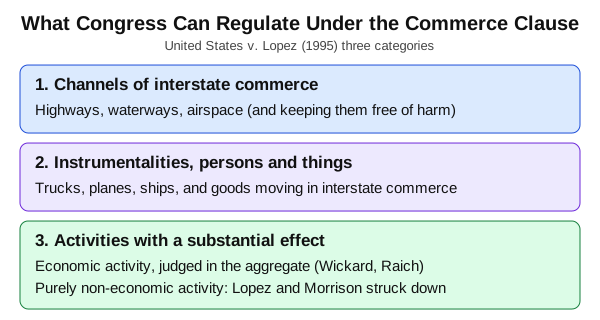
Goods moving across state lines
Highways and waterways
Purely non-economic local activity with no substantial effect on commerce
Economic activity that substantially affects commerce in the aggregate
The three Lopez categories are channels, instrumentalities (and persons or things in commerce), and activities with a substantial effect on commerce. Non-economic local conduct falls outside.
