Quiz · Medium
The Convention, compromises, ratification fight and later amendments, from the Articles of Confederation to the 27th Amendment.
Which plan at the Constitutional Convention proposed a legislature based on population in both houses?
The New Jersey Plan
The Connecticut Compromise
The Virginia Plan
The Hamilton Plan
The Virginia Plan (Randolph, Madison) favored large states. New Jersey asked for one vote per state. Connecticut combined both.
The Great Compromise created:
A House chosen by state legislatures and a Senate by population
One house with proportional votes
A House based on population and a Senate with equal representation
An executive council instead of a president
It balanced large and small states. Senators were chosen by state legislatures until the 17th Amendment.
Which statement best describes the weaknesses of the Articles of Confederation?
Congress could not tax or regulate trade, and amendments needed unanimous consent
The president was too powerful and states had no say
The courts could strike down state laws
Congress could override any state law
There was no executive or national judiciary, and states were sovereign. The weaknesses led to the 1787 Convention.
Shays' Rebellion mattered because it:
Led directly to the Bill of Rights
Caused the Articles of Confederation to be ratified
Ended the slave trade
Showed the national government's weakness and increased support for a stronger constitution
Shays' Rebellion happened in 1786-87, after the Articles took effect (1781). It spurred reformers like Washington and Madison.
Why did Anti-Federalists oppose ratification without a bill of rights?
They wanted a stronger executive with longer terms
They feared the strong national government would threaten individual liberties and state powers
They wanted the president chosen by Congress
They believed a bill of rights was already in Article I
Anti-Federalists such as Patrick Henry and George Mason demanded protections. Federalists promised amendments, and Madison drafted the Bill of Rights in 1789.
The Three-Fifths Compromise determined:
Whether the slave trade ended in 1800
How enslaved people were counted for House representation and direct taxes
The number of electors per state
Whether the Senate would have equal representation
It increased southern representation. The importation clause (1808) was separate. The 14th Amendment replaced it.
Which state's ratification made the Constitution take effect under Article VII?
Delaware, the first state
Virginia, the tenth state
New Hampshire, the ninth state
New York, the eleventh state
Nine states were required. Delaware was first, but the ninth ratification triggered it. Virginia and New York were crucial for practical reasons.
Which was a Federalist argument for the Constitution?
A large republic would prevent any one faction from dominating
A bill of rights was essential before ratification
States should keep full sovereignty
Congress should choose the president
That is Madison's Federalist No. 10. The others are Anti-Federalist positions or not arguments of either side.
Which amendment overturned the effect of Chisholm v. Georgia?
The 10th Amendment
The 12th Amendment
The 14th Amendment
The 11th Amendment
Chisholm let a South Carolina citizen sue Georgia in federal court; the 11th (1795) barred suits against a state by citizens of another state.
The 12th Amendment was a response to which event?
The disputed election of 1876
The death of a president-elect
The tie in the electoral vote between Jefferson and Burr in 1800
The creation of political primaries
Before the 12th, electors cast two votes without distinguishing president and VP, so Jefferson and Burr tied. The House chose Jefferson.
Which amendment made it possible for the federal government to tax income without apportionment among the states?
The 14th Amendment
The 16th Amendment
The 17th Amendment
The 18th Amendment
The 16th (1913) reversed the effect of Pollock v. Farmers' Loan & Trust (1895). The 17th (direct election of senators) was ratified the same year.
What is the purpose of the 25th Amendment?
To limit presidents to two terms
To let DC vote for president
To bar poll taxes
To set out presidential succession and disability
Section 4 allows the VP and cabinet to declare the president unable to serve. The 22nd is term limits, the 23rd DC electors, the 24th poll taxes.
A newly elected member of Congress wants to give herself an immediate raise. Which amendment blocks this?
The 27th Amendment
The 20th Amendment
The 21st Amendment
The 26th Amendment
The 27th says a pay change cannot take effect until an election of representatives has intervened. It was written in 1789 but ratified in 1992.
Which statement about the amendment process is accurate?
Only one amendment, the 21st, has been ratified by state conventions
The president must sign each amendment
The Supreme Court must approve each amendment
A national convention has proposed several amendments
The president has no formal role. Congress has proposed all 27, and no Article V national convention has ever been held.
The Equal Protection Clause of the 14th Amendment applies to:
Private businesses only
Only citizens, not other people
State governments and, through the 5th Amendment, the federal government
Only the federal government
It says 'any person within its jurisdiction.' State action is required; private discrimination is governed by statutes such as the Civil Rights Act of 1964.
Which of these was NOT among the changes the 14th Amendment made?
It defined national citizenship
It abolished slavery
It created the Equal Protection Clause
It included a due process clause that binds the states
The 13th abolished slavery. The 14th defined citizenship (birthright), and added due process and equal protection.
Which pair of amendments both expanded the right to vote?
13th and 14th
16th and 17th
20th and 22nd
19th and 26th
The 19th (women) and 26th (age 18) expanded voting. The 17th changed how senators are chosen but did not expand the electorate.
Which amendment bars the government from using evidence from an unreasonable search?
The 5th
The 4th, as applied by the exclusionary rule in Mapp v. Ohio
The 8th
The 3rd
The 4th bars unreasonable searches; the exclusionary rule is a court-made remedy. The 5th covers self-incrimination and double jeopardy.
Federalist No. 84 argued against a bill of rights because:
Hamilton opposed individual liberty
States already had full bills of rights
Congress would abuse it
Listing rights might imply the government had powers not listed
Hamilton's argument was that the Constitution already limited the government to enumerated powers. The Anti-Federalists answered with demands that led to the 9th Amendment.
Which of these describes the Constitution's treatment of the slave trade?
Congress could not ban importing slaves until 1808
It banned the slave trade immediately
It left the trade to the states forever
It required states to end slavery by 1800
The clause (Art. I, Sec. 9) was a compromise. Congress banned importation effective January 1, 1808.
The Declaration of Independence (1776) is not part of the Constitution but influenced it because it:
Created the Congress
Established the electoral college
Asserted natural rights and government by consent of the governed
Set the amendment process
Locke's ideas run through the Declaration. The Constitution created the institutions to carry out those principles.
The painting by Howard Chandler Christy shows the signing of the Constitution. Who presided over the Convention?
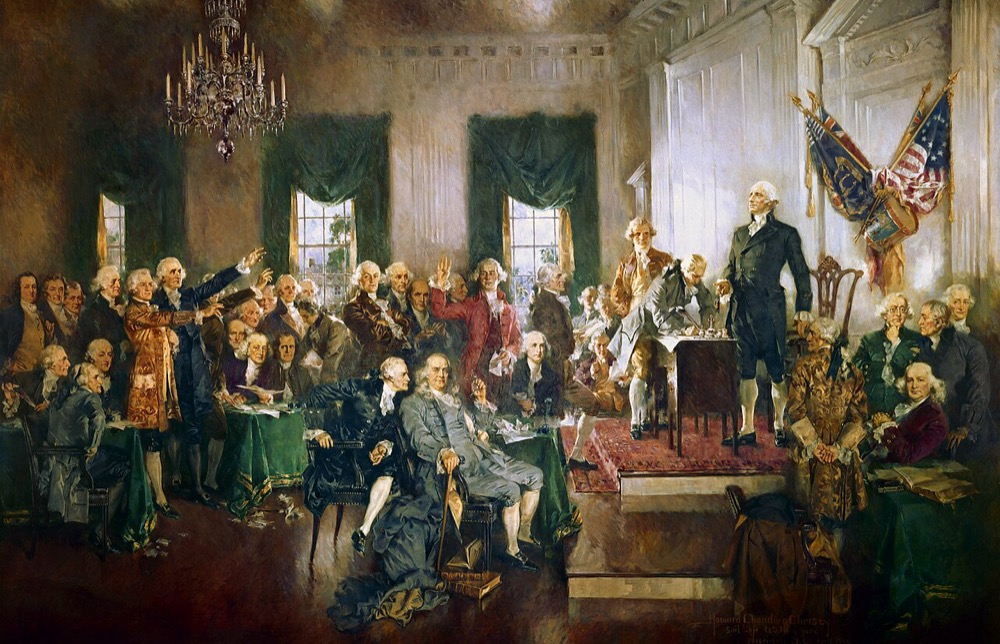
Benjamin Franklin
James Madison
George Washington
Thomas Jefferson
Washington presided. Franklin was the oldest delegate; Madison kept notes; Jefferson was in France as minister and did not attend. Image: Christy, public domain.
