Quiz · Medium
Twenty-two questions on British policies, colonial protest, independence, the major battles and the peace.
Which British law was a direct tax on printed materials such as newspapers and legal documents?
Stamp Act
Sugar Act
Townshend Acts
Tea Act
The Stamp Act (1765) taxed printed items to raise revenue in America. The Sugar Act dealt with molasses; the Townshend Acts taxed imports; the Tea Act concerned the East India Company's monopoly.
What did colonists mean by 'no taxation without representation'?
Only the king could tax
Taxes were illegal
Only legislatures in which they were represented could tax them
Representatives could not be paid
Colonists believed that taxes required consent through elected representatives, and they sent none to Parliament. Virtual representation was the British counterargument.
The Declaratory Act (1766) stated that
the colonies were independent
the Stamp Act would continue
colonists could elect MPs
Parliament could legislate for the colonies in all cases
It was passed with the repeal of the Stamp Act to assert Parliament's authority. The colonies were not independent and had no MPs.
What does this print by Paul Revere (1770) show?
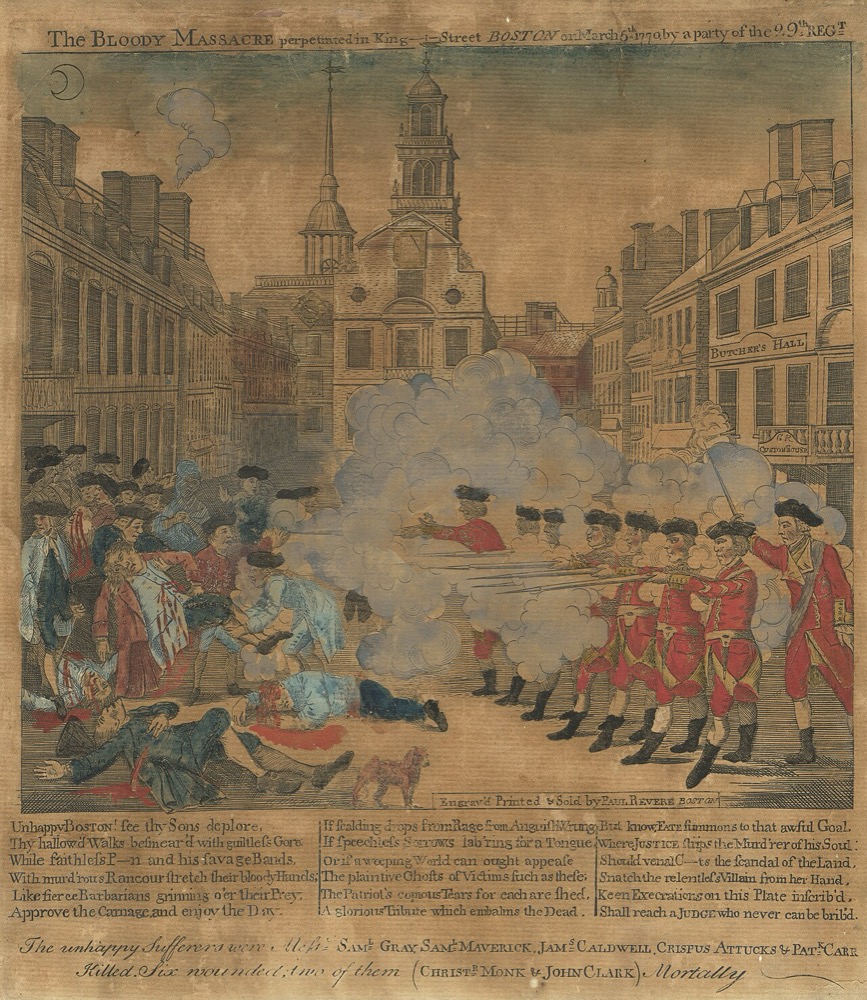
The Boston Tea Party
The Boston Massacre
The Battle of Bunker Hill
The Stamp Act riots
The 'Bloody Massacre' print shows soldiers firing on a crowd on King Street, Boston; it was powerful propaganda that exaggerated the event. Image: Paul Revere after Henry Pelham, CC0, National Gallery of Art, via Wikimedia Commons.
Why did the Tea Act of 1773 provoke the Boston Tea Party?
It raised the price of tea sharply
It banned tea entirely
It taxed all colonial merchants
It gave the East India Company a monopoly and kept the tax on tea
The act made tea cheaper but protected the company's monopoly and the Townshend tea tax, which colonists saw as a trick to get them to accept taxation.
Which of these was one of the Coercive (Intolerable) Acts?
The Boston Port Act
The Sugar Act
The Currency Act
The Declaratory Act
The Boston Port Act closed the harbor until the destroyed tea was paid for. The other laws came earlier.
Which body organized the Continental Association boycott in 1774?
The Stamp Act Congress
The First Continental Congress
The Second Continental Congress
The Confederation Congress
Delegates from 12 colonies met in Philadelphia in 1774. The Stamp Act Congress was in 1765; the Second Congress began in 1775.
The first battles of the Revolutionary War took place at
Saratoga and Yorktown
Trenton and Princeton
Lexington and Concord
Bunker Hill and Boston
Fighting began April 19, 1775 when British troops marched to seize military supplies. Bunker Hill came in June 1775.
Who was appointed commander-in-chief of the Continental Army in 1775?
Horatio Gates
George Washington
Nathanael Greene
Charles Lee
The Second Continental Congress chose Washington partly to win Southern support for a New England-centered war.
What was the main impact of Thomas Paine's Common Sense?
It persuaded many colonists to support independence
It created the Continental Army
It ended the Stamp Act
It was a petition to the king
Its clear language made independence a popular cause in 1776. The Olive Branch Petition was the petition to the king.
Which statement from the Declaration of Independence reflects the ideas of John Locke?
Monarchy is the best form of government
Parliament may tax the colonies
Governments derive their just powers from the consent of the governed
Slavery is a natural right
Consent of the governed and natural rights come from Locke's social contract theory. The other statements contradict the Declaration.
The painting below by John Trumbull shows
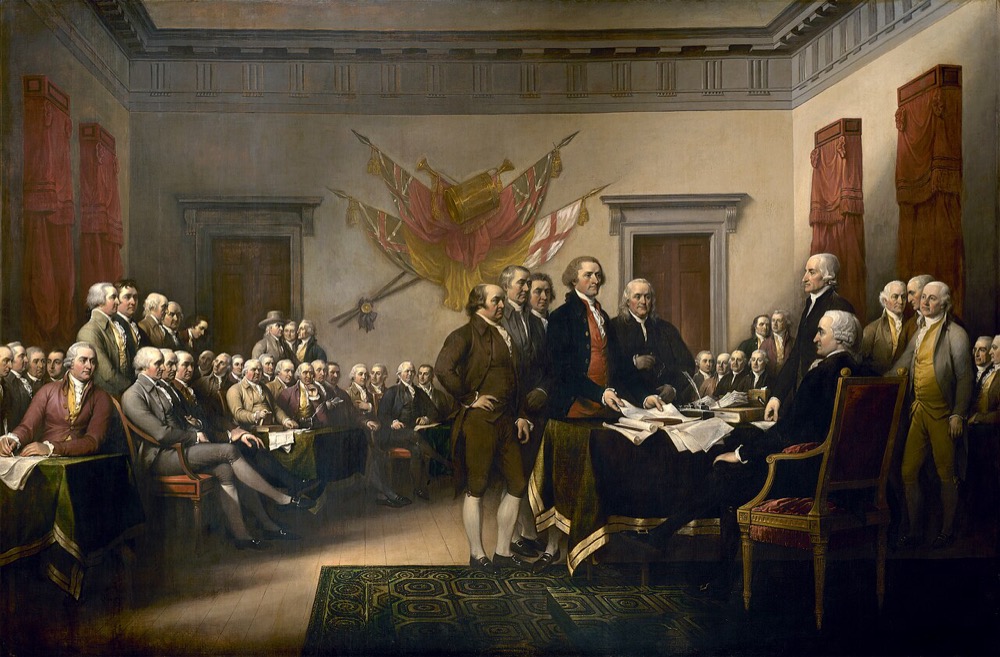
the signing of the Constitution
the First Continental Congress
the Treaty of Paris negotiations
the committee presenting the draft Declaration of Independence to Congress
It shows the Committee of Five presenting the draft on June 28, 1776, not the signing. Image: John Trumbull, public domain, via Wikimedia Commons.
Why was the Battle of Saratoga a turning point?
It ended the war
It captured Charleston
It ended Loyalist resistance
It convinced France to ally with the US
Burgoyne's surrender persuaded France that the Americans could win, leading to a formal alliance in 1778. The war continued until 1781-83.
The painting below shows which event?
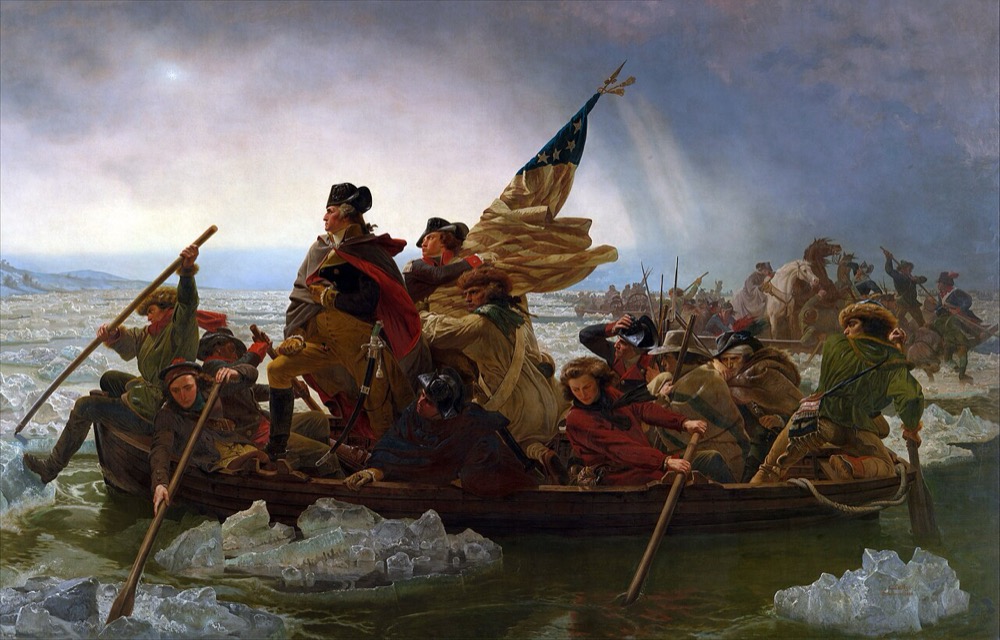
The retreat from Bunker Hill
The surrender at Yorktown
Washington crossing the Delaware to attack Trenton
Washington at Valley Forge
It depicts the December 1776 crossing to attack Hessians at Trenton. Image: Emanuel Leutze, public domain, via Wikimedia Commons.
What was a major weakness of the Articles of Confederation?
Congress could not levy taxes
The president was too powerful
There was no state government
It banned trade
Congress had to request money from states, which often did not pay. There was no president and states kept their governments.
Which achievement is associated with the Confederation Congress?
The Bill of Rights
The Northwest Ordinance of 1787
The Judiciary Act of 1789
The Louisiana Purchase
The ordinance set a path to statehood and banned slavery in the Northwest Territory. The others are later events.
Which battle effectively ended the fighting in 1781?
Yorktown
Camden
Brandywine
Long Island
Cornwallis surrendered at Yorktown after being trapped by American and French forces and the French fleet.
Which of these helped the American victory at Yorktown?
Spanish troops under Galvez
The French navy under de Grasse
A Loyalist uprising
British refusal to fight
The French fleet blocked Cornwallis's escape and French and American armies besieged him. Galvez fought elsewhere, along the Gulf Coast.
What were the western and southern boundaries of the United States under the Treaty of Paris (1783)?
The Rocky Mountains on the west and Mexico on the south
The Appalachians on the west and Louisiana on the south
The Ohio River on the west and Texas on the south
The Mississippi River on the west and Spanish Florida on the south
The western boundary was the Mississippi River; Florida was returned to Spain.
What did Lord Dunmore's Proclamation (1775) promise?
Land to Loyalists
Self-government to Virginia
Freedom for enslaved people of rebels who joined the British
An end to tea taxes
It encouraged thousands of enslaved people to flee to British lines and angered Southern slaveholders.
Which law of 1774 extended Quebec's boundaries to the Ohio River and angered colonists?
Proclamation of 1763
Quebec Act
Stamp Act
Quartering Act of 1765
The Quebec Act was seen as blocking colonial expansion and favoring Catholicism.
What best describes the Loyalists?
Colonists who wanted independence
French allies
Colonists who supported British rule
British soldiers
Loyalists, perhaps 15-20 percent of colonists, remained loyal to the Crown. Patriots supported independence.
