Quiz · Medium
Twenty-one questions on computing eigenvalues and eigenvectors, trace and determinant shortcuts, defective matrices, symmetric matrices and diagonalization.
What are the eigenvalues of ?
1 and 2
1 and 3
2 and 2
0 and 4
The characteristic equation is λ² − 4λ + 3 = (λ − 1)(λ − 3) = 0. The trace 4 equals 1 + 3 and the determinant 3 equals 1·3. The diagonal entries (2, 2) are the eigenvalues only for triangular matrices.
A is 2 × 2 with trace 7 and determinant 10. What are its eigenvalues?
1 and 6
7 and 10
2 and 5
3 and 4
λ² − 7λ + 10 = (λ − 2)(λ − 5). The sum of the eigenvalues is the trace (7) and the product is the determinant (10).
In the sheared picture of the Mona Lisa, which arrow is an eigenvector of the shear?

The blue horizontal arrow
Both arrows
Neither arrow
The red vertical arrow
The blue horizontal arrow keeps its direction (and length), so it is an eigenvector with eigenvalue 1. The red arrow is tilted by the shear, so it is not an eigenvector. Image: TreyGreer62, CC0, via Wikimedia Commons.
What are the eigenvalues of ?
−2, 7, 4
They cannot be read off
3, 5, 1
3, −2, 7
For a triangular matrix the eigenvalues are the diagonal entries: 3, −2 and 7. The entries above the diagonal do not matter.
Which vector is an eigenvector of ?
(1, 1)
(1, −1)
(1, 2)
(2, 3)
A(1, 1) = (3, 3) = 3(1, 1). The others fail: A(1, 2) = (5, 3), A(2, 3) = (8, 6) and A(1, −1) = (−1, 3), none of which is a multiple of the input.
A has eigenvalues 3 and −2. What are the eigenvalues of A²?
6 and −4
3 and 2
9 and −4
9 and 4
If Av = λv then A²v = λ²v, so the eigenvalues are 3² = 9 and (−2)² = 4. Squaring removes the sign.
A is 3 × 3 with eigenvalues 1, 2 and 4. What is det A?
8
3
14
7
The determinant is the product of the eigenvalues: 1·2·4 = 8. The sum, 7, is the trace.
A square matrix A is singular. Which statement must be true?
1 is an eigenvalue
0 is an eigenvalue
A is not diagonalizable
All eigenvalues are 0
Singular means Av = 0 = 0·v for some nonzero v, so 0 is an eigenvalue. A singular matrix can still be diagonalizable, e.g. diag(1, 0).
Which statement is true for the rotation matrix (90° counterclockwise)?
Its only eigenvalue is 90
Its eigenvalues are 1 and −1
Its eigenvalues are i and −i, so it has no real eigenvectors
Its eigenvalues are 0 and 1
λ² + 1 = 0 gives λ = ±i. No real direction is mapped to itself by a 90° rotation.
Which matrix is NOT diagonalizable?
[[2, 1], [0, 2]] has the eigenvalue 2 twice but only one eigenvector direction (1, 0), so it is defective. The others are diagonal or symmetric, hence diagonalizable.
An eigenvalue has algebraic multiplicity 3. Which geometric multiplicity is impossible?
4
1
2
3
The geometric multiplicity is at most the algebraic multiplicity, so 4 is impossible. It is also at least 1, and the values 1, 2, 3 can all occur.
In A = PDP⁻¹, what are the columns of P?
The columns of A
The eigenvalues of A
Independent eigenvectors of A, in the same order as the entries of D
The rows of A
Each column of P is an eigenvector, and the j-th diagonal entry of D is its eigenvalue. If you reorder the columns of P you must reorder D in the same way.
A is a real symmetric matrix. Which statement is true?
Eigenvectors for distinct eigenvalues are orthogonal
It may fail to be diagonalizable
Its eigenvalues are all positive
Its eigenvalues can be complex
The spectral theorem says real symmetric matrices have real eigenvalues, orthogonal eigenvectors for distinct eigenvalues, and an orthonormal eigenbasis. Eigenvalues may be negative or zero.
The diagram shows the orthogonal diagonalization of a symmetric matrix. Which equation does it illustrate?
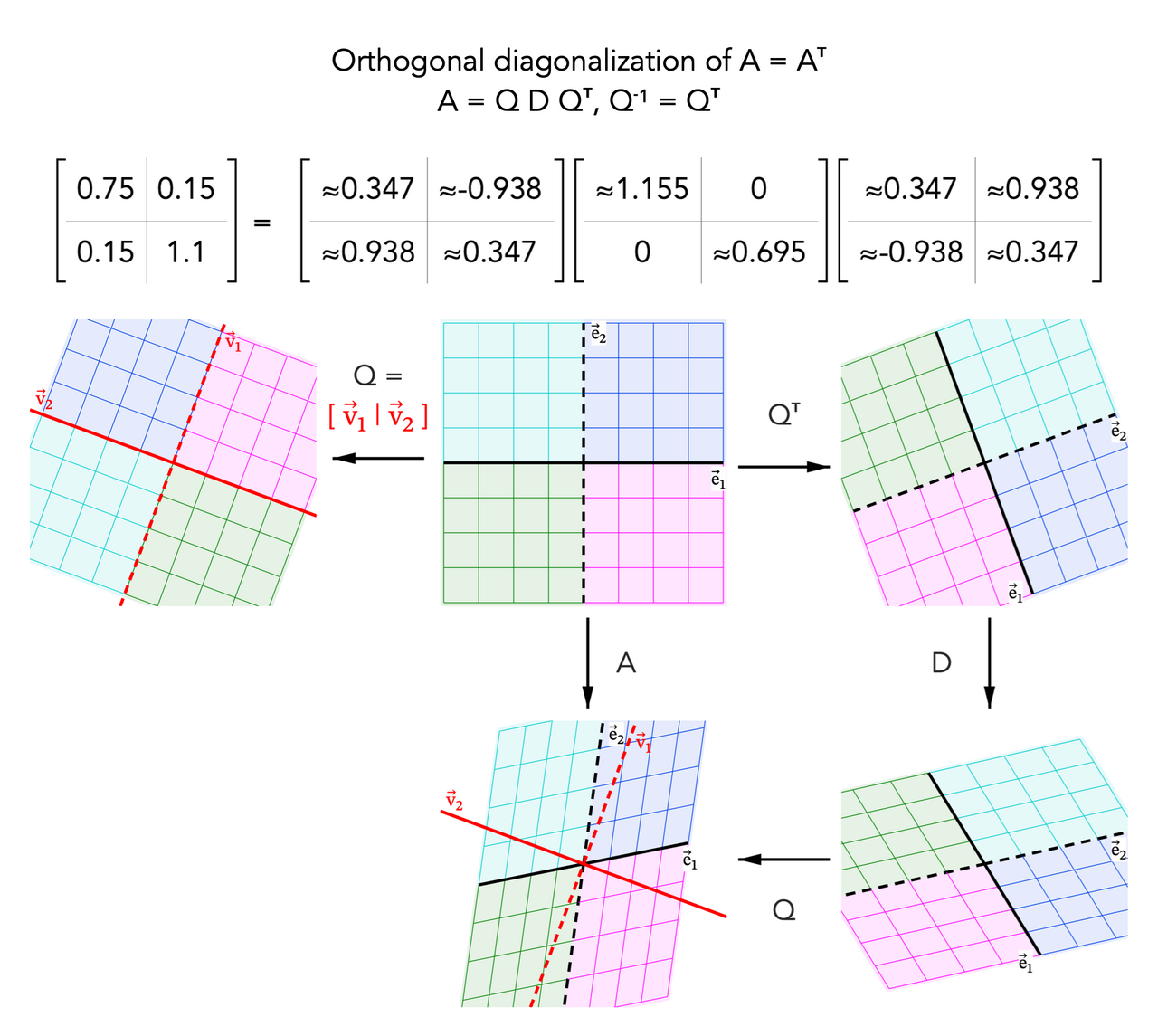
A = QQᵀD
A = QDQᵀ
A = QᵀDQ
A = DQQᵀ
Reading the right-hand route: rotate with Qᵀ, stretch with D, rotate back with Q, which equals A (matrices act right to left). The columns of Q are the orthonormal eigenvectors. Image: Eteri byazrova, CC BY-SA 4.0, via Wikimedia Commons.
If A = PDP⁻¹, which expression equals A⁵?
PD⁵P⁻¹
P⁵DP⁻¹
5PDP⁻¹
P⁵D⁵P⁻⁵
A⁵ = (PDP⁻¹)(PDP⁻¹)... = PD⁵P⁻¹ because the inner P⁻¹P pairs cancel. D⁵ is found by raising each diagonal entry to the 5th power.
A is a column-stochastic (Markov) matrix. Which number is always an eigenvalue?
−1
1/2
0
1
The rows of Aᵀ sum to 1, so Aᵀ(1, ..., 1) = (1, ..., 1), and A and Aᵀ have the same eigenvalues. The steady state is the eigenvector for 1.
A is symmetric with eigenvalues 1 and 3. What is true for the quadratic form xᵀAx?
It is negative definite
It is indefinite
It is positive definite
It is zero for some nonzero x
All eigenvalues are positive, so xᵀAx > 0 for every nonzero x. Mixed signs would make it indefinite.
True or false: row reducing A to echelon form preserves its eigenvalues.
True
False
False. Row operations do not preserve eigenvalues (for example, swapping the rows of the identity gives a matrix with eigenvalues ±1). Similarity transformations P⁻¹AP do.
True or false: A and Aᵀ have the same eigenvalues.
True
False
True, because det(Aᵀ − λI) = det((A − λI)ᵀ) = det(A − λI). They generally have different eigenvectors.
For xₖ₊₁ = Axₖ, A has eigenvalues 0.5 and −0.8. What happens to xₖ as k grows?
It oscillates forever with constant size
It depends on the sign of the eigenvalues
It grows without bound
It tends to 0
Both eigenvalues have absolute value less than 1, so 0.5ᵏ → 0 and (−0.8)ᵏ → 0. The negative eigenvalue only makes the sign alternate while it shrinks.
A real 2 × 2 matrix has the eigenvalue 3 + 2i. What is its other eigenvalue?
3 + 2i again
3 − 2i
−3 − 2i
2 + 3i
Non-real eigenvalues of a real matrix come in conjugate pairs because the characteristic polynomial has real coefficients.
