Quiz · Hard
Conditional probability, total probability, Bayes' theorem with a screening test, expected value and variance of discrete random variables.
How many different 5-card hands contain exactly 4 aces from a 52-card deck?
52
48
4
13
Choose all 4 aces (1 way) and any 1 of the other 48 cards: 48 hands.
Ten people each shake hands once with every other person. How many handshakes?
90
100
10
45
C(10,2) = 45.
A disease has 1% prevalence. A test is positive for 95% of sick people and for 5% of healthy people. What is P(disease | positive)?
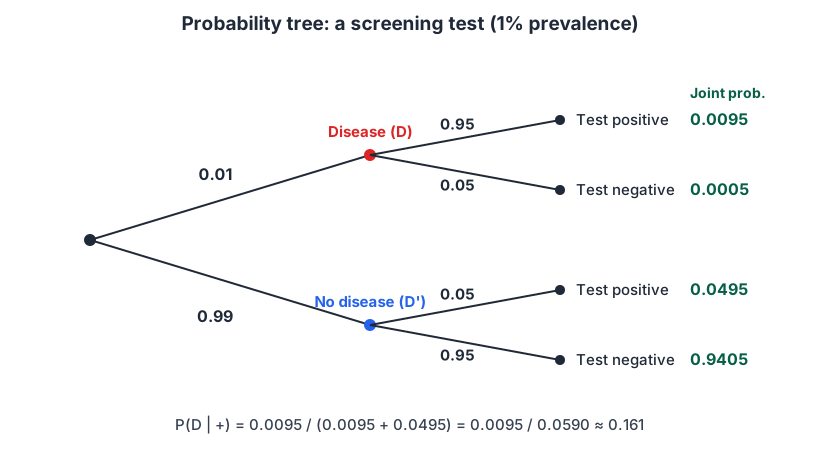
About 95%
About 16%
About 50%
About 5%
P(D and +) = 0.0095, P(+) = 0.0095 + 0.0495 = 0.059, so P(D | +) ≈ 0.161.
In the tree, what is P(positive test)?
0.059
0.95
0.0095
0.059 / 0.0095
Add the two positive paths: 0.0095 + 0.0495 = 0.0590.
A factory has machine A (60% of output, 2% defective) and machine B (40%, 5% defective). What fraction of all items is defective?
3.5%
7%
2.8%
3.2%
Total probability: 0.6(0.02) + 0.4(0.05) = 0.012 + 0.020 = 0.032.
In the factory above, an item is found defective. What is the probability it came from machine A?
0.6
0.012
0.375
0.4
P(A | D) = 0.012 / 0.032 = 0.375.
Two events with P(A) = 0.4, P(B) = 0.5 are independent. What is P(A | B)?
0.2
0.4
0.5
0.8
Independence means P(A | B) = P(A).
P(A) = 0.5, P(B) = 0.4 and A, B are mutually exclusive. What is P(A | B)?
0
0.5
0.4
0.2
They cannot occur together, so given B, A is impossible.
A random variable X has P(X=0) = 0.2, P(X=1) = 0.5, P(X=2) = 0.3. What is E(X)?
1.0
0.9
1.5
1.1
0(0.2) + 1(0.5) + 2(0.3) = 1.1.
For the distribution above, what is Var(X)?
1.1
0.7
0.49
1.21
E(X^2) = 0.5 + 4(0.3) = 1.7. Var = 1.7 - 1.1^2 = 1.7 - 1.21 = 0.49.
E(X) = 10 and Var(X) = 4. Find the mean and standard deviation of Y = 2X + 3.
Mean 23, sd 7
Mean 23, sd 4
Mean 20, sd 4
Mean 23, sd 16
E(Y) = 2(10) + 3 = 23. Var(Y) = 4(4) = 16, so sd = 4.
X and Y are independent with sd 3 and sd 4. What is the standard deviation of X + Y?
5
7
25
1
Variances add: 9 + 16 = 25, so sd = 5. Standard deviations do not add.
A raffle ticket costs $5. There is one prize of $1,000 and 500 tickets are sold. What is the expected net gain per ticket?
$2
-$5
-$1
-$3
Expected prize = 1000/500 = $2. Net = 2 - 5 = -$3.
How many distinct arrangements are there of the letters in MISSISSIPPI?
34650
39916800
11
4950
11!/(4! 4! 2!) = 39,916,800 / (24 x 24 x 2) = 34,650.
Why is Var(X - Y) = Var(X) + Var(Y) for independent X and Y?
Because the variances cancel
Because X - Y has no variance
Subtracting a variable does not reduce its variability; the variances add
Because the standard deviations multiply
Var(-Y) = (-1)^2 Var(Y) = Var(Y).
Which is the best interpretation of the law of large numbers?
After many tails, heads becomes more likely
The number of heads and tails becomes equal
The relative frequency of an event approaches its probability as trials increase
A small sample must match the true probability
It is a statement about long-run proportions, not a force that balances streaks.
In a class, 40% are seniors and 70% of seniors drive. 30% of non-seniors drive. What is P(drives)?
50%
46%
70%
40%
0.4(0.7) + 0.6(0.3) = 0.28 + 0.18 = 0.46.
The probability that at least two of 23 people share a birthday is closest to...
50%
6%
25%
90%
1 - (365/365)(364/365)...(343/365) ≈ 0.507.
Which phrase correctly describes sensitivity?
P(has the condition | positive test)
P(negative test | no condition)
P(no condition | negative test)
P(positive test | has the condition)
Sensitivity is the true positive rate. The second option is the positive predictive value.
