Quiz · Medium
Stages, schemas, conservation, ZPD, theory of mind and language, with scenario questions.
Which Piagetian stage is characterized by object permanence developing and learning through senses and movement?
Preoperational
Sensorimotor
Concrete operational
Formal operational
The sensorimotor stage (birth to about 2) is marked by learning through sensing and acting and by the emergence of object permanence.
A child fits the new animal 'zebra' into her existing 'horse' schema. This is an example of:
Accommodation
Equilibration
Assimilation
Conservation
Assimilation fits new information into an existing schema without changing it.
What does a preoperational child usually fail at when liquid is poured into a taller, thinner glass?
Object permanence
Conservation
Seriation
Symbolic play
Preoperational children centrate on height and do not conserve quantity.
Which feature of preoperational thinking best explains the three mountains task results?
Egocentrism
Reversibility
Class inclusion
Hypothetical reasoning
Preoperational children have trouble taking another's perspective, so they describe their own view.
Which ability first appears in the concrete operational stage?
Pretend play
Mental reversibility of actions
Searching for hidden objects
Primary circular reactions
Reversibility, along with conservation, appears in the concrete operational stage.
A teenager systematically tests every combination of variables to find which affects a pendulum's swing. Which stage is she showing?
Concrete operational
Preoperational
Sensorimotor
Formal operational
Systematic hypothesis testing and abstract reasoning are formal operational.
Which finding is most often used to argue Piaget underestimated infants?
Infants fail the A-not-B task
Infants look longer at physically impossible events
Infants babble at 6 months
Infants show stranger anxiety
Violation-of-expectation studies suggest infants understand some object properties much earlier than Piaget claimed.
Vygotsky's zone of proximal development refers to:
Tasks a learner can do independently
Tasks a learner cannot do even with help
Tasks a learner can do only with guidance
The stage after formal operations
The ZPD is the range between independent performance and what can be done with help.
Which statement best contrasts Piaget and Vygotsky?
Piaget stressed social interaction; Vygotsky stressed biology alone
Piaget stressed individual exploration; Vygotsky stressed social and cultural influence
Both said stages are fixed and universal
Both rejected the idea that children construct knowledge
Piaget emphasized independent discovery; Vygotsky emphasized guided learning through social interaction.
A teacher gives hints at first, then fewer as the student improves. This is best called:
Habituation
Scaffolding
Assimilation
Imprinting
Scaffolding is temporary support that is removed as competence grows.
A 3-year-old says Sally will look in the box, where the marble really is, in the Sally-Anne task. What does this suggest?
Difficulty with false beliefs
Advanced theory of mind
Formal operations
Secure attachment
Children under about 4 usually fail because they do not yet grasp that others can hold false beliefs.
In the visual cliff experiment, most infants who could crawl:
Crossed the deep side readily
Refused to cross the deep side
Cried on the shallow side
Only crossed with a stranger present
They refused to cross onto the deep side, indicating depth perception.
Saying 'goed' instead of 'went' is an example of:
Telegraphic speech
Overregularization
Babbling
Fast mapping
Overregularization shows that children apply grammar rules to irregular words.
Chomsky's explanation for language acquisition relies mainly on:
Reinforcement
An innate capacity for grammar
Imitation only
Operant shaping
Chomsky proposed an innate language acquisition device or universal grammar.
An infant's looking time increases when a new picture replaces a repeated one. Researchers call this:
Habituation
Imprinting
Dishabituation
Assimilation
Renewed attention to a new stimulus after habituation is dishabituation.
Which pair is mismatched?
Egocentrism: preoperational
Conservation: concrete operational
Object permanence: sensorimotor
Abstract reasoning: preoperational
Abstract, hypothetical reasoning is formal operational, not preoperational.
A child is shown three containers like the ones in the photo and says the tall glass holds more liquid than a wide cup holding the same amount. Which concept is missing?
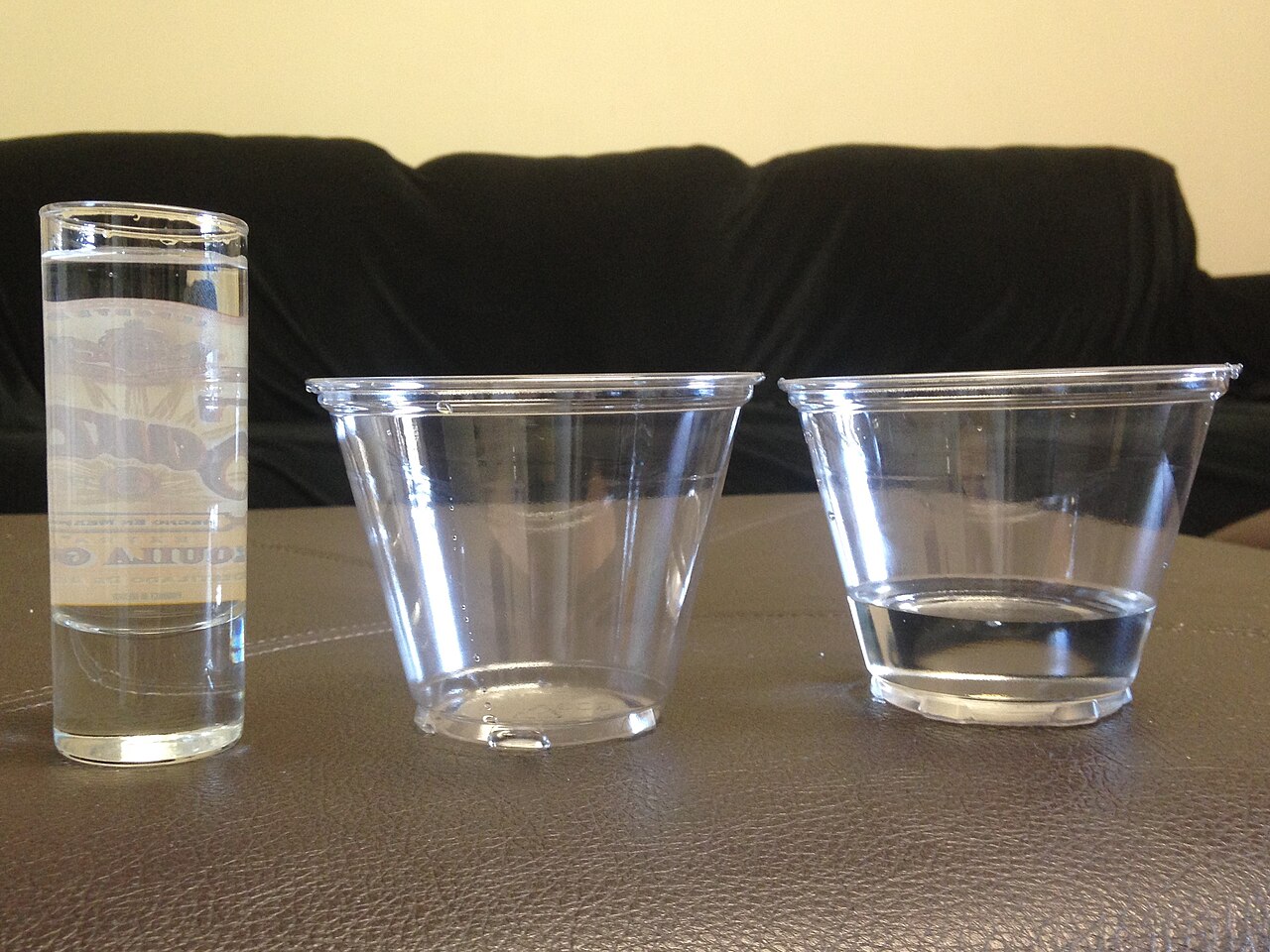
Conservation
Object permanence
Assimilation
Theory of mind
Children who judge by height alone have not yet gained conservation of liquid quantity.
Infants of crawling age are placed on the glass apparatus shown and called by their mother. Most refuse to cross the 'deep' side. What does this show?
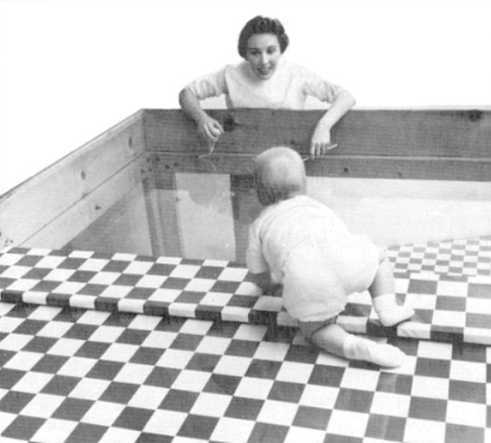
Infants can perceive depth
Infants have no fear
Infants imitate their mothers
Infants lack object permanence
Gibson and Walk's visual cliff indicates that depth perception is present by the time infants crawl.
