Quiz · Medium
Twenty questions on set operations, inclusion-exclusion, Venn regions, injective and surjective functions, relation properties and countability.
How many subsets does the set have?
10
32
25
120
Each of the 5 elements is either in or out, giving 2^5 = 32 subsets. 25 is 5^2, 10 is the number of 2-element subsets, and 120 is 5!.
In the Venn diagram, which region(s) represent ?
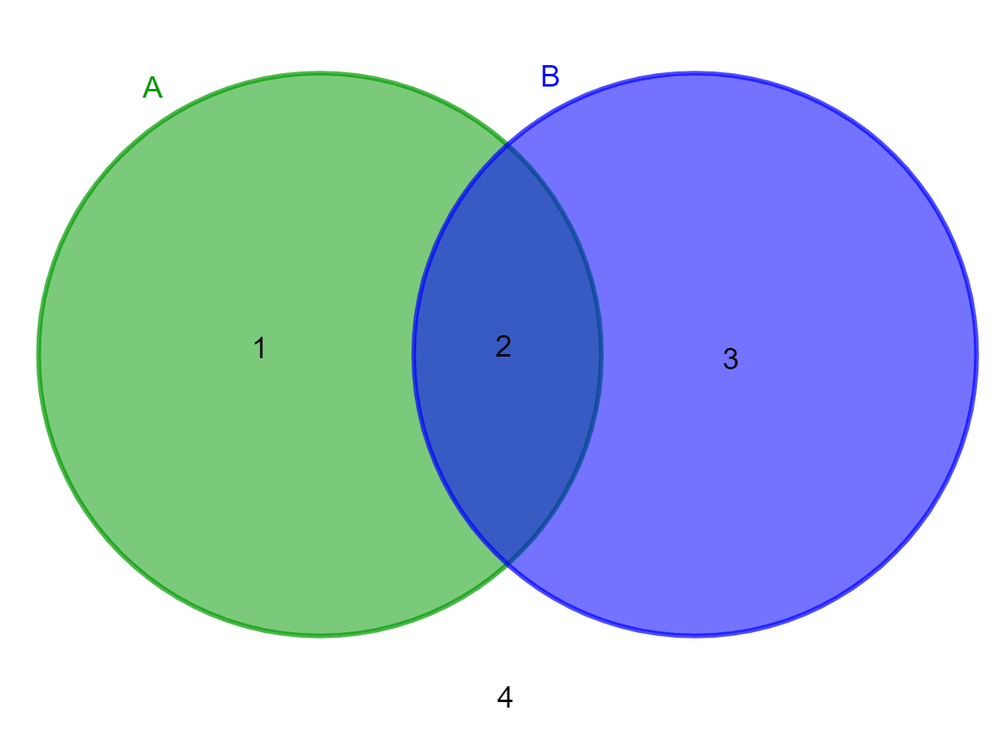
Region 1
Region 2
Region 3
Region 4
Region 3 lies in B but outside A. Region 1 is A only, region 2 the overlap and region 4 is outside both circles. Image: Addemf, CC0, via Wikimedia Commons.
Which statement is true for all sets A and B?
Everything in both sets is certainly in at least one of them. The others are false in general: the union equals the intersection only when A = B, A \ B differs from B \ A, and the size formula needs the sets to be disjoint.
Which is ?
De Morgan: the complement of a union is the intersection of the complements. Choice A is the complement of the intersection.
Evaluate
0
2
1
3
The two elements are the empty set and the set containing the empty set. They are different objects, so the size is 2.
A survey of 120 people: 70 own a dog, 50 own a cat, 20 own both. How many own neither?
10
30
40
20
|D ∪ C| = 70 + 50 - 20 = 100, so 120 - 100 = 20 own neither. Forgetting to subtract the overlap gives 0.
The function , is
injective but not surjective
surjective but not injective
bijective
neither injective nor surjective
Different integers have different doubles (injective), but odd numbers are never hit (not surjective).
The function , is
injective but not surjective
surjective but not injective
bijective
neither
Cubing is strictly increasing (injective) and every real number has a real cube root (surjective). x^2 is the one that fails both on the reals.
Let and . What is ?
13
37
15
20
f(2) = 5, then g(5) = 15. Computing f(g(2)) = f(6) = 37 reverses the order.
Which relation on the integers is an equivalence relation?
Congruence mod 5 is reflexive, symmetric and transitive. 'a ≤ b' and 'a divides b' are not symmetric; '|a - b| ≤ 1' is not transitive (0, 1, 2).
Which relation is a partial order on the positive integers?
a is congruent to b mod 3
a divides b
a and b are coprime
a != b
Divisibility is reflexive, antisymmetric and transitive. The others lack antisymmetry or transitivity or reflexivity.
How many relations are there on the set ?
4
8
2
16
A x A has 4 ordered pairs; each pair is in or out of the relation, giving 2^4 = 16 relations.
The relation on is
symmetric
reflexive
an equivalence relation
a partial order
(1,2) and (2,1) are both present so it is symmetric. It is not reflexive (no (2,2) or (3,3)), so it is not an equivalence relation, and it is not antisymmetric because (1,2) and (2,1) have 1 != 2.
The Hasse diagram of the power set of {x, y, z} ordered by inclusion has how many edges (drawn lines)?
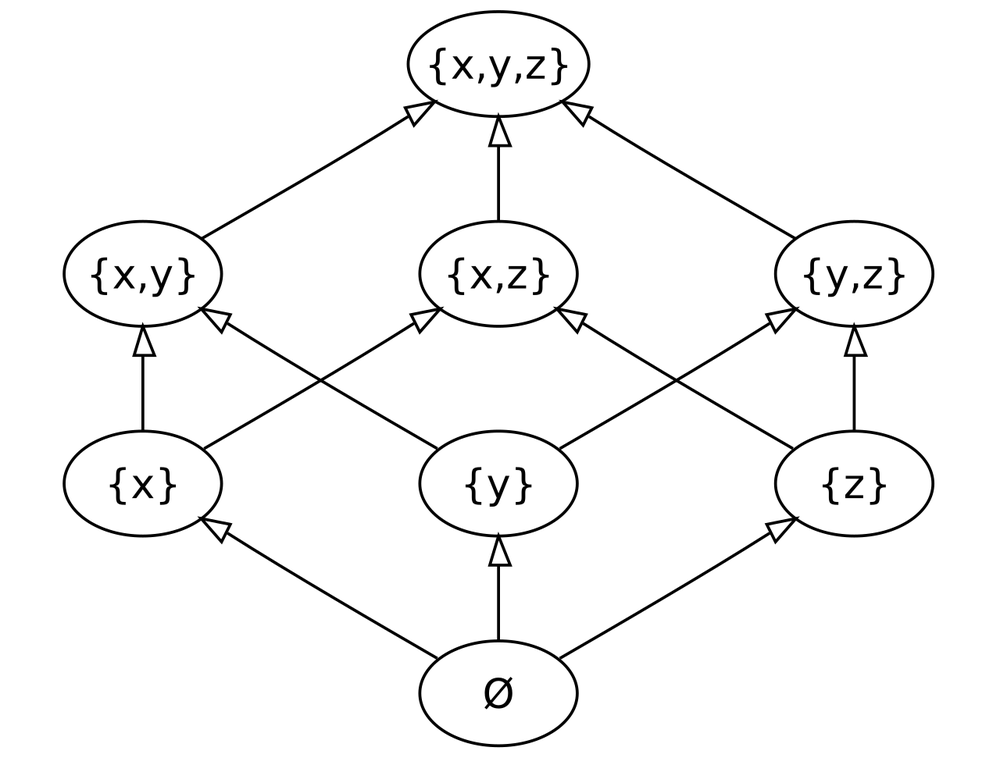
8
12
9
16
Covering pairs: 3 from the empty set to singletons, 6 from singletons to pairs (each singleton is in 2 pairs), 3 from pairs to the full set: 12 in total. Image: KSmrq, CC BY-SA 3.0, via Wikimedia Commons.
Which of these sets is NOT countable?
the set of all finite binary strings
the set of all infinite binary sequences
Infinite binary sequences are uncountable by Cantor's diagonal argument (they correspond to subsets of N). The other three can all be listed.
True or false: for every set A, including infinite ones.
True
False
This is Cantor's theorem: no function from A onto P(A) exists. It gives an endless ladder of larger infinities.
If and , how many injective functions are there?
15
125
60
243
5 * 4 * 3 = 60 (the first input has 5 targets, the next 4, the last 3). 125 = 5^3 counts all functions; 243 is 3^5.
Which expression is equal to ?
An element of A avoiding B ∪ C must avoid B and avoid C, so it lies in both differences. Choice A would only require avoiding one of them.
What are and in this diagram, where B sits inside A?
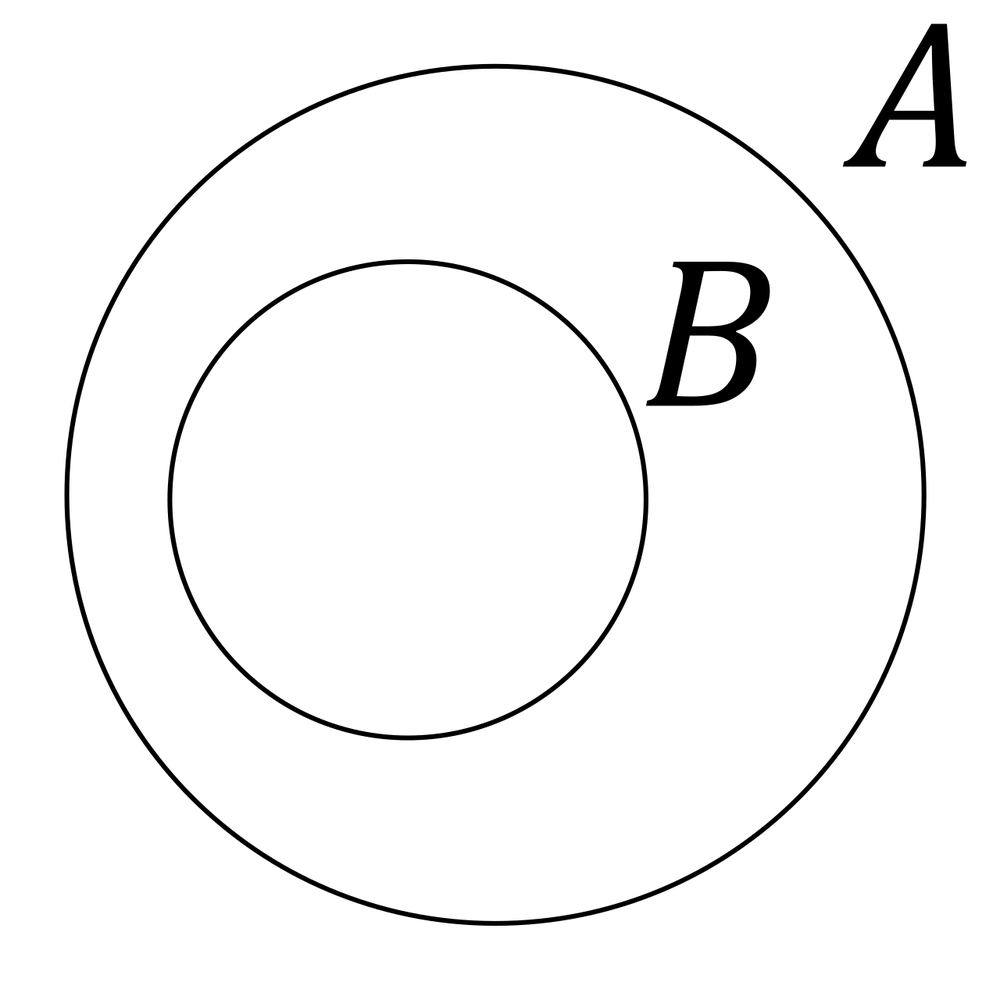
B is a subset of A, so everything in B is in A: the intersection is B, the union is A. Image: Fleshgrinder, public domain, via Wikimedia Commons.
Which statement about and is correct?
The first is always a subset of the second, and they are often not equal
They are always equal
The second is always a subset of the first
They are disjoint
Any subset of A or of B is a subset of A ∪ B, but a subset like {a, b} (one element from each) lies only in the right-hand side.
