Quiz · Medium
Twenty-one questions on recognizing linear maps, standard matrices, kernel and image, rank-nullity, and the geometry of rotations, reflections, shears and projections (with pictures).
Which transformation has determinant −1?
Uniform scaling by 2
Rotation by 30°
Reflection in the y-axis
Horizontal shear
A reflection reverses orientation, so its determinant is −1. Rotations and shears have determinant 1 and scaling by 2 has determinant 4 in the plane.
T_A is applied first and then T_B. What is the matrix of the combined map?
BA
A + B
A⁻¹B
AB
The map applied first sits next to the input vector, so (T_B ∘ T_A)(x) = B(Ax) = (BA)x. Because AB and BA usually differ, the order matters.
Which map T: ℝ² → ℝ² is linear?
T(x, y) = (xy, x)
T(x, y) = (2x − y, x + 3y)
T(x, y) = (|x|, y)
T(x, y) = (x + 1, y)
Only (2x − y, x + 3y) has components that are linear expressions without constants, products or absolute values. T(0, 0) = (1, 0) for the first, xy breaks homogeneity in the second, and |x| breaks additivity in the fourth.
What is the standard matrix of T(x, y) = (2x − y, x + 3y)?
The columns are T(e₁) = (2, 1) and T(e₂) = (−1, 3). The second option writes the images as rows (the transpose), a common slip.
T is linear with T(1, 0) = (2, 3) and T(0, 1) = (−1, 4). What is T(3, −2)?
(8, 1)
(4, 17)
(8, −3)
(4, −1)
T(3, −2) = 3(2, 3) − 2(−1, 4) = (6 + 2, 9 − 8) = (8, 1). Linearity lets you expand in the basis vectors.
A linear map f: ℝ² → ℝ² has the kernel and image shown. Which statement is correct?
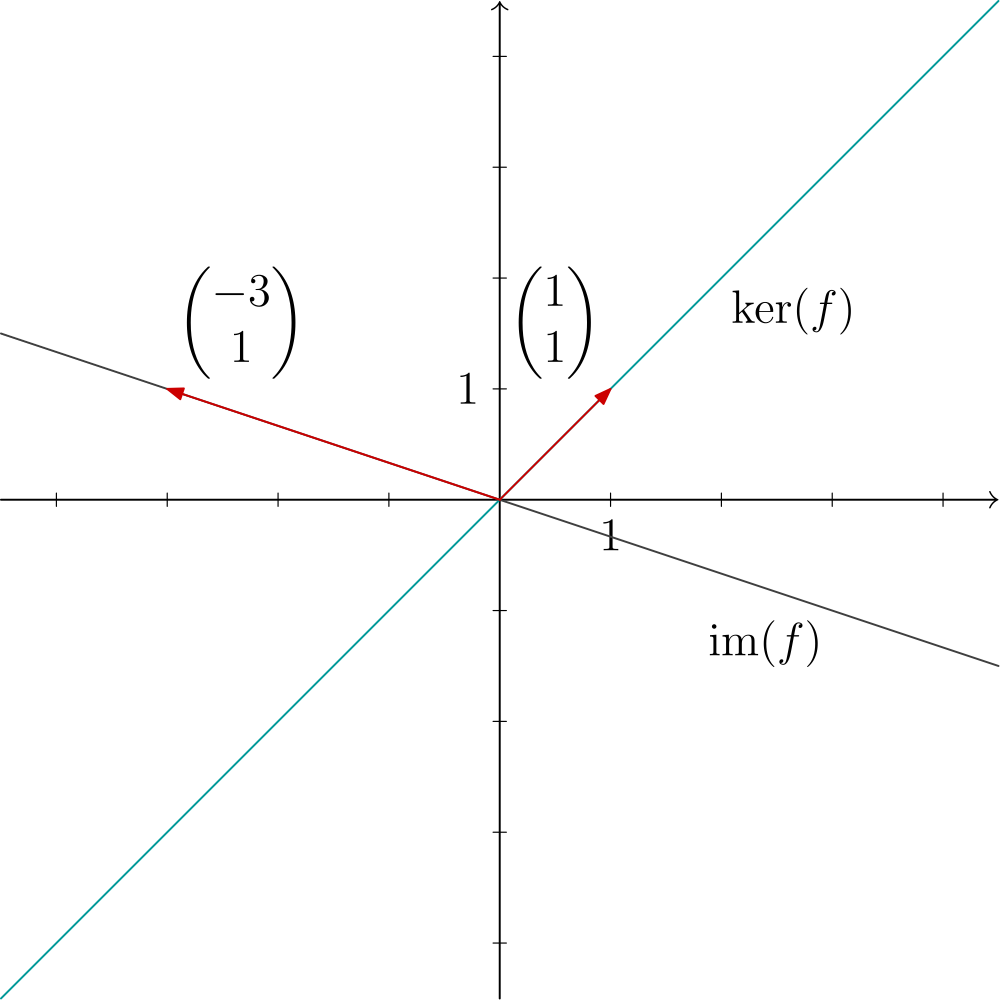
ker f is the dark line spanned by (−3, 1)
ker f = ℝ²
ker f = {0}
ker f is the teal line spanned by (1, 1)
The label ker(f) is on the teal line through (1, 1): those vectors are sent to 0. The dark line through (−3, 1) is the image, so f has rank 1 and nullity 1. Image: GruenerBogen, CC BY-SA 4.0, via Wikimedia Commons.
T: ℝ⁵ → ℝ³ is linear and onto. What is dim ker T?
2
3
8
0
Rank-nullity: dim ker T = 5 − rank T = 5 − 3 = 2.
A linear map T is injective exactly when:
Its matrix is square
Its determinant is 1
Its image is the whole codomain
Its kernel is {0}
If T(u) = T(v) then T(u − v) = 0, so injectivity is equivalent to a trivial kernel. A full image is surjectivity, a different property.
Which matrix rotates the plane by 90° counterclockwise?
Rotation by θ is [[cos θ, −sin θ], [sin θ, cos θ]], and for θ = 90° this is [[0, −1], [1, 0]]. The first option is a clockwise rotation, the third a reflection in the x-axis and the fourth a reflection in y = x.
Which picture shows the image of the unit square under ? (In each picture the dashed square is the unit square, the red arrow is the image of e₁, the green arrow is the image of e₂ and the blue region is the image of the unit square.)
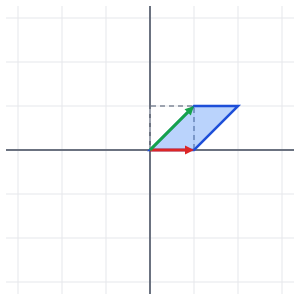
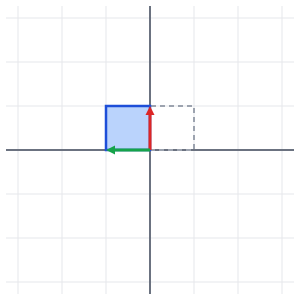
The columns are (1, 0) and (1, 1): e₁ stays fixed and e₂ moves to (1, 1), giving a sheared parallelogram. The other pictures show a rotation, a reflection and a stretch.
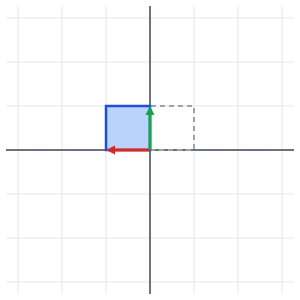
Which picture shows the image of the unit square under ? (In each picture the dashed square is the unit square, the red arrow is the image of e₁, the green arrow is the image of e₂ and the blue region is the image of the unit square.)
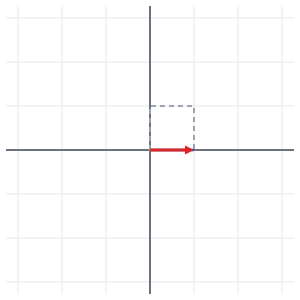
e₁ goes to (0, 1) and e₂ goes to (−1, 0): a 90° counterclockwise rotation, leaving the square in the upper-left quadrant. The reflection in y = x would send e₁ to (0, 1) and e₂ to (1, 0).
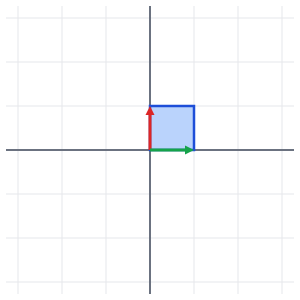
Which picture shows the image of the unit square under ? (In each picture the dashed square is the unit square, the red arrow is the image of e₁, the green arrow is the image of e₂ and the blue region is the image of the unit square.)
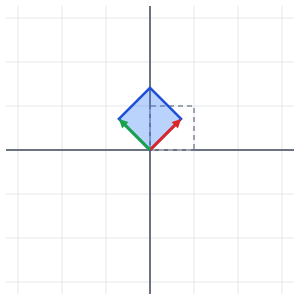
The columns are (0, 1) and (1, 0): the images of e₁ and e₂ are swapped, which is the reflection in y = x. The unit square maps onto itself, only with the red and green arrows exchanged.
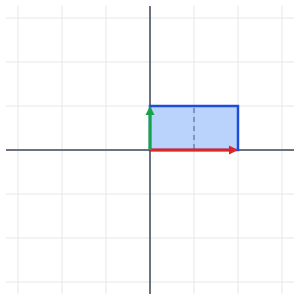
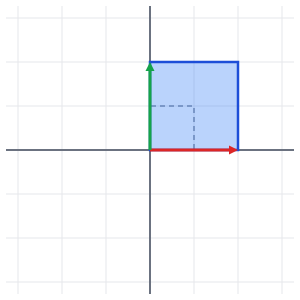
Which picture shows the image of the unit square under ? (In each picture the dashed square is the unit square, the red arrow is the image of e₁, the green arrow is the image of e₂ and the blue region is the image of the unit square.)
e₁ goes to (2, 0) and e₂ stays at (0, 1), so the square becomes a 2 × 1 rectangle. Uniform scaling by 2 (first option) would also double the height.
What is the kernel of the projection of ℝ² onto the x-axis?
The x-axis
The y-axis
{0}
ℝ²
The projection sends (x, y) to (x, 0); it is zero exactly when x = 0, i.e. on the y-axis. The x-axis is the image.
What is the kernel of differentiation D: P₃ → P₂?
The constant polynomials
The linear polynomials
All of P₃
{0}
The derivative of p is 0 exactly when p is constant. The kernel has dimension 1, and D is onto P₂ since 4 = 1 + 3.
Can a linear map T: ℝ⁴ → ℝ³ be injective?
Only if it is onto
Yes, if its matrix has rank 3
Yes, if det ≠ 0
No, its nullity is at least 1
The rank is at most 3, so by rank-nullity the nullity is at least 4 − 3 = 1. A nontrivial kernel means T is not injective.
What is the inverse of the shear ?
To undo the shear x → x + 2y, shear back by −2: the inverse is [[1, −2], [0, 1]]. Check: [[1, 2], [0, 1]] · [[1, −2], [0, 1]] = I.
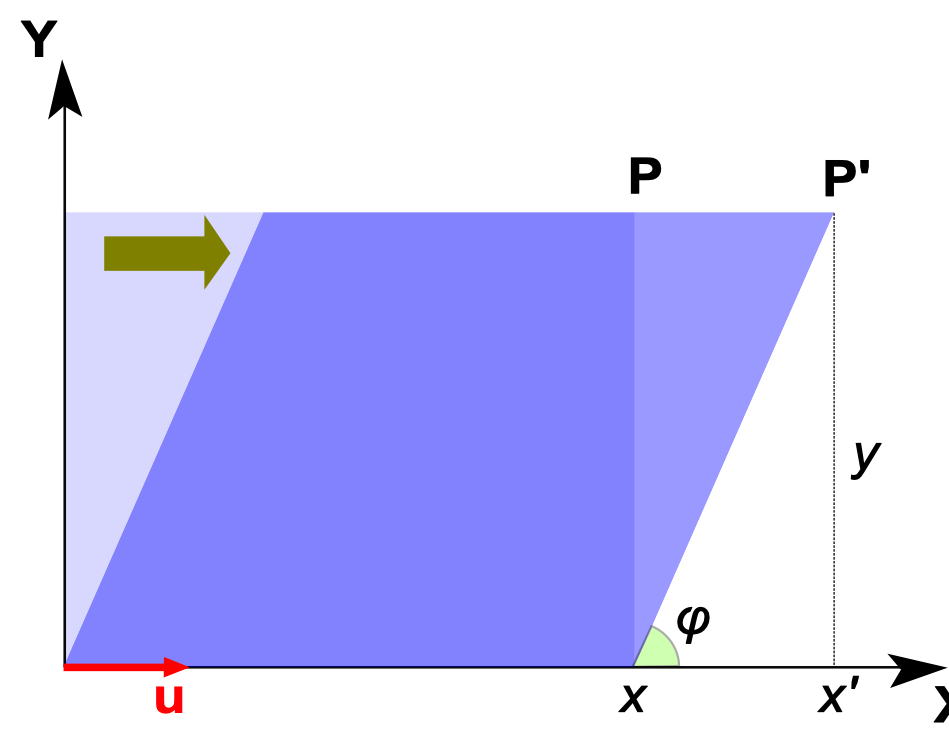
The picture shows a rectangle moved into a parallelogram with horizontal lines staying at the same height. What is this transformation?
Uniform scaling
Rotation
Reflection
Horizontal shear
Every point moves horizontally by an amount proportional to its height: (x, y) → (x + ky, y). Rotations and reflections do not tilt only the vertical sides, and scaling would change the heights. Image: Lyudmil Antonov, CC BY-SA 4.0, via Wikimedia Commons.
A = [[2, 1], [0, 3]] acts on the unit square. What is the area of its image?
5
6
1
3
The area scale factor is |det A| = |2·3 − 1·0| = 6. Adding the diagonal entries (5) is the trace, which does not measure area.
True or false: every linear transformation sends the zero vector to the zero vector.
True
False
True: T(0) = T(0·v) = 0·T(v) = 0. This is why translations are not linear.
In the picture, which matrix is the rotation R_z(γ) about the z-axis (blue)?
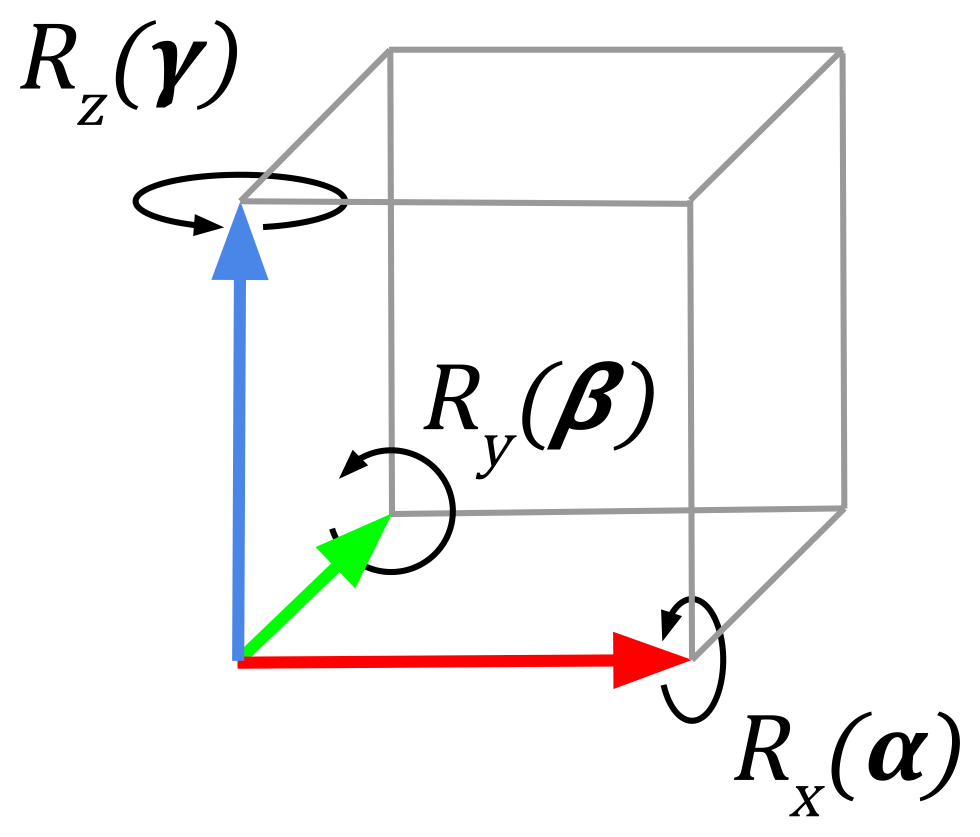
A rotation about the z-axis leaves the z-coordinate alone (the 1 in the last diagonal slot) and rotates the xy-plane by γ. The first option is R_x, the third is R_y and the last rotates by −γ. Image: AIphonsio, CC BY-SA 4.0, via Wikimedia Commons.
