Quiz · Medium
Working memory, long-term memory systems, encoding, interference and reconstructive memory.
Studying a list of Spanish words and finding it harder to recall French words learned earlier is an example of:
Retroactive interference
Proactive interference
Decay
Source amnesia
New learning interferes with older memories (retroactive). If new learning is disrupted by old learning, it is proactive.
Which finding supports a limited-capacity short-term memory of about four chunks?
Cowan (2001)
Ebbinghaus (1885)
Bartlett (1932)
Sperling's full-report task only
Cowan argued that Miller's 7 plus or minus 2 overestimated capacity once chunking and rehearsal are controlled.
A student recalls the first and last items of a list best. This is explained by:
The serial position effect
The spacing effect
Proactive interference only
Source amnesia
Primacy reflects transfer to long-term memory and recency reflects items still in short-term memory.
Which component of Baddeley's model would be most involved in mentally rehearsing a phone number?
Visuospatial sketchpad
Central executive only
Phonological loop
Episodic buffer
The phonological loop holds and rehearses verbal and acoustic information.
Retrieval is best when the conditions at recall match those at learning. This is the:
Levels of processing framework
Encoding specificity principle
Misinformation effect
Testing effect
Tulving and Thomson's encoding specificity principle.
In Godden and Baddeley's study, divers recalled most words when they:
Learned on land and were tested underwater
Learned underwater and were tested on land
Learned and were tested in the same environment
Learned the lists twice
Matching environments gave better recall, a demonstration of context-dependent memory.
Which statement about H.M.'s amnesia is correct?
He could not learn new motor skills
He could not form new explicit memories but could learn skills
He lost all earlier memories only
His intelligence was impaired severely
H.M. showed anterograde amnesia with preserved procedural learning, such as mirror drawing.
Which processing is predicted to lead to the best long-term recall under Craik and Lockhart's framework?
Structural (appearance)
Phonemic (sound)
Semantic (meaning)
Rote maintenance only
Deeper, meaning-based processing produces stronger memory traces.
In Loftus and Palmer's study, witnesses asked about cars that 'smashed' into each other:
Estimated lower speeds
Estimated higher speeds and more often recalled nonexistent glass
Gave identical estimates for all verbs
Remembered fewer details of the film
Leading wording altered both speed estimates and later recollection.
A person remembers a fact from a TV show but thinks a friend told her. This error is called:
Source misattribution (source amnesia)
Retroactive interference
Flashbulb memory
Chunking
The content is remembered but the source is forgotten or confused.
Bartlett's 'War of the Ghosts' study supports which view?
Memory is a perfect recording
Memory is reconstructive and shaped by schemas
Forgetting is only due to decay
Implicit memory is unimpaired
Participants altered the story to fit their cultural expectations.
After 18 seconds of counting backward, recall of a trigram falls to about 10 percent. This shows:
Short-term memory fades quickly without rehearsal
Long-term memory has limited capacity
Implicit memory is fragile
Iconic memory lasts 18 seconds
This is the Peterson and Peterson finding.
Which memory type is a person using to ride a bike?
Episodic
Semantic
Procedural
Flashbulb
Procedural memory is for skills and habits and is implicit.
Which study strategy is best supported by research on retention?
Re-reading notes repeatedly
Massing all study in one night
Spaced retrieval practice
Highlighting
Spacing and testing both promote long-term retention.
According to the multi-store diagram, information in short-term memory is forgotten through:
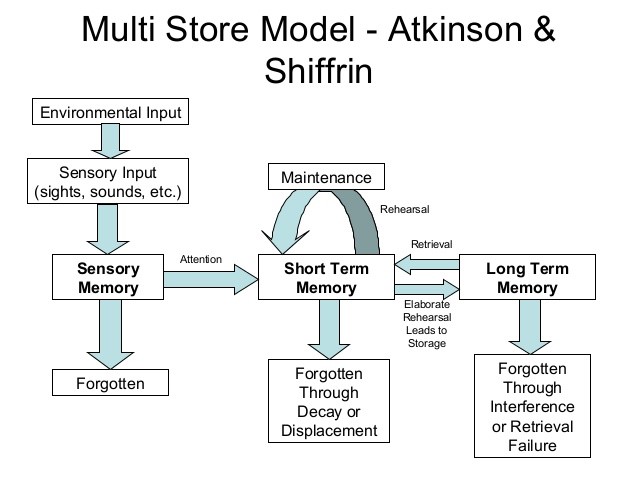
Decay or displacement
Interference or retrieval failure
Elaborate rehearsal
Attention
The diagram labels STM loss as decay or displacement and LTM loss as interference or retrieval failure.
The graph shows a U-shaped curve of recall by position. The raised right end reflects:
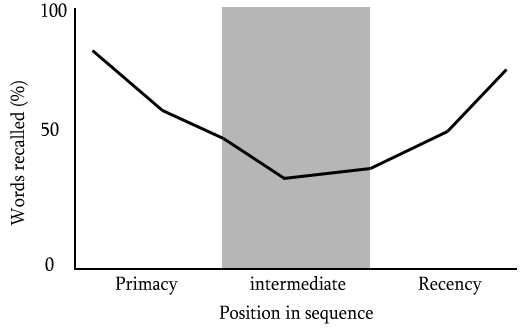
Primacy effect
Recency effect
Spacing effect
Levels of processing
Recent items are still in short-term memory at recall.
