Quiz · Medium
Foundational practice with the graphical side of derivatives: matching f, f' and f'', tangent and secant lines, differentiability, extrema, concavity and the Mean Value Theorem.
The graph shows , the derivative of . On which intervals is increasing?
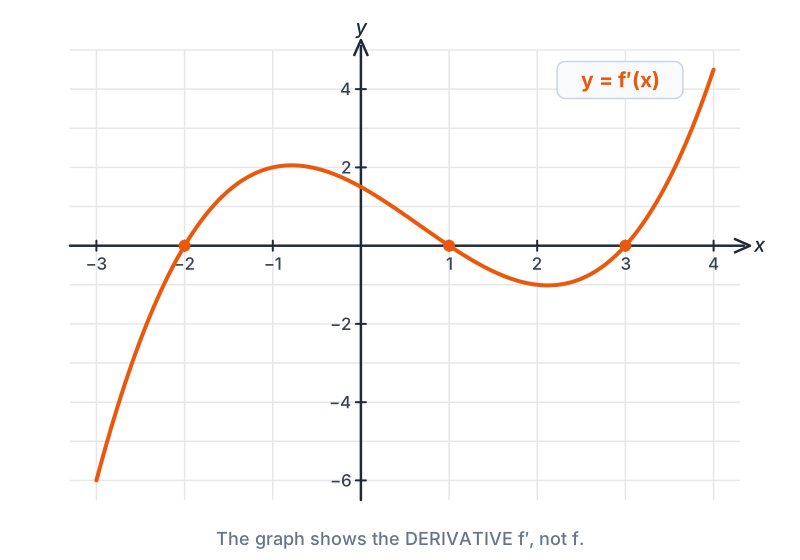
and
and
f is increasing where f' > 0, which is where the graph is above the x-axis. The tempting answer (-∞, -2) and (1, 3) is where f' < 0, so f is decreasing.
The graph shows . At which x-value does have a local maximum?
A local max of f occurs where f' changes from positive to negative: at x = 1. At x = -2 and x = 3 the sign goes from negative to positive (local minima). x ≈ -0.8 is a peak of f', which is an inflection point of f.
The graph shows . What is the sign of ?
Positive, because
Zero, because has no critical point there
It cannot be determined from the graph
Negative, because is decreasing at
f'' is the slope of the graph of f'. At x = 0 the graph slopes downward, so f''(0) < 0. The value f'(0) > 0 only tells you that f is increasing.
The graph shows . How many inflection points does have?
1
2
3
0
Inflection points of f occur where f' has a local maximum or minimum (f'' changes sign). The graph of f' has one peak and one valley.
For (shown), which graph is ?
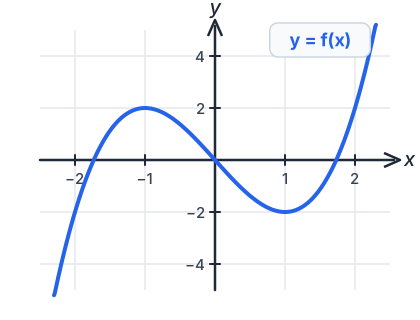
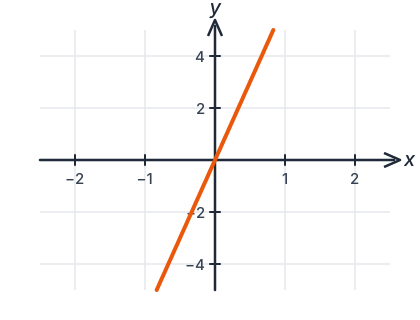
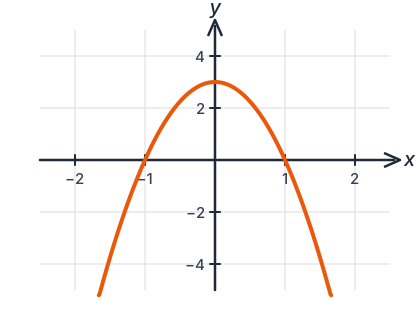
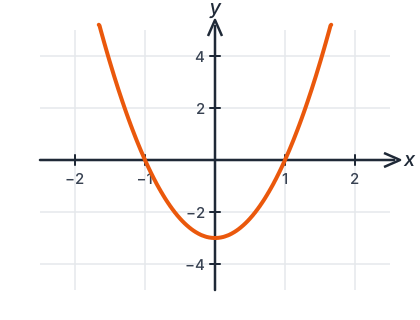
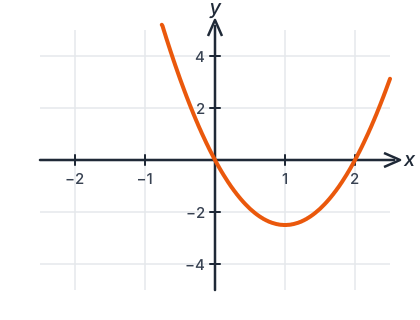
f'(x) = 3x² - 3 is an upward parabola with zeros at x = ±1 and y-intercept -3. The line is f''-shaped, the downward parabola is -f', and the shifted parabola has zeros at 0 and 2.
For (shown), which graph is ?
f''(x) = 6x is a line through the origin with positive slope. f' is the parabola; the other two are transformations of it.
Which of the four panels shows a point where the function is NOT continuous?
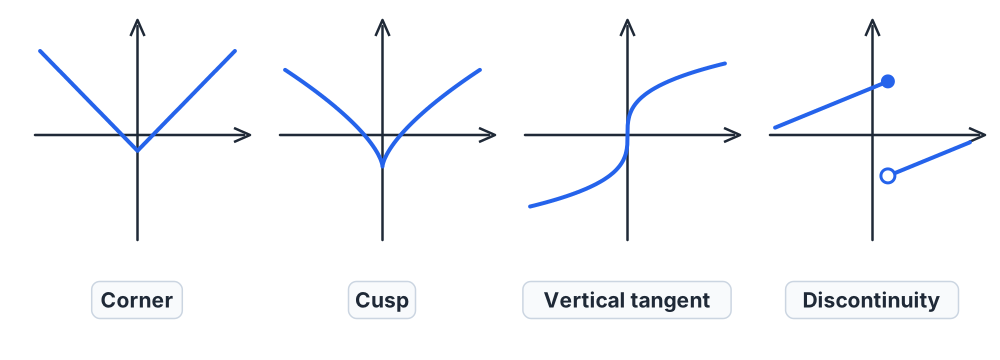
The first panel (corner)
The fourth panel (discontinuity)
The second panel (cusp)
The third panel (vertical tangent)
The corner, cusp and vertical tangent are all continuous but not differentiable. Only a jump, hole or asymptote breaks continuity.
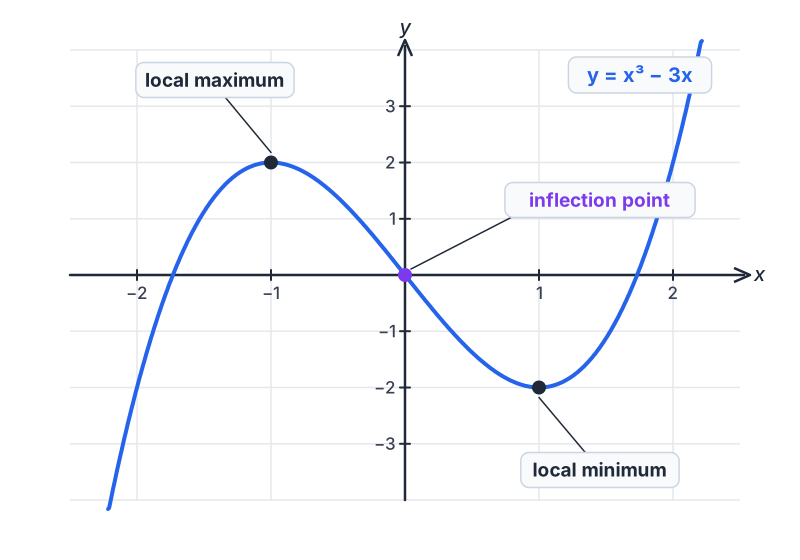
For (graph shown), what happens at ?
Local maximum
Local minimum
Critical point, because y' = 0
Inflection point: y'' = 6x changes sign
y'(0) = -3, not 0, so x = 0 is not a critical point. y'' changes from negative to positive, so the concavity changes.
In the diagram, which expression is the slope of the secant line through P and Q?
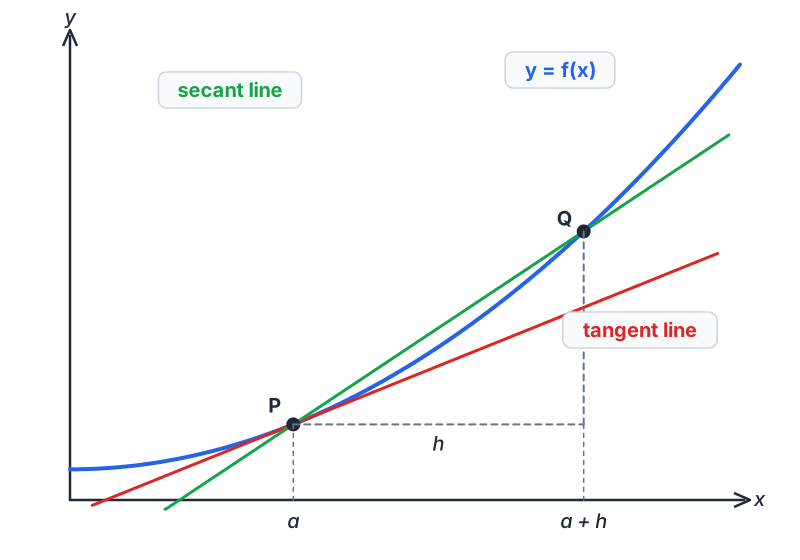
Slope is rise over run. f'(a) is the limit of this slope as h goes to 0, so it is the slope of the tangent, not the secant.
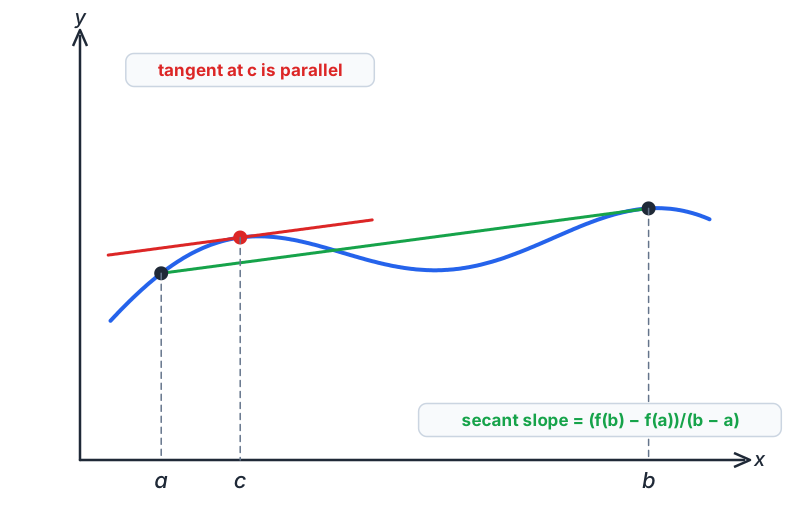
In the Mean Value Theorem diagram, what is true at the point c?
The tangent line at c is horizontal
c is the midpoint of [a, b]
The tangent line at c is parallel to the secant line from a to b
f(c) is the average of f(a) and f(b)
The MVT says f'(c) equals the average rate (f(b) - f(a))/(b - a). c is not necessarily the midpoint, and the tangent is horizontal only in Rolle's special case.
Use the linearization of at , , to estimate .
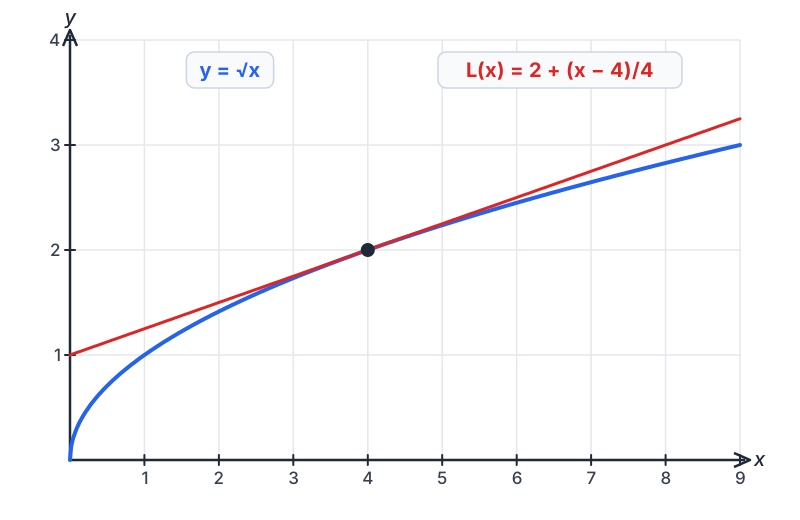
L(3.9) = 2 + (1/4)(-0.1) = 1.975. The 2.025 option has the wrong sign for x - 4.
A table gives f(1) = 4, f(2) = 7 and f(3) = 12. Which is the best estimate of f'(2) using the points on both sides?
5
4
3
7
The symmetric difference quotient is (f(3) - f(1))/(3 - 1) = 8/2 = 4. Using only one side gives 5 (right) or 3 (left).
Find the slope of the tangent line to at .
y' = -x/y = -3/(-4) = 3/4. The tempting -3/4 comes from forgetting that y is negative at this point.
What is for ?
Variable base and exponent: use ln y = x ln x, so y'/y = ln x + 1. The power rule alone gives x·x^(x-1) = x^x, and the exponential rule alone gives x^x ln x; neither is complete.
If , what is ?
f(1) = 2, so a = 1 and f'(1) = 4; the answer is 1/f'(1) = 1/4. Using 1/f'(2) = 1/13 is the common mistake: the derivative of f is taken at a, where f(a) = 2.
What is ?
Chain rule: 1/(1 + u²) times u' with u = 2x. That gives 2/(1 + 4x²); squaring u gives 4x², not 2x².
If f'(c) = 0, then f must have a local maximum or minimum at c.
True
False
A critical point is only a candidate. f(x) = x³ has f'(0) = 0 but no extremum.
If f is continuous at x = a, then f is differentiable at x = a.
True
False
|x| is continuous at 0 but has a corner there. The true statement is the reverse: differentiable implies continuous.
If f''(c) = 0, then (c, f(c)) is an inflection point.
True
False
The concavity must change. f(x) = x⁴ has f''(0) = 0 but is concave up on both sides.
Which is true if f''(x) < 0 on (a, b)?
The graph of f is decreasing
The graph of f is concave up and its tangent lines lie below the curve
f has a local minimum in (a, b)
The graph of f is concave down and its tangent lines lie above the curve
f'' < 0 means f' is decreasing, so the curve bends downward and lies below its tangents. It says nothing about whether f itself increases or decreases.
