Quiz · Medium
Hypotheses, p-values, significance level, Type I and II errors, power and correct conclusions.
Which is a correctly stated null hypothesis?
mu > 100
mu = 100
x-bar = 100
mu is not 100
The null hypothesis is about a population parameter and includes equality.
A researcher wants to show a new teaching method raises the mean score above 70. The hypotheses are...
H0: mu = 70, Ha: mu > 70
H0: mu > 70, Ha: mu = 70
H0: mu = 70, Ha: mu < 70
H0: x-bar = 70, Ha: x-bar > 70
Ha states the claim to be supported, in the right direction.
The p-value is the probability of...
H0 being true
H0 being false
Making a Type II error
Data at least this extreme if H0 is true
It is computed assuming H0 is true.
A test gives p = 0.03. At alpha = 0.05, what is the decision?
Fail to reject H0
Accept Ha with 97% probability
Reject H0
Accept H0
0.03 < 0.05, so reject H0 (statistically significant).
A test gives p = 0.12. At alpha = 0.05, the correct conclusion is...
H0 is proven true
Fail to reject H0; the evidence is not strong enough
The probability that H0 is true is 12%
Reject H0
A large p-value is just insufficient evidence against H0.
Which statement about the p-value is TRUE?
A smaller p-value gives stronger evidence against H0
It is the probability that H0 is true
It is the size of the effect
It equals alpha
It measures how unlikely the data are under H0.
A Type I error occurs when we...
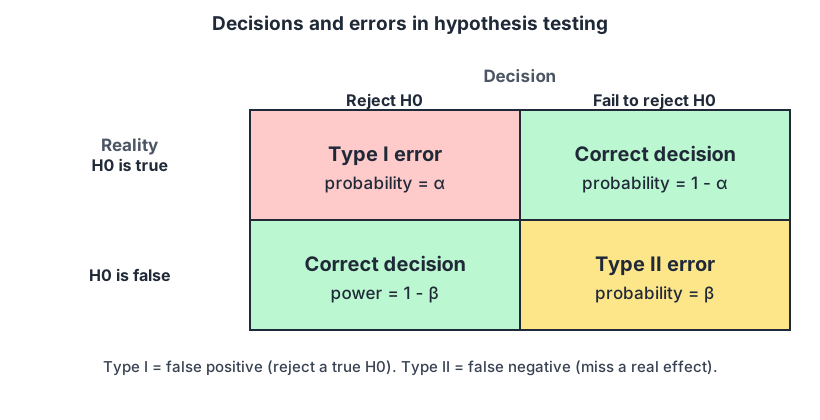
Fail to reject a false null hypothesis
Reject a false null hypothesis
Fail to reject a true null hypothesis
Reject a true null hypothesis
Type I is a false positive.
A Type II error occurs when we...
Reject a true null hypothesis
Choose alpha too large
Fail to reject a false null hypothesis
Use the wrong test statistic
It is a false negative, with probability beta.
The probability of a Type I error equals...
beta
alpha
1 - alpha
the p-value
alpha is the chosen risk of rejecting a true H0.
Power of a test is...
1 - beta
alpha
1 - alpha
beta
Power = P(reject H0 | H0 false).
Which change increases the power of a test?
Decreasing alpha
Using a smaller effect size
Increasing the population variability
Increasing the sample size
More data reduces the standard error, making real effects easier to detect.
If you lower alpha from 0.05 to 0.01 with the same sample, then...
Power increases
The Type I error increases
The Type II error probability (beta) increases
The critical value decreases
A stricter threshold makes rejecting harder, so beta rises and power falls.
For a two-tailed z test at alpha = 0.05, reject H0 if z is...
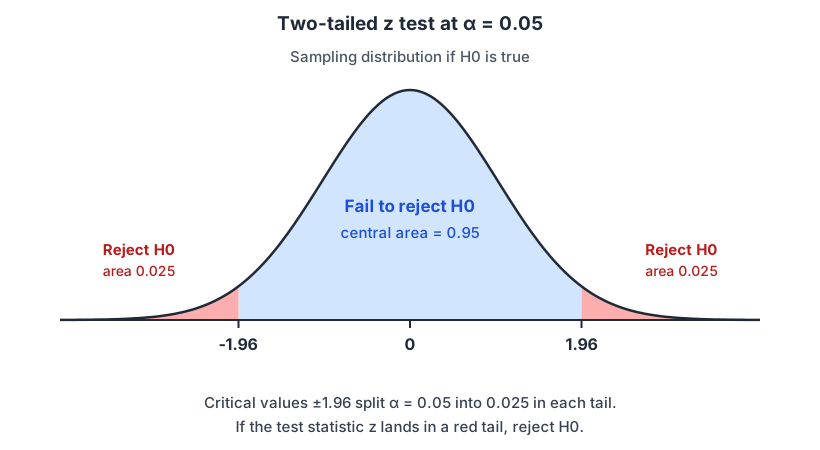
Beyond 1.645
Beyond ±1.96
Beyond ±2.576
Less than 0.05
Critical values are ±1.96, leaving 2.5% in each tail.
The critical z for a one-tailed test at alpha = 0.05 is...
1.645
1.96
2.326
2.576
The upper 5% point of the standard normal.
With H0: mu = 100, sigma = 15, n = 36 and x-bar = 104, the z statistic is...
0.27
4
2.5
1.6
SE = 15/6 = 2.5; z = 4/2.5 = 1.6.
A very large study finds a statistically significant difference of 0.1 points on a 100-point scale. The best description is...
Practically important because p is small
Not statistically significant
Statistically significant but possibly not practically important
Proof of a large effect
Large samples detect tiny effects; judge the effect size.
A two-sided test at alpha = 0.05 rejects H0: mu = 50. The 95% confidence interval for mu...
Contains 50
Does not contain 50
Is centered at 50
Has width zero
The two-sided test and the CI agree: reject exactly when mu0 is outside the interval.
A researcher runs 20 independent tests at alpha = 0.05 when all null hypotheses are true. About how many false positives are expected?
1
0
5
20
20 x 0.05 = 1. This is why corrections are needed.
Why is it incorrect to say we 'accept H0' when p > alpha?
Because alpha is too small
Because H0 is always false
Because the sample is random
The test cannot prove H0; we only lack sufficient evidence against it
Failing to reject is not confirmation.
Which of the following is a p-value misinterpretation?
The probability of seeing data this extreme if H0 is true
A measure of evidence against H0
The probability that the null hypothesis is true
A quantity that shrinks as evidence grows
The p-value is P(data | H0), not P(H0 | data).
