Quiz · Medium
Twenty-one questions on matrix products and sizes, transposes, 2 x 2 and triangular determinants, inverses, rank and linear systems.
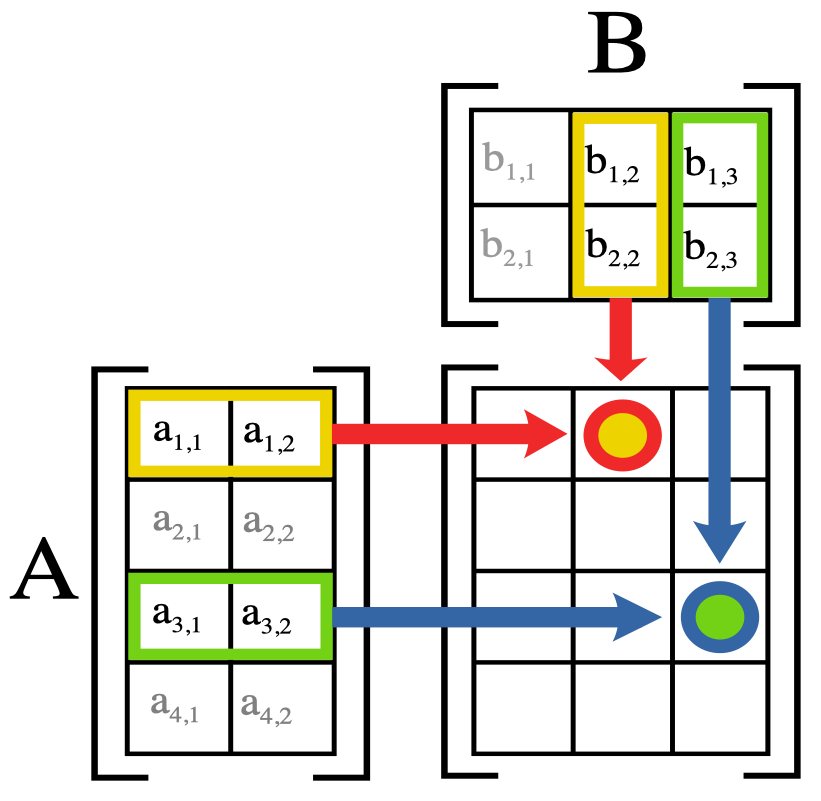
In the picture, A is 4 × 2 and B is 2 × 3. What is the size of the product AB?
3 × 4
4 × 3
AB is not defined
2 × 2
The inner dimensions (2 and 2) match and disappear, leaving the outer dimensions 4 × 3. Reading the picture as '3 × 4' swaps rows and columns; AB has as many rows as A and as many columns as B. Image: Lakeworks, CC BY-SA 3.0, via Wikimedia Commons.
A is 2 × 3, B is 3 × 4 and C is 2 × 4. Which product is defined?
CB
BA
AB
AC
Only AB works: (2 × 3)(3 × 4) has matching inner dimension 3 and gives a 2 × 4 matrix. BA needs 4 = 2, AC needs 3 = 2, and CB needs 4 = 3.
For and , what is the product AB?
Row of A times column of B: first row is (2·1 + 1·2, 2·4 + 1·(−1)) = (4, 7); second row is (0·1 + 3·2, 0·4 + 3·(−1)) = (6, −3). The first option is BA, which is a different matrix because multiplication is not commutative; the third is AᵀBᵀ and the last multiplies entry by entry, which is not matrix multiplication.
Which expression equals (A + B)² for square matrices A and B?
A² + B²
(A² + B²) + 2AB − BA
A² + 2AB + B²
A² + AB + BA + B²
Expand (A + B)(A + B) = A² + AB + BA + B². The usual binomial formula needs AB = BA, which is not true in general.
What is (AB)ᵀ?
BᵀAᵀ
ABᵀ
(BA)ᵀ
AᵀBᵀ
Transposing reverses the order of a product. AᵀBᵀ is tempting but its size may not even be compatible (for A 2×3 and B 3×4, AᵀBᵀ would be 3×2 times 4×3).
Find det .
15
-7
7
23
ad − bc = 3·5 − (−2)(4) = 15 + 8 = 23. The value 7 comes from forgetting that subtracting a negative adds.
A is 2 × 2 with det A = 4. What is det(3A)?
36
108
16
12
For an n × n matrix, det(kA) = kⁿ det A. Here n = 2, so det(3A) = 9 · 4 = 36. The value 12 forgets the exponent, and 108 would be right only for a 3 × 3 matrix with det 4.
What is the inverse of ?
det = 6 − 5 = 1. Swap the diagonal entries and negate the off-diagonal entries: [[3, −5], [−1, 2]]. The first option forgets the signs; the third negates but forgets to swap the diagonal; the last has the wrong signs.
Which of these matrices is NOT invertible?
det = 2·2 − 4·1 = 0, because row 1 is twice row 2. The others have determinants −2, −1 and 35.
True or false: (A + B)⁻¹ = A⁻¹ + B⁻¹ whenever A, B and A + B are invertible.
True
False
False. For A = B = I, (A + B)⁻¹ = (2I)⁻¹ = ½I, but A⁻¹ + B⁻¹ = 2I. The rule that does hold is (AB)⁻¹ = B⁻¹A⁻¹.
What is the rank of ?
3
It cannot be found without a calculator
1
2
Row 2 is twice row 1, so one of them is redundant. Row 3 is not a multiple of row 1, so there are exactly 2 independent rows: rank 2. It is not 3, because a 3 × 3 matrix with dependent rows has det 0.
Find det .
−36
36
8
−6
For a triangular matrix the determinant is the product of the diagonal entries: 2 · (−3) · 6 = −36. Watch the sign of the −3.
Which statement is NOT equivalent to 'the n × n matrix A is invertible'?
The columns of A are linearly independent
Ax = 0 has only the trivial solution
0 is an eigenvalue of A
det A ≠ 0
If 0 is an eigenvalue then Av = 0 for some nonzero v, so A is singular. The other three statements are all part of the invertible matrix theorem.
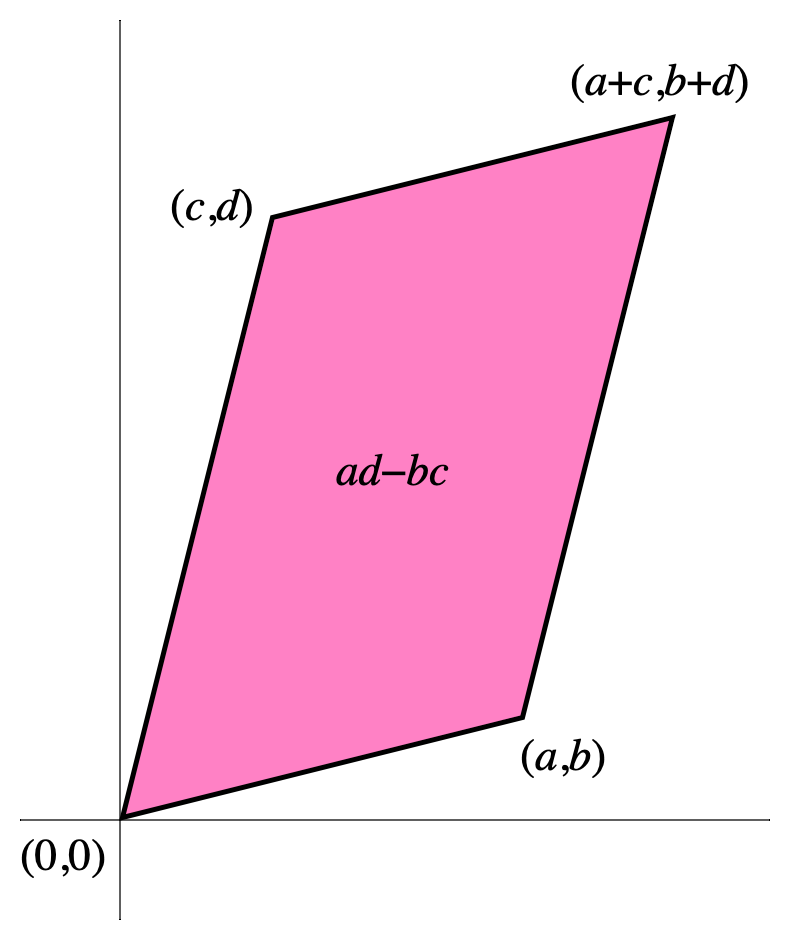
Use the area formula shown. What is the area of the parallelogram with edge vectors (3, 1) and (1, 2) from the origin?
5
6
1
7
Area = |ad − bc| = |3·2 − 1·1| = 5. The value 7 comes from adding instead of subtracting. Image: Jitse Niesen, public domain, via Wikimedia Commons.
Solve 3x + 2y = 8 and x − y = 1. What is (x, y)?
(1, 0)
(2, 1)
(3, 2)
(1, 2.5)
From the second equation x = 1 + y. Substitute: 3 + 3y + 2y = 8, so y = 1 and x = 2. Check the first equation: 6 + 2 = 8.
An augmented matrix reduces to a row [0 0 0 | 5]. What does this say about the system?
No solution
The solution is x = 5
Infinitely many solutions
A unique solution
That row says 0 = 5, which is impossible, so the system is inconsistent. A row of all zeros including the right side (0 0 0 | 0) would be harmless and would indicate free variables.
Which of these is true for all square matrices A and B of the same size?
tr(AB) = tr(A) + tr(B)
tr(AB) = tr(A)tr(B) only for diagonal matrices
tr(AB) = tr(A)·tr(B)
tr(AB) = tr(BA)
The trace is invariant under cyclic permutation, so tr(AB) = tr(BA) even though AB ≠ BA in general. The trace is linear, but not multiplicative.
Q is an orthogonal matrix. Which value could det Q take?
2
0
−1
1/2
Since QᵀQ = I, (det Q)² = 1, so det Q = ±1. Reflections have determinant −1 and rotations have +1.
det A = 3 and det B = −2 for 3 × 3 matrices. What is det(A²Bᵀ)?
12
−36
−12
−18
det(A²) = 3² = 9 and det(Bᵀ) = det B = −2, so the determinant of the product is 9·(−2) = −18.
Swapping two rows of a matrix changes its determinant by what?
Nothing
A factor of −1
A factor of 2
It becomes 0
A row swap multiplies the determinant by −1. Adding a multiple of one row to another leaves it unchanged, and scaling a row by c multiplies it by c.
Which matrix is always symmetric, for any matrix A (any size)?
A² (A square)
AB for symmetric A and B
AAᵀ and AᵀA both
A − Aᵀ
(AᵀA)ᵀ = AᵀA and (AAᵀ)ᵀ = AAᵀ. A − Aᵀ is skew-symmetric, A² need not be symmetric, and (AB)ᵀ = BA, which equals AB only if A and B commute.
