Quiz · Medium
Twenty questions on how the thirteen colonies were founded, how the regions differed, and how the colonies changed up to 1763.
Why was Jamestown (1607) founded?
As a for-profit venture of the Virginia Company, a joint-stock company
As a refuge for English Catholics
To create a Puritan 'city upon a hill'
As a buffer against Spanish Florida
Investors in the Virginia Company hoped for gold and trade profits. Catholics went to Maryland, Puritans to Massachusetts Bay, and Georgia was the buffer against Spain.
What crop made Virginia economically successful?
Rice
Tobacco
Indigo
Wheat
John Rolfe's tobacco gave Virginia a profitable export from around 1612. Rice and indigo were Lowcountry crops, and wheat was grown mostly in the Middle Colonies.
What does the document shown in this engraving establish?
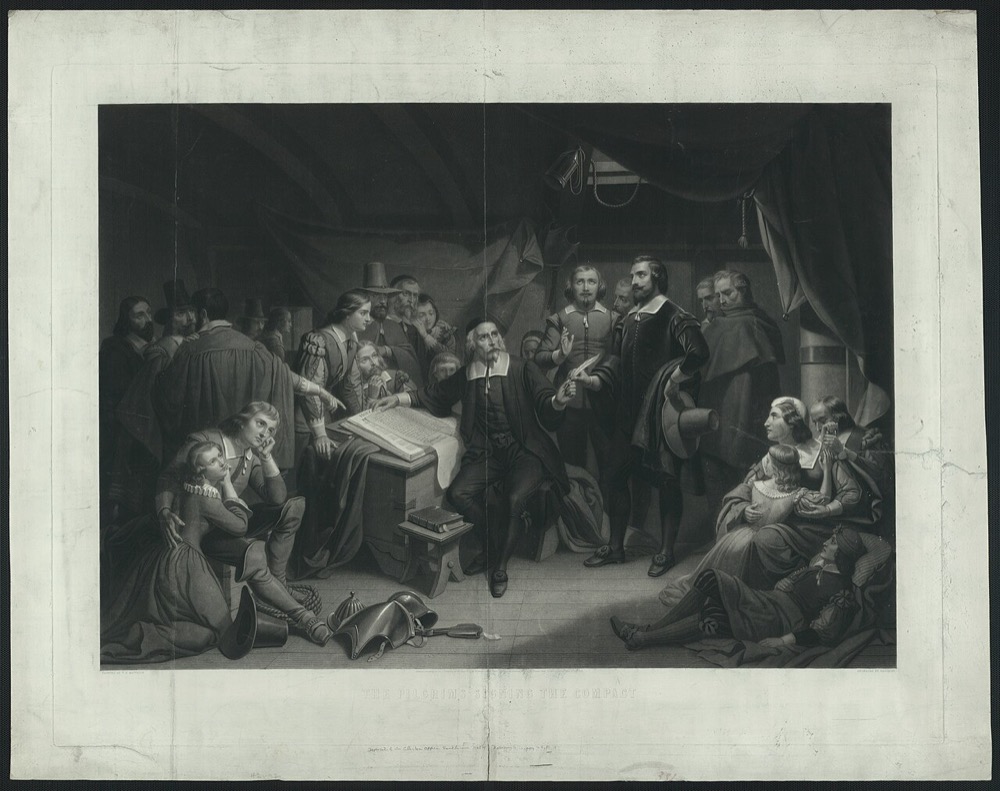
Freedom of the press in Massachusetts
Religious toleration for Catholics
Government by consent and majority rule among the Pilgrims
Representative government in Virginia
The Mayflower Compact (1620) was a pledge to obey laws made for the general good. The Pilgrims had no charter for the land where they landed. Image: T. H. Matteson, public domain, via Wikimedia Commons.
What was the main difference between Pilgrims and Puritans?
Pilgrims were Catholic
Puritans were Quakers
Pilgrims settled in Virginia
Pilgrims had separated from the Church of England; Puritans wanted to reform it from within
Pilgrims were Separatists. Puritans, who settled Massachusetts Bay in 1630, wanted to purify the Church of England. Neither group was Catholic or Quaker.
Roger Williams was banished from Massachusetts and went on to found which colony?
Connecticut
Rhode Island
New Hampshire
Maryland
He founded Providence in 1636, the start of Rhode Island, based on religious toleration and separation of church and state. Thomas Hooker led settlers to Connecticut.
Which colony was founded by a Quaker as a 'Holy Experiment' in religious freedom?
Pennsylvania
Maryland
New Jersey
Delaware
William Penn founded Pennsylvania in 1681. Maryland was a Catholic haven; New Jersey and Delaware were not Quaker ventures.
The Middle Colonies were sometimes called the 'breadbasket' colonies because they
grew most of the colonies' rice and indigo
were the first to industrialize
exported large amounts of wheat and other grain
depended on tobacco for income
Fertile land and a longer growing season than New England led to grain surpluses. Rice and indigo were Carolina crops; tobacco was the Chesapeake's.
Which statement about the colonial South is accurate?
It had many compact towns around meetinghouses
It was the most religiously diverse region
Most colonists were Puritans
Its economy relied on cash crops produced by enslaved labor and indentured servants
Tobacco, rice and indigo plantations used indentured servants, then increasingly enslaved Africans. Compact towns and Puritanism were New England features; the Middle Colonies were the most diverse.
What was the main purpose of the Navigation Acts?
To ensure colonial trade benefited England under mercantilism
To provide revenue for colonial schools
To allow free trade among colonies and France
To outlaw smuggling of molasses
They required colonial trade to go through English ports and ships. Mercantilist theory treated colonies as sources of raw materials and markets. They were not designed to raise revenue or allow free trade.
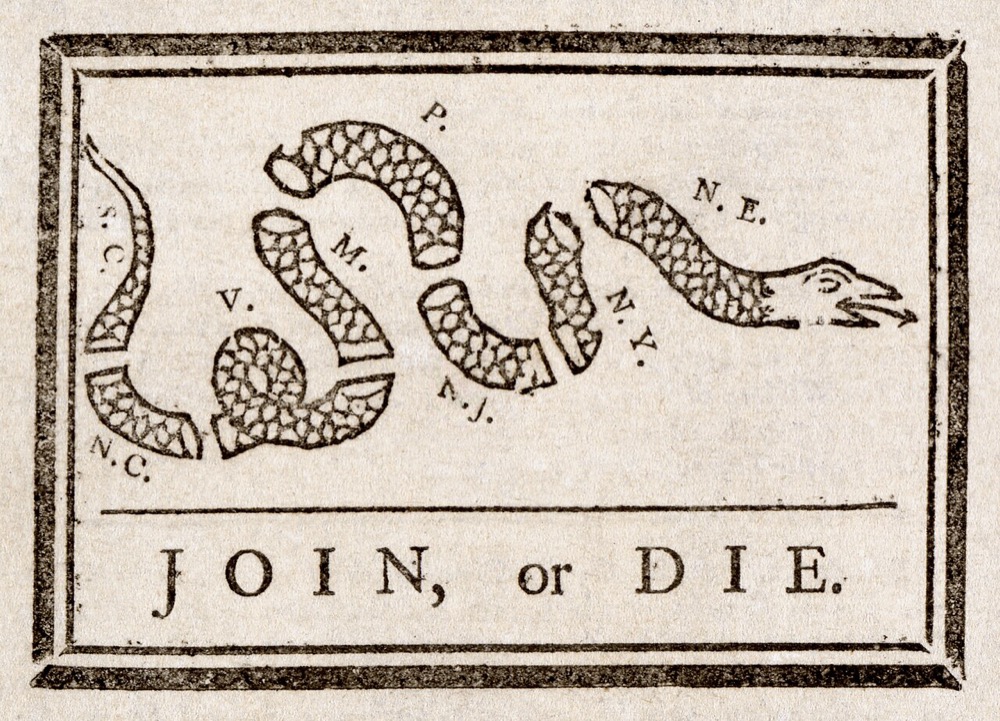
The cartoon below, published in 1754, urged colonists to
boycott British goods
declare independence
accept the Stamp Act
unite against the French threat
Franklin's 'Join, or Die' supported the Albany Plan of Union during the French and Indian War. Boycotts and independence came later. Image: Benjamin Franklin, public domain, via Wikimedia Commons.
The House of Burgesses, established in 1619, was
a Puritan church council
a royal court in New York
the first elected representative assembly in English America
a tribunal for the Salem witch trials
It gave Virginia planters a voice in local laws. It was elected by landowning men, not by all.
Which event best demonstrates tension between the Puritan church and individual religious conscience?
The Half-Way Covenant
The banishment of Anne Hutchinson
The Stono Rebellion
The Albany Congress
Hutchinson taught that grace could be known directly, challenging ministers' authority, and was banished in 1637-38. The Half-Way Covenant was a membership compromise; the Stono Rebellion was a slave revolt.
Why did the Zenger trial (1735) matter?
It banned slavery in New York
It created the Dominion of New England
It supported the principle that truth is a defense against libel
It ended salutary neglect
Andrew Hamilton convinced the jury to acquit printer John Peter Zenger, an early step toward freedom of the press. It had no effect on slavery or trade policy.
Which of these was a result of the First Great Awakening?
The rise of Puritan control in Virginia
A ban on public worship
Support for monarchy
Growth of religious diversity and challenges to established authority
The revival split congregations into New Lights and Old Lights and encouraged ordinary colonists to question clergy. The other choices are the opposite of what happened.
What did the Treaty of Paris (1763) mean for Britain's North American empire?
Britain gained Canada and land east of the Mississippi from France
Britain lost Florida to Spain
France gained the Ohio Valley
Spain gave up Louisiana to Britain
Britain gained Canada and the land east of the Mississippi. Spain actually gave Florida to Britain, and France gave Louisiana to Spain.
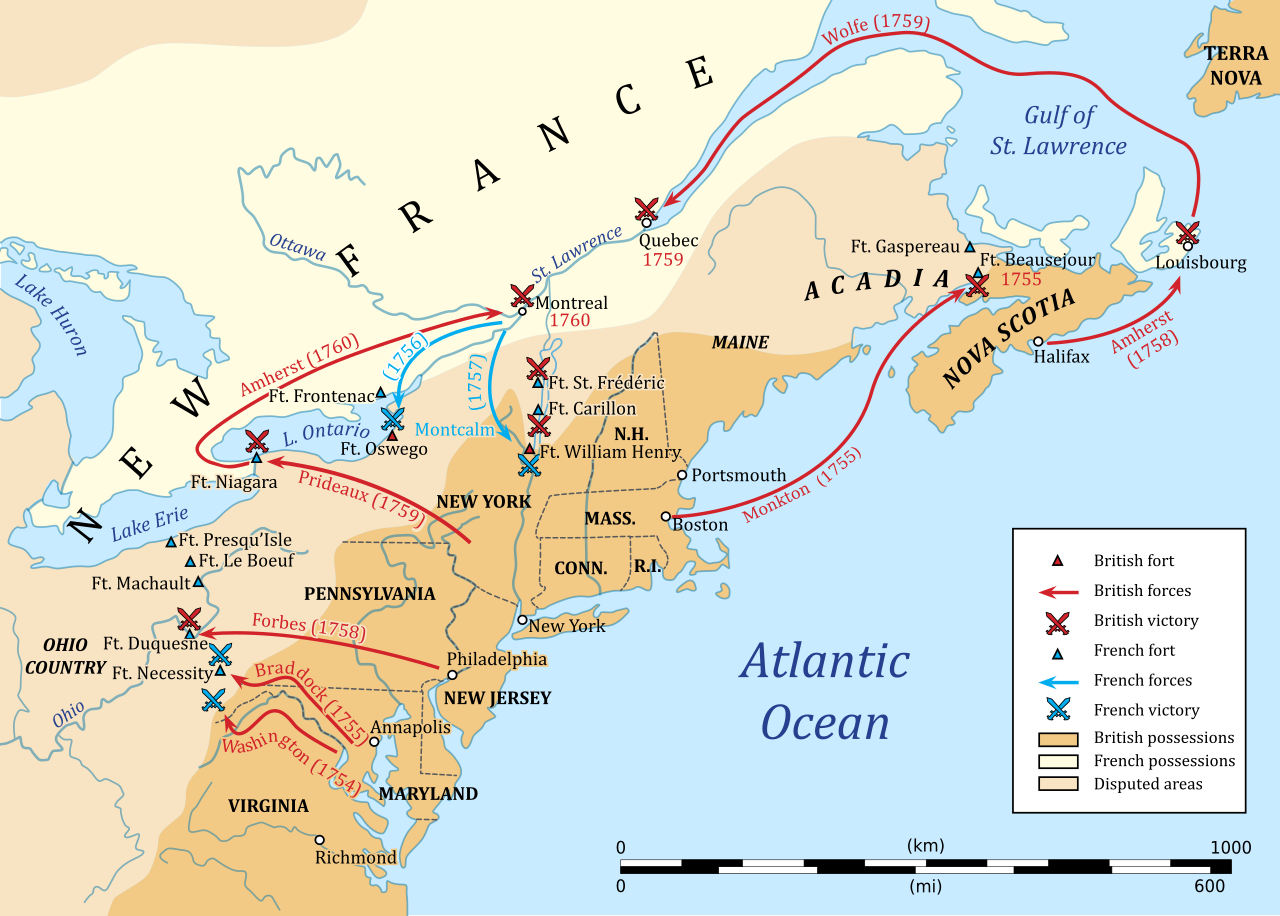
In this map of the French and Indian War, which area was claimed by both Britain and France?
New England
The Ohio Country
Virginia's Tidewater
Nova Scotia
The Ohio Country, between the Appalachians and the Great Lakes, was contested; the war began over the forks of the Ohio River. Image: Hoodinski, CC BY-SA 3.0, via Wikimedia Commons.
Which colony was established in 1732 partly as a buffer against Spanish Florida?
South Carolina
Georgia
North Carolina
Virginia
James Oglethorpe's Georgia was the last of the 13 colonies. The Carolinas and Virginia had been settled earlier.
Compared with indentured servitude, slavery in the colonies was
temporary and contractual
only found in New England
prohibited by the Navigation Acts
a lifelong, inheritable condition
Enslaved people had no contract and their children inherited slave status (Virginia law, 1662). Slavery existed in every colony.
The 'Middle Passage' refers to
the forced voyage of enslaved Africans across the Atlantic
the route from New England to the Caribbean
the Appalachian road to Ohio
the compromise between Puritans and Anglicans
It was the middle leg of the Atlantic slave trade. Millions of Africans were shipped to the Americas, though only a small share to North America.
Which law attempted to prevent colonial settlement west of the Appalachians after the French and Indian War?
The Molasses Act
The Navigation Act of 1651
The Proclamation of 1763
The Tea Act
The Proclamation was a response to Pontiac's Rebellion, intended to avoid more frontier wars. The other laws concerned trade and taxes.
