StudyFox
कीमतेंब्लॉगएक्सटेंशनमुफ़्त टूल
  • कीमतें
  • ब्लॉग
  • एक्सटेंशन
  • मुफ़्त टूल
  • शुरू करेंसाइन इन
StudyFox

अपने नोट्स, PDF और स्लाइड्स को फ़्लैशकार्ड, क्विज़, नोट्स और माइंड मैप में बदलें।

StudyFox खोलें

स्टडी टूल्स

  • होमवर्क हेल्पर
  • नोट मेकर
  • फ़्लैशकार्ड मेकर
  • क्विज़ मेकर
  • माइंड मैप मेकर

प्रोडक्ट

  • कीमतें
  • Chrome एक्सटेंशन
  • मुफ़्त एक्सटेंशन
  • स्टडी सेट देखें
  • ब्लॉग

सहायता

  • सहायता केंद्र
  • संपर्क करें
  • गोपनीयता नीति
  • सेवा की शर्तें

तुलना करें

  • Chegg का विकल्प
  • Course Hero का विकल्प
  • Coursology का विकल्प
  • Photomath का विकल्प
  • Gauthmath का विकल्प
  • PhotoSolve का विकल्प
  • CollegeTools का विकल्प
  • Transcript का विकल्प
  • SmartSolve का विकल्प
  • Homeworkify का विकल्प
  • AnswersAi का विकल्प
  • StudyX का विकल्प
  • Quizlet का विकल्प
  • Anki का विकल्प
  • Knowt का विकल्प
  • Brainscape का विकल्प
  • सभी तुलनाएँ

© 2026 StudyFox AI. सर्वाधिकार सुरक्षित।

  • X
  • Discord
  • Instagram
ExploreMathAlgebraPolynomials Practice: Classifying, Multiplying and Factoring

Quiz · Medium

Polynomials Practice: Classifying, Multiplying and Factoring

Foundational practice on degree and classification, polynomial arithmetic, special products, factoring patterns and Pascal's triangle.

by Kill h.19 questionsCreated Nov 20, 2026, 08:27 PM
Algebra· PolynomialsTags#algebra#polynomials#factoring

19 questions

  1. 1

    What is the degree of ?

    • A

      4

    • 5

    • C

      6

    • D

      3

    Add the exponents in each term: has degree 5, has degree 4. The largest is 5. Answering 4 means you only looked at single-variable powers.

  2. 2

    Which expression is a polynomial?

    • A

    • B

    • D

    has a fractional coefficient, which is fine. The others put x in a negative exponent, under a root, or in a denominator.

  3. 3

    Classify .

    • A

      Cubic trinomial

    • B

      Quadratic binomial

    • Cubic binomial

    • D

      Quartic binomial

    Degree 3 (cubic) and two terms (binomial).

  4. 4

    Simplify .

    • A

    • C

    • D

    Distribute the minus: . The x-terms cancel. comes from subtracting only the first term.

  5. 5

    Expand .

    • A

    • B

    • C

    . forgets the middle term; the last term is .

  6. 6

    Multiply .

    • B

    • C

    • D

    . The second option multiplies only the 2 into the constant.

  7. 7

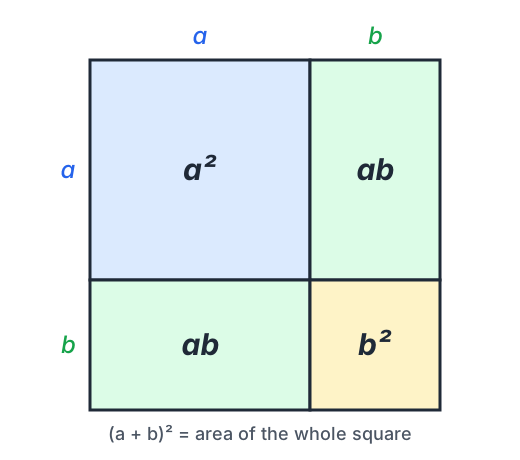
    The area model shows (a + b)². What is the combined area of the two green rectangles?
    • A

    • C

    • D

    Each green rectangle is a by b, so together they give 2ab, the middle term of .

  8. 8

    Factor .

    • B

    • C

    • D

    Need two numbers with product +20 and sum -9: -4 and -5. (x - 2)(x - 10) has the right product but sum -12.

  9. 9

    Factor .

    • A

    • B

    • D

      It does not factor

    Difference of squares: . would give a middle term of .

  10. 10

    Factor completely: .

    • A

    • C

    • D

    GCF 3x first, then . is correct but not complete.

  11. 11

    Factor .

    • A

    • B

    • C

    Check by expanding: . gives in the middle: the signs are swapped.

  12. 12

    Factor .

    • A

    • C

    • D

    Sum of cubes: with a = x, b = 2. SOAP: same sign, opposite sign, always positive.

  13. 13

    Factor by grouping: .

    • B

    • C

    • D

    .

  14. 14

    Which polynomial cannot be factored over the real numbers?

    • A

    • B

    • C

    A sum of squares has no real zeros, so no real linear factors. is a difference of cubes and factors as .

  15. 15

    True or false: .

    • A

      True

    • False

    False. . Try a = b = 1: 8 is not 2.

  16. 16

    What is the coefficient of in the expansion of ?

    • A

      5

    • B

      15

    • 10

    • D

      20

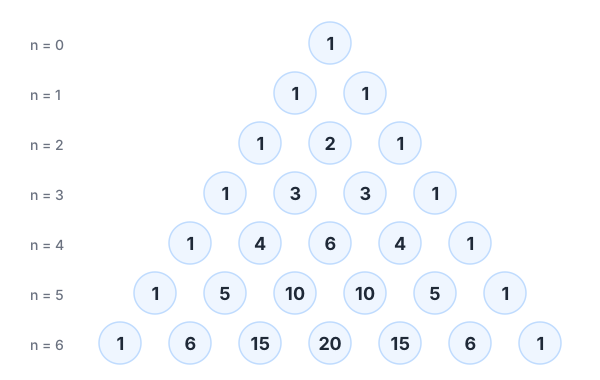
    The term is . Row 5 of Pascal's triangle is 1, 5, 10, 10, 5, 1.

  17. 17

    Using the pattern in the triangle, what is row n = 7?
    • A

      1 7 20 35 35 20 7 1

    • 1 7 21 35 35 21 7 1

    • C

      1 6 21 35 21 6 1

    • D

      1 7 22 34 34 22 7 1

    Add neighbors in row 6 (1 6 15 20 15 6 1): 1, 1+6 = 7, 6+15 = 21, 15+20 = 35, then symmetric.

  18. 18

    What is the degree of ?

    • A

      12

    • B

      4

    • 7

    • D

      3

    When multiplying, degrees add: 3 + 4 = 7. 12 comes from multiplying the degrees instead.

  19. 19

    What is the GCF of ?

    • B

    • C

    • D

    GCF of 12 and 18 is 6; take the lowest power of each variable: x² and y².