Quiz · Medium
Questions on Plato and Aristotle, Hume on causation, dualism and physicalism, personal identity, theories of time and the free will debate.
Which view holds that universals exist only in the particular things that instantiate them?
Aristotelian realism
Platonic realism
Nominalism
Berkeleyan idealism
Aristotle rejected separate Forms; forms exist in individual substances. Platonic realism places universals in a separate realm, and nominalism denies that universals exist at all.
In Plato's allegory of the cave, the sunlight outside the cave represents...
sensory knowledge
political power
the physical sun only
the Form of the Good
The sun stands for the Good, which makes the Forms intelligible as the sun makes visible things visible. The shadows represent appearances, not the world outside.
Which is NOT one of Aristotle's four causes?
Material
Instrumental
Formal
Final
The four are material, formal, efficient and final. 'Instrumental' is not one of them, though the efficient cause is sometimes confused with an instrument.
Hume's account of causation says that our idea of 'necessary connection' comes from...
direct observation of a force linking cause and effect
the habit of the mind expecting an effect after repeated conjunction
logical deduction from the nature of the cause
divine intervention
Hume denied that we perceive power or necessity in events; we observe only constant conjunction, and the mind projects necessity out of custom. Directly observing a linking force is exactly what he denied.
Berkeley's 'esse est percipi' means...
to think is to exist
to exist is to be extended
everything is made of atoms
to be is to be perceived
Berkeley held that sensible things are ideas and exist only as perceived. 'I think, therefore I am' is Descartes.
The identity of indiscernibles says that...
if two things share all their properties they are one and the same
if two things are identical they share all their properties
no two things have any properties in common
identity is not a relation
'If two things are identical they share all their properties' is the indiscernibility of identicals, which is uncontroversial. The identity of indiscernibles (Leibniz) is the contested converse.
Kripke argued that 'water is H2O' is...
contingent and known a priori
necessary and known a priori
necessary and known a posteriori
contingent and known a posteriori
If water is H2O, it is so in every possible world where water exists (rigid designation), yet we discovered it empirically. Before Kripke, necessity was linked to a priori knowledge.
The interaction problem is a difficulty for...
functionalism
identity theory
eliminative materialism
Cartesian substance dualism
If mind is non-extended and body extended, it is unclear how they causally influence one another. Materialist views have no gap to bridge.
What does Frank Jackson's Mary's room argument aim to show?
Physical facts do not exhaust all facts about experience
Colour vision is not physical
Machines can understand language
Free will is an illusion
Mary knows all physical facts but learns something new on seeing red, so there are facts about experience beyond the physical (knowledge argument). The Chinese room concerns understanding.
The multiple realizability argument was used by Putnam against...
functionalism
dualism
type identity theory
behaviourism
If the same mental state can be realized in different physical kinds, mental types cannot be identical to a single brain type. Functionalism is the view it supports.
Searle's Chinese room argument is directed at the claim that...
mental states are caused by brain states
running the right program is sufficient for understanding
humans have free will
other minds exist
Syntax (symbol manipulation) is not sufficient for semantics (meaning), so a program alone cannot constitute understanding. Searle accepts that brains cause minds.
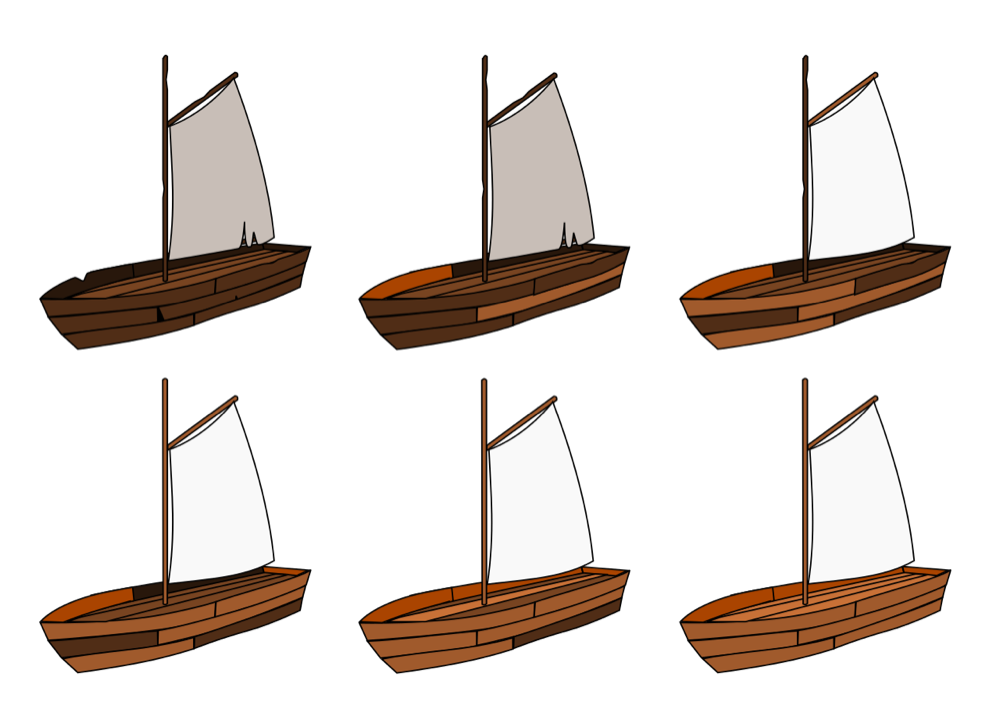
The diagram shows several versions of one ship. Which puzzle does it illustrate?
The Ship of Theseus
The Gettier problem
The trolley problem
Zeno's Achilles paradox
The ship whose planks are replaced one by one, compared with a ship rebuilt from the old planks, is the Ship of Theseus, a puzzle about persistence and identity over time. Image: Belbury (ship outline by Yosemite), CC BY 4.0, via Wikimedia Commons.
Locke's memory theory of personal identity is challenged by Reid's brave officer case because...
memory is not transitive but identity is
memory can be false
the body changes
the soul is eternal
The general remembers the officer, and the officer the boy, but the general does not remember the boy; if identity were memory, the general would both be and not be the boy.
Which view says only the present moment exists?
Eternalism
The block universe
Presentism
The B-theory with temporal parts
Presentism denies the existence of the past and future. Eternalism and the block universe hold that all times exist equally.
McTaggart's argument in 'The Unreality of Time' (1908) targets...
the B-series as inconsistent with relativity
the A-series, the idea of events as past, present and future
the concept of space
the possibility of causal laws
McTaggart argued the A-series is contradictory (events must be past, present and future), so time, which requires it, is unreal. He thought the B-series alone lacks change.
A compatibilist holds that...
free will requires indeterminism
determinism is false
moral responsibility is an illusion
free will is compatible with determinism
Compatibilists like Hume say freedom means acting on one's own desires without constraint, which can be causally determined. Incompatibilists include libertarians and hard determinists.
What does a Frankfurt-style case show?
Determinism is true
Alternate possibilities are required for responsibility
A person can be morally responsible even if they could not have done otherwise
Choices are caused by brain states
The counterfactual intervener never acts, so the agent chooses freely, yet could not have done otherwise. This undermines the principle of alternate possibilities.
Kant's objection to the ontological argument is that...
existence is not a real predicate
the premises are inconsistent
God is not conceivable
necessary beings cannot exist
If existence adds nothing to a concept, we cannot define God into existence. It is not a claim that God is inconceivable.
Which pair is correctly matched?
Leibniz: reality is a single substance
Berkeley: matter exists independently of mind
Descartes: the mind is an extended substance
Spinoza: one substance, God or Nature
Leibniz posited many monads; Berkeley denied material substance; Descartes held that mind is thinking, not extended.
Plato's theory of Forms faces the 'third man' objection. What does it claim?
Forms cannot be known
It leads to an infinite regress of Forms
Particulars have no properties
Forms exist in space and time
If a Form explains why many things are F, then the Form and its instances resemble each other, requiring a further Form, and so on without end.
Eternalism holds that the future does not yet exist.
True
False
Eternalism holds that past, present and future events all exist equally. The view that the future does not yet exist is the growing block (or presentism).
