Quiz · Hard
Applied problems (projectile, area, revenue, geometry), parameter questions with the discriminant, Vieta's formulas, complex roots and equations that reduce to quadratics.
A farmer has 120 m of fencing and uses a barn as one side of a rectangular garden. What is the largest area she can enclose?
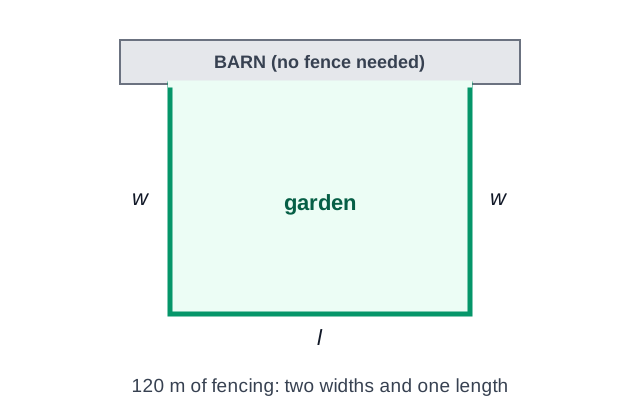
1,600 m²
1,800 m²
3,600 m²
900 m²
, maximized at : . 900 would be , forgetting that the length is .
A ball is thrown with (feet). When does it hit the ground?
At t = -1 second
At t = 4 seconds
At t = 3 seconds
At t = 1.5 seconds
, so . Time cannot be negative, so . is the time of the maximum height (100 ft).
For which values of does have exactly one real solution?
only
or
or
One repeated root needs , so . Both and work.
For which values of does have no real solutions?
gives . At there is one repeated root; for there are two real roots.
What are the sum and product of the roots of ?
Sum , product
Sum , product
Sum , product
Sum , product
Sum and product . Forgetting to divide by gives 7 and 3.
If and are the roots of , what is ?
25
23
21
17
. 25 forgets the term.
Which quadratic has roots and ?
Sum and product , so . A product of 7 would come from adding the squares.
The legs of a right triangle differ by 7 and the hypotenuse is 13. How long is the shorter leg?
6
7
12
5
gives , . The shorter leg is 5 (the other is 12). 12 is the longer leg.
Demand is 200 - 4p units at price p, so revenue is R = p(200 - 4p). What price maximizes revenue?
$50
$25
$12.50
$100
, vertex at ; . $50 would make demand zero.
A border of equal width x surrounds an 8 by 10 picture. The total area (picture + border) is 168. What is x?
1
2
3
4
, so or , giving . The border adds x on EACH side, so the sides grow by 2x.
Solve .
and
only
No solution
only
Squaring gives , so or . Check : , so it is extraneous.
How many real solutions does have?
4
2
1
0
Let : , so or . Each gives two solutions: and .
Where do the line and the parabola intersect?
and
only
and
and
Set : , so or . Then gives and .
Solve .
No solution at all
, so . 'No solution' is only true over the real numbers.
What is the equation of the parabola with vertex (1, 2) that passes through (3, 10)?
, so and . forgets to subtract the 2 and divide by .
If the discriminant of ax^2 + bx + c = 0 (integer coefficients) is a perfect square, the quadratic factors over the integers.
True
False
A perfect-square discriminant means is an integer, so the roots are rational and the quadratic factors.
Solve .
or
or
or
or
Expand: , so and . Setting each factor to 6 is invalid: the zero product property needs a product of 0.
A company's profit is P(x) = -x^2 + 10x - 16 (x in thousands of units). For which production levels is the profit positive?
Fewer than 5 thousand units
Between 2 and 8 thousand units
More than 2 thousand units
Between 0 and 10 thousand units
, positive between the roots 2 and 8. The maximum profit is at : .
