Quiz · Medium
FDA classes, design controls, electrical safety, ECG, pacing, pulse oximetry and signal acquisition basics.
Which FDA device class typically requires premarket approval (PMA)?
Class I
Class II
Class III
All classes
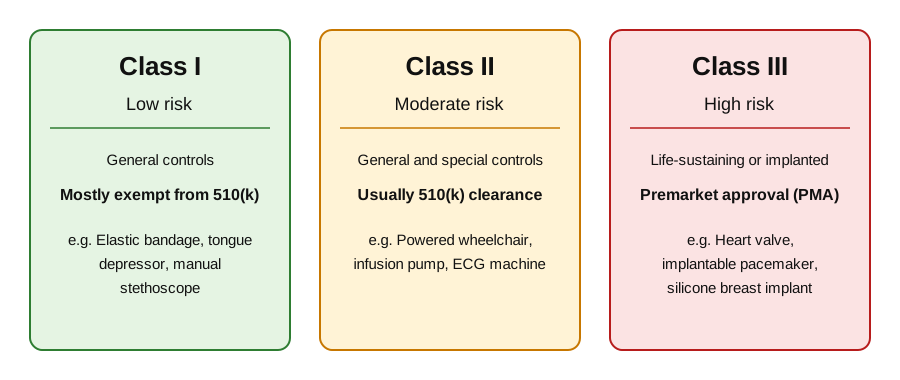
Class III devices (high risk, life-sustaining or implanted) need PMA. Class II usually uses 510(k) and Class I is mostly exempt.
A 510(k) submission demonstrates:
Substantial equivalence to a predicate device
Clinical superiority to existing devices
Cost-effectiveness
Compliance with EU MDR
A 510(k) shows the device is as safe and effective as a legally marketed predicate. It does not require showing superiority.
Verification answers the question:
Did we build the right device for the user?
Is the device profitable?
Is it sterile?
Did we build the device right against the specifications?
Verification checks outputs against design inputs. Validation checks that the device meets user needs in real use.
Which standard governs risk management for medical devices?
ISO 9001
ISO 14971
IEC 62304
ISO 10993
ISO 14971 is risk management. ISO 10993 is biocompatibility and IEC 62304 is software life cycle.
In the risk control hierarchy, the most effective measure is:
Warning labels
Operator training
Instructions for use
Inherently safe design
Eliminating the hazard by design is preferred, then protective measures, then information for safety. Labels are the weakest.
Which applied part type has the strictest leakage current limits?
CF
B
BF
All are the same
CF (cardiac floating) parts may touch the heart, so normal patient leakage must not exceed 10 µA.
In the waveform shown, the T wave represents:
Atrial depolarization
Ventricular depolarization
Ventricular repolarization
AV node conduction
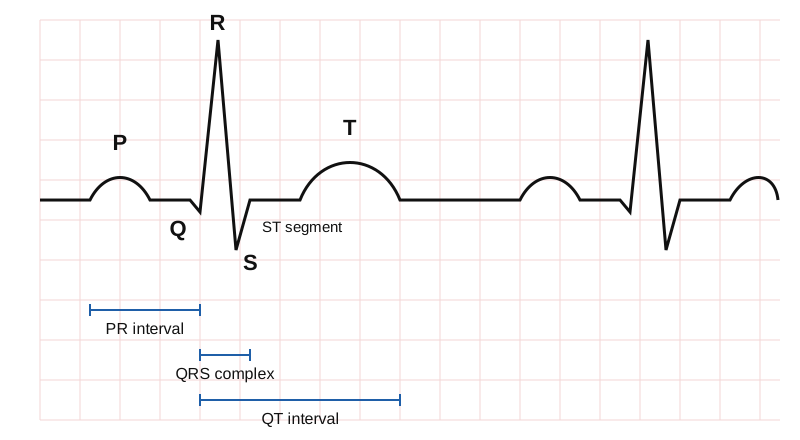
P = atrial depolarization, QRS = ventricular depolarization, T = ventricular repolarization.
In the waveform shown, the PR interval mainly reflects:
Ventricular repolarization
Conduction through the atria and AV node
Ventricular depolarization
The refractory period
It spans the start of atrial depolarization to the start of ventricular depolarization, so the AV node delay dominates.
At 25 mm/s, R-R intervals of 5 large boxes give a heart rate of:
50 bpm
75 bpm
60 bpm
100 bpm
300/5 = 60 bpm. Each large box is 0.2 s, so R-R is 1.0 s.
Einthoven's law states:
II = I + III
I = II + III
III = I + II
I + II + III = 0 always
Lead II = Lead I + Lead III, from the voltage differences between limb electrodes.
The main purpose of high input impedance in a biopotential amplifier is to:
Increase power consumption
Reduce CMRR
Increase bandwidth
Avoid loading the signal source (electrode and skin)
A high input impedance prevents signal loss across the electrode-skin impedance.
A pacemaker coded VVI will:
Pace both chambers
Pace the ventricle and be inhibited by a sensed ventricular beat
Pace the atrium on demand
Always pace regardless of intrinsic rhythm
V paced, V sensed, I = inhibited by a sensed event.
In pulse oximetry, which wavelength is absorbed more by deoxygenated hemoglobin?
940 nm
800 nm
1000 nm
660 nm
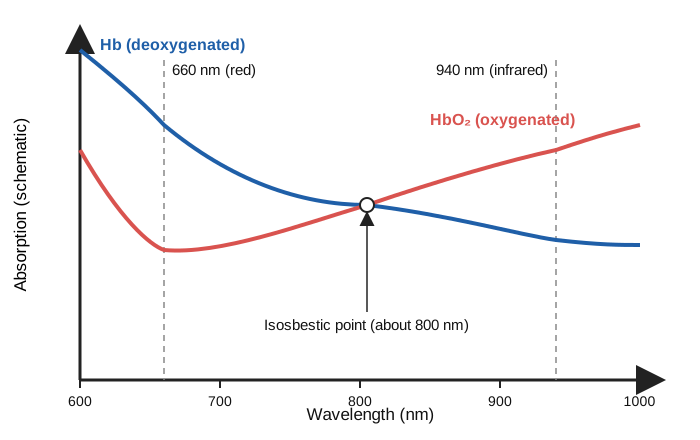
At 660 nm deoxyhemoglobin absorbs much more than oxyhemoglobin, while at 940 nm the opposite is true.
Carbon monoxide poisoning causes a pulse oximeter to read:
Falsely normal or high
Falsely low
Zero
Erratically negative
Carboxyhemoglobin absorbs red light similarly to oxyhemoglobin, so SpO₂ appears normal although oxygen delivery is poor.
A 12-bit ADC spans 0 to 5 V. Its LSB is about:
2.4 mV
0.5 mV
1.2 mV
12 mV
5/4096 = 1.22 mV. Using a 10 V span would give 2.44 mV.
To avoid aliasing a 100 Hz-bandwidth ECG, the sampling rate must be at least:
50 Hz
200 Hz
100 Hz
60 Hz
Nyquist: at least twice the highest frequency. Sampling at 100 Hz would alias components above 50 Hz.
True or false: Validation proves that a device meets its design input specifications.
True
False
That is verification. Validation shows it meets user needs and intended use.
Why are mains interference and baseline wander different problems in ECG?
They are identical
Both are above 1 kHz
Mains is at 50/60 Hz and is removed by notch filtering, baseline wander is very low frequency and is removed by high-pass filtering
Only baseline wander is a noise
Mains is a narrow band at 50/60 Hz; baseline wander (breathing, motion) is below about 0.5 Hz. Different filters are required.
Which is the best description of microshock?
Small current applied directly to the heart that can cause fibrillation at around 100 µA
Shock through intact skin at about 1 mA
A shock from static electricity
A shock from X-rays
Microshock bypasses skin resistance, so very small currents are dangerous.
A strain-gauge pressure transducer has a Wheatstone bridge. Compared with a quarter bridge, a full bridge gives:
The same sensitivity
Half the sensitivity
No temperature compensation
Four times the sensitivity
Four active gauges give 4 times the output of one and cancel temperature effects.
The oscillometric BP method estimates mean arterial pressure from:
The first Korotkoff sound
The cuff pressure at maximal oscillation amplitude
The pulse transit time
The final Korotkoff sound
The oscillation amplitude is greatest at the mean arterial pressure. Korotkoff sounds belong to the auscultatory method.
Which pathway is intended for novel low-to-moderate risk devices with no predicate?
PMA
HDE
IDE
De Novo
De Novo creates a new Class I or II classification. HDE is for rare disease devices and IDE is for clinical study exemptions.
The gain of an instrumentation amplifier input stage with R = 10 kΩ and R_gain = 200 Ω is:
101
51
201
50
G = 1 + 2R/R_gain = 1 + 20000/200 = 101.
