Quiz · Medium
Choose the correct reason or criterion for steps in triangle, parallel line and quadrilateral proofs, plus converse, contrapositive, counterexample and indirect proof questions.
Lines m and n are parallel. Which statement about the numbered angles is correct?
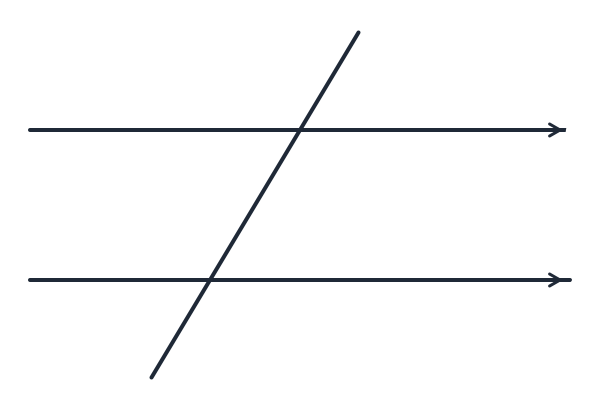
(alternate interior angles)
and are congruent (same-side interior)
(alternate interior angles)
and are supplementary (corresponding)
Alternate interior angles are between the lines on opposite sides of the transversal: 3 and 6 (and 4 and 5). Angles 3 and 5 are same-side interior, which are supplementary. Corresponding angles such as 1 and 5 are congruent, not supplementary.
In the figure, the angles at A and C inside the triangle are 55° and 70°. What is the exterior angle x at B?
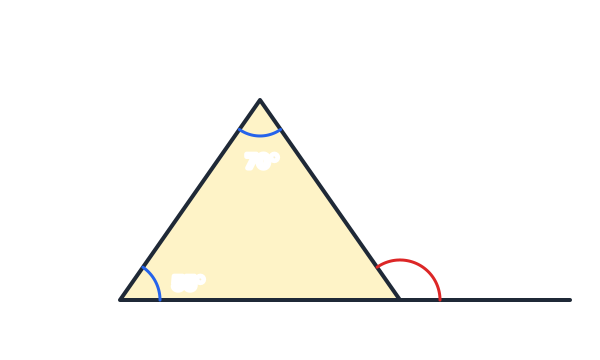
125°
55°
110°
135°
The exterior angle theorem: . Using only one remote angle, or the third interior angle (55°), is a typical error.
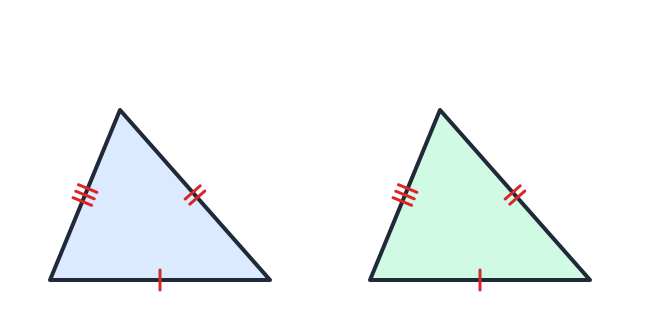
Which congruence criterion do the markings show?
SAS
ASA
HL
SSS
All three pairs of sides carry matching tick marks and there is no angle information, so it is SSS.
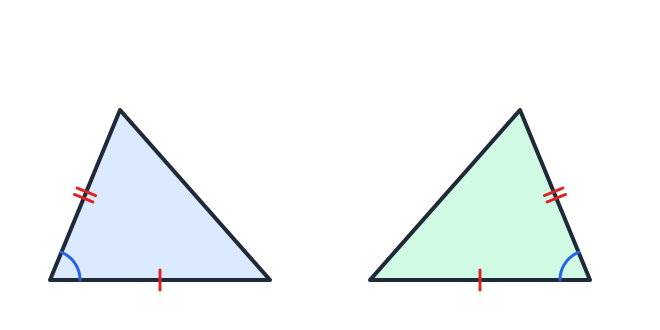
The marks show two congruent sides and the angle between them. Which criterion applies?
SSS
SAS
AAS
SSA
The congruent angle is included between the congruent sides: SAS. SSA is not a valid criterion.
Two angles and a side that is NOT between them are marked congruent. Which criterion applies?
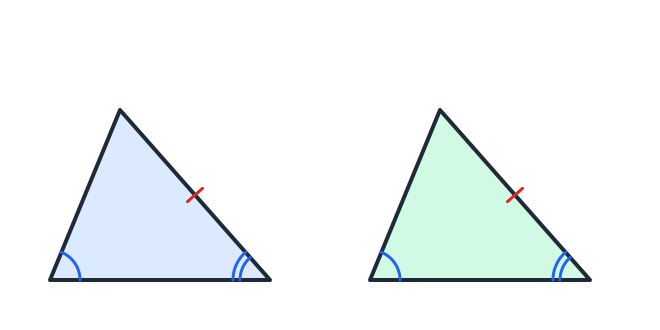
ASA
AAS
SAS
AAA
The side is not between the two angles, so it is AAS. ASA needs the included side. AAA is not a congruence criterion.
These right triangles have congruent hypotenuses and one pair of congruent legs. Which statement justifies congruence?
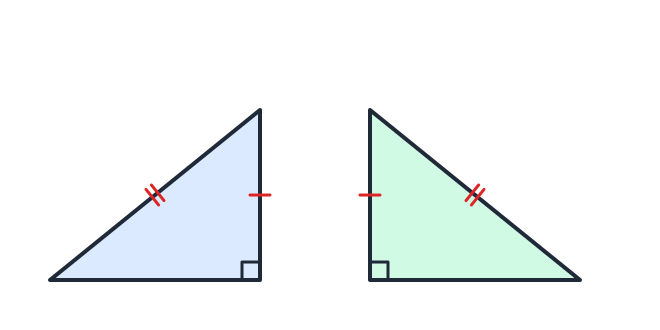
SAS
ASA
SSA applies to all triangles
HL
HL is the valid special case for right triangles. SAS would need the right angle to be between the two congruent sides, which it is not (the congruent leg is only one of the two sides forming the right angle).
The two triangles have two pairs of congruent sides and a congruent angle, as marked. Are they congruent?
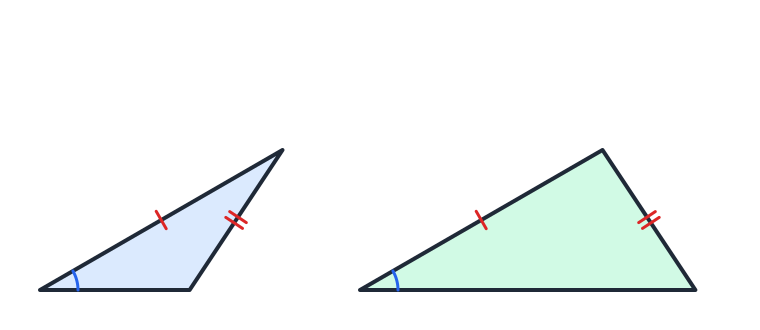
No, because the congruent angle is not between the two congruent sides (SSA)
Yes, by SAS
Yes, by SSA
Yes, because they share an angle
The angle is opposite one of the sides rather than between them, which is SSA. The two triangles have different third sides, so they are not congruent.
All three pairs of angles are congruent. What can you conclude?
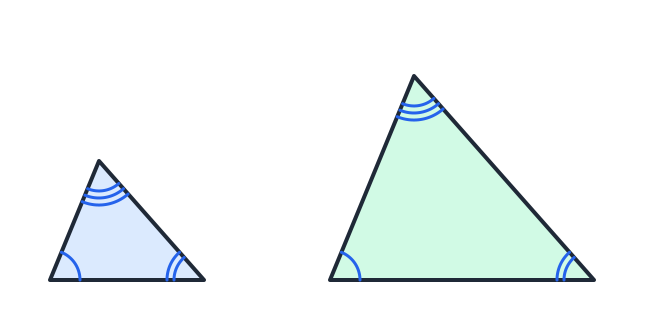
The triangles are congruent by AAA
The triangles are congruent by ASA
The triangles are similar by AA
Nothing can be concluded
Congruent angles fix the shape but not the size. AA proves similarity. AAA is not a congruence criterion.
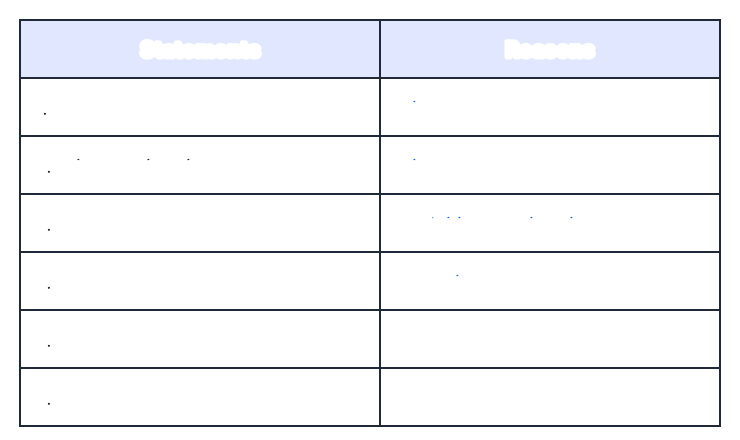
In the proof that ∠B ≅ ∠C, what is the reason for step 6?
SSS
Reflexive property
Definition of midpoint
CPCTC
Step 5 proved the triangles congruent by SSS, so their corresponding angles are congruent by CPCTC. SSS is the reason for step 5, not step 6.
AB and CD bisect each other at M. Which pair of angles lets you prove by SAS?
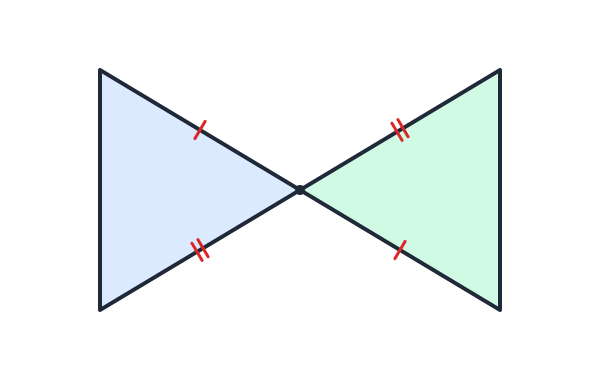
and , alternate interior angles
and , vertical angles
and , by the isosceles triangle theorem
and , a linear pair
The sides AM, MB and CM, MD are congruent by the definition of bisect, and the included angles at M are vertical, so SAS applies. Nothing says AC and BD are parallel.
In parallelogram ABCD, AC is a diagonal. To prove using , what is the shared side's reason?
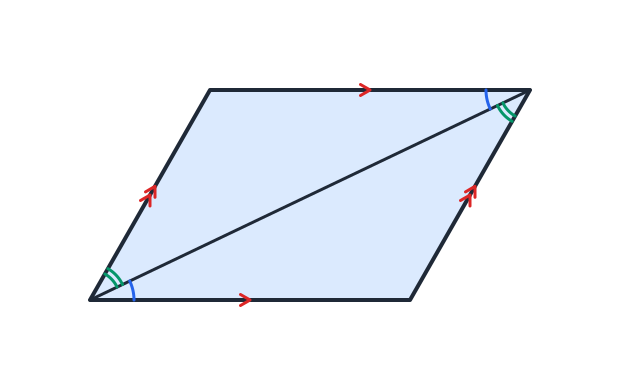
Definition of parallelogram
Transitive property
Reflexive property
CPCTC
AC belongs to both triangles, so by the reflexive property. CPCTC comes later, after congruence is established.
What is the converse of "If a quadrilateral is a square, then it has four congruent sides"?
If a quadrilateral has four congruent sides, then it is a square
If a quadrilateral is not a square, then it does not have four congruent sides
If a quadrilateral does not have four congruent sides, then it is not a square
A quadrilateral is a square if and only if it has four sides
The converse swaps hypothesis and conclusion. The second option is the inverse, the third is the contrapositive. The converse is false: a rhombus is a counterexample.
Which statement is logically equivalent to "If it is a rhombus, then its diagonals are perpendicular"?
If the diagonals are perpendicular, then it is a rhombus
If it is not a rhombus, then its diagonals are not perpendicular
If the diagonals are not perpendicular, then it is not a rhombus
Its diagonals are perpendicular only if it is a square
A conditional is equivalent to its contrapositive. The converse and the inverse are not guaranteed to be true: a kite also has perpendicular diagonals.
You want to prove by contradiction that " is not a right angle." What do you assume first?
is a right angle
is acute
is obtuse
is not a right angle
Assume the opposite of the conclusion: is a right angle, then reach a contradiction. Assuming the statement you want is not a proof.
Which is a valid reason for the statement "" in a proof?
Symmetric property
CPCTC
Definition of midpoint
Reflexive property
Anything is congruent to itself: reflexive property. Symmetric would swap the two sides of a congruence statement.
A student claims "two supplementary angles must be a linear pair." Which counterexample disproves it?
Two angles of 90° each, side by side on a line
Two separate angles of 100° and 80° that are not adjacent
Angles of 60° and 120° that are adjacent on a straight line
Angles of 30° and 60°
Supplementary only means the measures sum to 180°. A linear pair also requires the angles to be adjacent on a line. The 100° and 80° angles are supplementary without being adjacent, so they work as a counterexample.
Which of these is enough to prove a quadrilateral is a parallelogram?
One pair of opposite sides congruent
One pair of opposite sides that is both parallel and congruent
Diagonals that are congruent
One pair of opposite angles congruent
One pair of sides that are both parallel and congruent works. Only one pair of congruent sides still allows shapes such as an isosceles trapezoid. Congruent diagonals are also found in isosceles trapezoids.
True or False: In a proof, it is acceptable to assume two segments are congruent because they look the same length in the diagram.
False
True
You may only use what is given, marked, or follows from definitions and theorems. Diagrams are not necessarily to scale.
True or False: AAS can be used to prove two triangles congruent.
True
False
Yes: two angles and a non-included side, since the third angles must also be congruent, which reduces it to ASA.
Coordinate proof: A(0, 0), B(6, 0), C(6, 4), D(0, 4). Which fact most directly shows ABCD is a rectangle?
AB = 6 and BC = 4 are different lengths
The midpoint of AC is (3, 2)
Adjacent sides AB and BC have slopes 0 and undefined, so they are perpendicular (and opposite sides are parallel)
AC and BD have the same slope
A horizontal side AB meets a vertical side BC, so a right angle at B exists; all four sides are axis-parallel, so all angles are right. Different side lengths only rule out a square. The common midpoint (3, 2) is also true but shows only a parallelogram.
Which reason justifies going from to ?
Addition property of equality
Substitution property
Transitive property
Distributive property
Multiplying 3 through the parentheses is the distributive property.
In which situation may you NOT cite CPCTC?
After △ABC ≅ △DEF is proved by SAS
Before the triangles have been proved congruent
To show after ASA
To show after HL
CPCTC says corresponding parts of congruent triangles are congruent, so it can only follow a proof of congruence. Using it before that is circular.
