Quiz · Medium
Angle types, complementary and supplementary angles, transversals, algebraic angle equations, bearings and polygon angles.
An angle measures 148°. What type is it?
Acute
Straight
Obtuse
Reflex
It is between 90° and 180°, so obtuse. Reflex would need more than 180°.
What is the complement of 63°?
27°
297°
37°
117°
90 − 63 = 27°. 117° is the supplement (180 − 63).
What is the supplement of 63°?
27°
117°
297°
107°
180 − 63 = 117°. 27° is the complement.
Two angles on a straight line are (5x + 10)° and (3x + 30)°. What is x?
17.5
15
10
20
They sum to 180°: 8x + 40 = 180, so x = 17.5 (the angles are 97.5° and 82.5°).
Two lines cross. One angle is 65°. How many different angle sizes are formed?
3
2
1
4
Vertical angles are equal, so you get 65° (twice) and 115° (twice). Two sizes.
In the diagram the lines are parallel and the transversal makes angle 3 = 70°. What is angle 6?
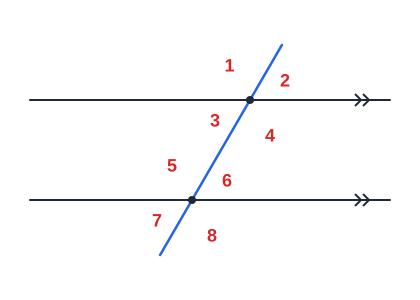
90°
110°
20°
70°
Angles 3 and 6 are alternate interior angles, equal for parallel lines. 110° would be a co-interior partner.
In the same diagram (parallel lines), angle 3 = 70°. What is angle 5?
70°
110°
180°
20°
Angles 3 and 5 are co-interior on the left side of the transversal, so they sum to 180°: 110°.
Find x. The two marked angles are vertically opposite.
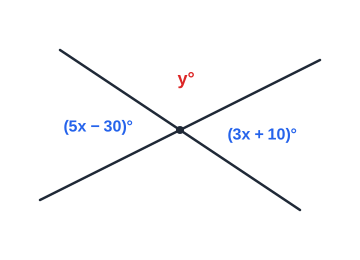
x = 40
x = 20
x = 35
x = 10
3x + 10 = 5x − 30 gives 2x = 40, x = 20. Adding them (as if supplementary) would give a wrong result.
The marked angles together form a right angle. What is x?
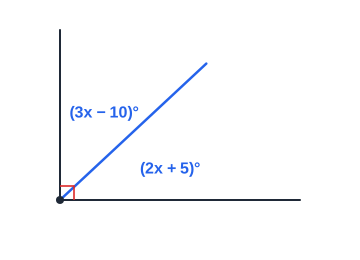
18
21
19
23
(2x + 5) + (3x − 10) = 90, so 5x = 95 and x = 19.
With parallel lines, the marked co-interior angles are (4x + 20)° and (6x − 10)°. What is x?
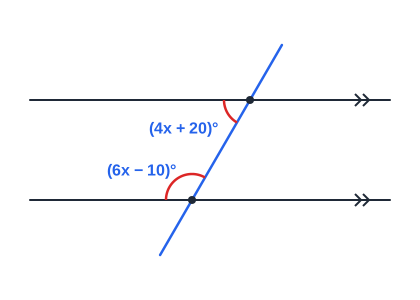
20
17
14
15
They sum to 180°: 10x + 10 = 180, x = 17. Setting them equal (15) would be wrong for co-interior angles.
Which pair of angles must be equal when two parallel lines are cut by a transversal?
Interior angles on the same side
Co-interior angles
Alternate interior angles
Adjacent angles on the transversal
Alternate interior (Z) angles are equal. Co-interior (C) angles add up to 180°.
What is each interior angle of a regular hexagon?
120°
108°
135°
60°
Sum = 4 × 180 = 720°, divided by 6 = 120°. 108° is a pentagon.
A regular polygon has each exterior angle 18°. How many sides does it have?
24
18
10
20
360 ÷ 18 = 20 sides. The exterior angles always total 360°.
Convert 150° to radians.
150 × π/180 = 5π/6. 2π/3 is 120°.
What is the bearing of A from B if the bearing of B from A is 245°?
295°
245°
115°
065°
Subtract 180° when the bearing is over 180°: 245 − 180 = 065°.
What is the angle between the hands of a clock at 5:00?
120°
180°
150°
135°
Each hour mark is 30°, and 5 × 30 = 150°.
A line l is cut by a transversal and corresponding angles are 72° and 76°. What can you conclude?
The lines are parallel
Nothing; corresponding angles are always equal
The transversal is perpendicular
The lines are not parallel
Corresponding angles are equal only for parallel lines. Since they differ, the lines are not parallel.
True or false: the angle of depression from the top of a tower to a car equals the angle of elevation from the car to the top of the tower.
True
False
They are alternate interior angles between horizontal lines, so they are equal.
The sum of interior angles of a polygon is 1080°. How many sides does it have?
6
7
9
8
(n − 2) × 180 = 1080 gives n − 2 = 6, so n = 8.
The reflex angle at a point is 5x° and the other angle at the point is x°. How big is the reflex angle?
150°
72°
300°
60°
6x = 360, x = 60, and the reflex angle is 5 × 60 = 300°.
Which is the best name for angle types in this diagram, left to right?
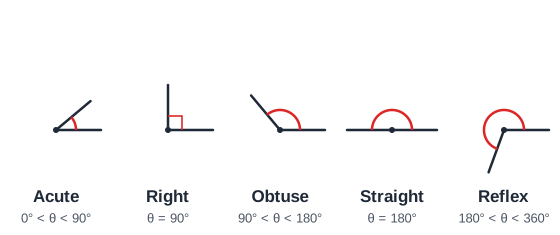
Acute, right, obtuse, straight, reflex
Right, acute, obtuse, reflex, straight
Acute, obtuse, right, straight, reflex
Acute, right, obtuse, reflex, straight
They increase in size: acute (<90°), right (90°), obtuse, straight (180°), reflex (>180°).
