Quiz · Hard
Multi-step problems on infinite series, telescoping sums, binomial coefficients, constant terms and induction.
Evaluate .
55
3025
385
100
10·11·21/6 = 385. 3025 is Σk³ = 55², and 55 is Σk.
Evaluate .
3/2
3
1
6
a₁ = 2 and r = −1/3, so S = 2/(1 + 1/3) = 3/2. Forgetting the minus sign in 1 − r would give 3.
Evaluate .
5/3
2/3
2/5
3/2
The first term is 2/5, so S = (2/5)/(1 − 2/5) = 2/3. 5/3 is the sum starting at k = 0.
For which x does converge?
|x| < 1
|x| < 2
x < 2
|x| < 1/2
A geometric series converges when |r| < 1, here |x/2| < 1, so −2 < x < 2. x < 2 allows x = −5, where |r| > 1.
Evaluate .
99/100
1
100/101
98/99
Telescoping: 1/(k(k + 1)) = 1/k − 1/(k + 1), so the sum is 1 − 1/100 = 99/100.
Find the coefficient of in .
80
−80
40
−40
C(5, 3)(2x)³(−1)² = 10·8·1 = 80. The sign is (−1)⁵⁻³ = +1.
Find the constant term of .
160
20
120
80
General term C(6, k)2ᵏx⁶⁻²ᵏ has power 0 at k = 3: 20·8 = 160. 20 forgets the 2³.
What is the sum of all coefficients of after expanding?
81
16
1
625
Set x = 1: (3 − 2)⁴ = 1. 81 is only the coefficient of x⁴ (from (3x)⁴).
For an arithmetic sequence, . What is ?
21
120
19
23
aₙ = Sₙ − Sₙ₋₁, so a₁₀ = 120 − 99 = 21. 120 is S₁₀, the sum rather than the term.
What is the sum of the first 6 terms of 3, −6, 12, −24, …?
63
−63
−189
21
r = −2: S₆ = 3(1 − (−2)⁶)/(1 + 2) = 3(−63)/3 = −63. Direct check: 3 − 6 + 12 − 24 + 48 − 96 = −63.
To prove 1 + 3 + 5 + … + (2n − 1) = n² by induction, which is the correct inductive step?
Assume the formula holds for k, then show k² + (2k + 1) = (k + 1)²
Check n = 1, 2, 3, 4, 5
Assume it holds for k + 1, then show it holds for k
Show k² = (k + 1)²
The inductive step assumes P(k) and uses it to prove P(k + 1). Checking cases is not a proof.
Three numbers form a geometric sequence with product 64 and sum 14. What is the middle number?
4
8
2
14/3
Write them as m/r, m, mr. The product is m³ = 64, so m = 4. Then 4/r + 4 + 4r = 14 gives r = 2 or 1/2, the numbers 2, 4, 8.
The sum 2 + 5 + 8 + … equals 345. How many terms were added?
14
15
16
23
Sₙ = n(4 + 3(n − 1))/2 = n(3n + 1)/2 = 345 gives 3n² + n − 690 = 0, so n = 15. Check: a₁₅ = 44 and 15(2 + 44)/2 = 345.
Four geometric means are inserted between 3 and 96. What is the third mean?
12
24
48
30
Six terms in all: 96 = 3r⁵, so r = 2 and the sequence is 3, 6, 12, 24, 48, 96. The third mean is 24.
Which term of has the largest coefficient?
5th
6th
10th
11th
The coefficients are largest in the middle: the 6th term has C(10, 5) = 252.
Which fraction equals 0.2333… (the 3 repeats)?
7/30
23/100
23/99
2/9
0.2333… = 0.2 + 0.0333… = 1/5 + 1/30 = 7/30. 23/99 would be 0.2323…
True or false: since the terms 1/n tend to 0, the series 1 + 1/2 + 1/3 + … must converge.
True
False
False. The harmonic series diverges. Terms tending to 0 is necessary for convergence but not sufficient.
A ball is dropped from 10 ft and each bounce reaches 60% of the previous height. What is the total distance it travels?
25 ft
40 ft
30 ft
55 ft
10 down, then 2(6 + 3.6 + …) = 2·(6/0.4) = 30 for all the up-and-down trips: total 40 ft. 25 forgets that each bounce goes up and down.
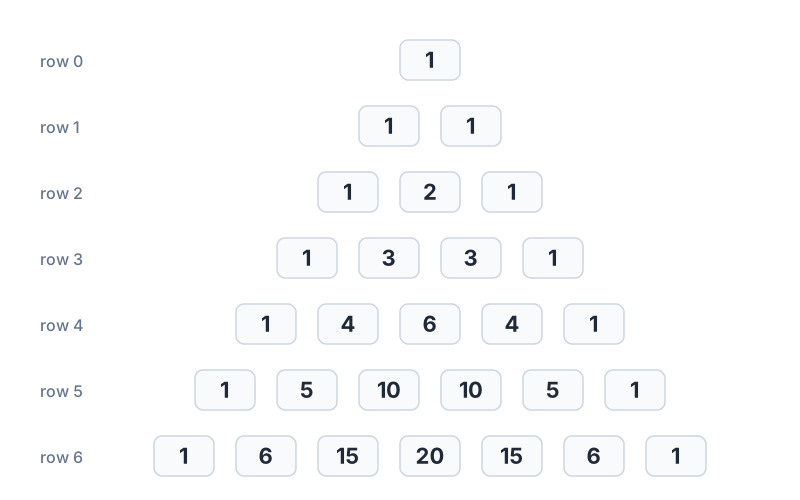
In (x + y)⁴, what is the coefficient of x²y²?
4
6
8
12
Row 4 of Pascal's triangle is 1, 4, 6, 4, 1, and x²y² is the middle term: C(4, 2) = 6.
