Quiz · Medium
Attachment styles, Erikson and Marcia, Kohlberg, parenting styles, Bronfenbrenner and aging.
Harlow's monkey studies showed that infant attachment depends most on:
Food
Contact comfort
Visual stimulation
Learned fear
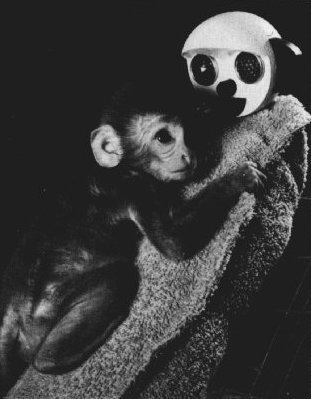
Infant monkeys chose the cloth mother over the wire mother that held the milk bottle.
In the Strange Situation, an infant who is distressed when the caregiver leaves but is quickly comforted on return is classified as:
Insecure-avoidant
Secure
Insecure-resistant
Disorganized
Secure infants use the caregiver as a base and recover quickly.
An infant shows little distress at separation and ignores the caregiver at reunion. This is:
Secure
Insecure-avoidant
Insecure-resistant
Imprinted
Avoidant infants show little separation distress and avoid contact on reunion.
Which factor is the best predictor of secure attachment?
Caregiver's sensitive responsiveness
Number of toys
Time spent in daycare
Birth order
Responsive caregiving that matches the infant's signals promotes secure attachment.
According to Bowlby, an internal working model is:
A reflex pattern
A mental template for relationships based on early caregiving
The first word learned
A form of classical conditioning
The model guides expectations about the self and others in later relationships.
Erikson's crisis for a typical school-age child is:
Trust vs mistrust
Initiative vs guilt
Industry vs inferiority
Identity vs role confusion
Stage 4, industry vs inferiority, centers on mastering skills and school work.
A person has explored alternatives and is now committed to a career and values. Marcia would call this:
Moratorium
Foreclosure
Diffusion
Identity achievement
Achievement requires both exploration and commitment.
Elkind's 'personal fable' in adolescence is the belief that:
Everyone is watching me
My experiences are unique and I am invulnerable
Authority is always right
Morals are relative
The imaginary audience is the belief that others are watching; the personal fable is the belief in one's uniqueness and invulnerability.
Kohlberg classified moral stages mainly by:
The decision a person made
The reasoning given for the decision
Whether they obeyed the law
Their age
Two people can make the same choice at different stages because their reasons differ.
Which reasoning is most characteristic of Kohlberg's conventional level?
'I will be punished if I do it.'
'It is my duty to follow the law.'
'Universal principles of justice apply.'
'What do I get out of it?'
Conventional morality centers on social approval and law and order.
Gilligan's main criticism of Kohlberg was that his theory:
Ignored culture entirely
Underrepresented a care-based moral perspective
Was based on infants
Had too many stages
Gilligan argued that women often emphasize care and relationships rather than abstract justice.
A parent sets clear rules, explains the reasons and listens to the child. This is:
Authoritarian
Permissive
Authoritative
Neglectful
Authoritative parenting combines warmth with firm limits and reasoning.
A parent's workplace policies affect the child indirectly. In Bronfenbrenner's model this is part of the:
Microsystem
Mesosystem
Exosystem
Chronosystem
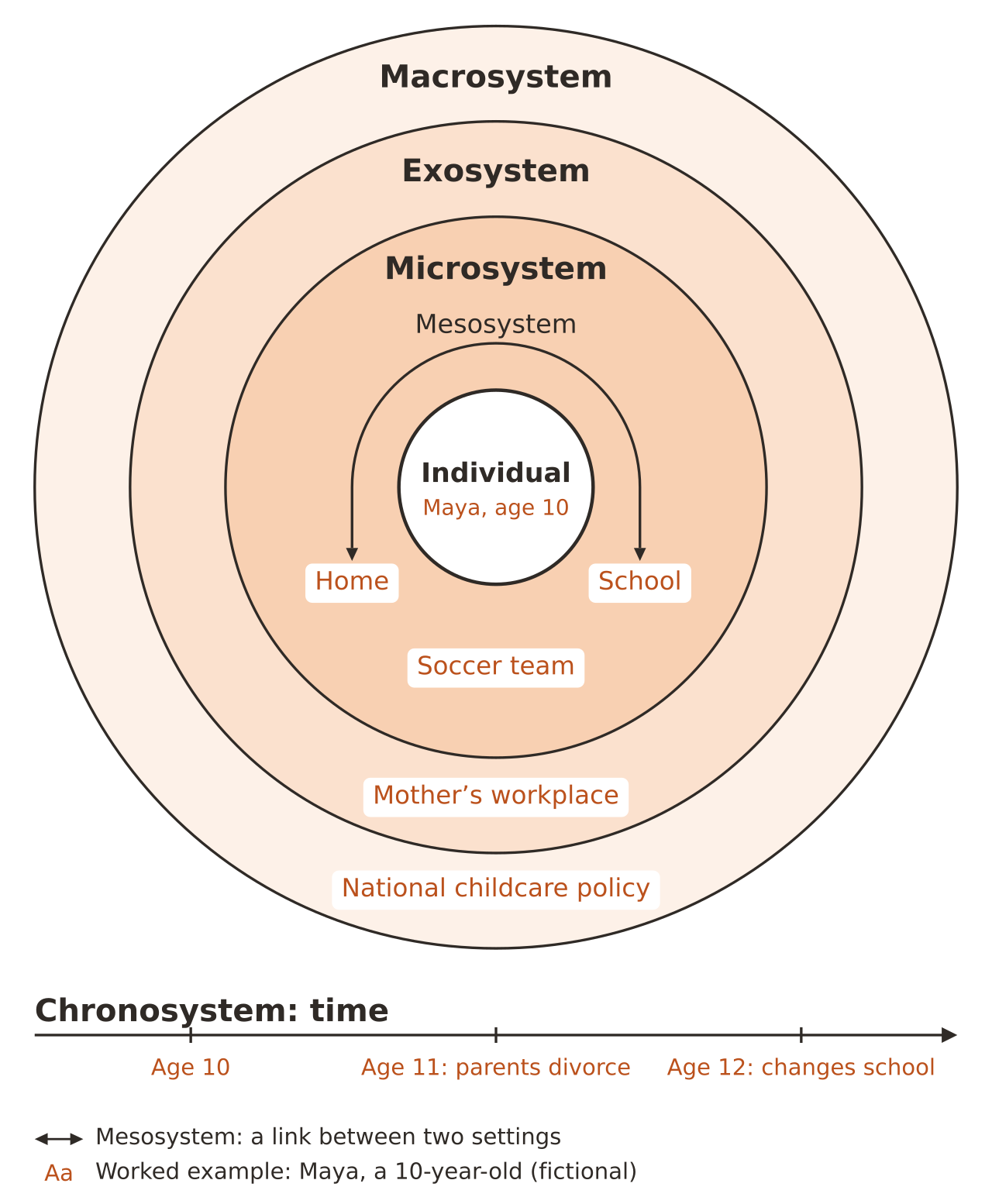
The exosystem includes settings the child does not take part in but which still influence them.
Which prenatal stage is the most sensitive to teratogens because organs form?
Germinal
Embryonic
Fetal
Neonatal
Major structures develop during the embryonic stage, so harm there is often severe.
A researcher compares memory in 20-, 40- and 60-year-olds tested in the same year. This is:
A longitudinal study
A cross-sectional study
A case study
An experiment with random assignment
Comparing different age groups at one time is cross-sectional, and cohort differences may confound the results.
Which type of intelligence usually holds steady or increases in older adults?
Fluid intelligence
Crystallized intelligence
Processing speed
Working memory
Crystallized intelligence (knowledge and vocabulary) holds up with age.
The photograph is from a classic study in which infant monkeys chose a cloth surrogate over a wire surrogate that provided milk. Who ran the study?
Harry Harlow
Konrad Lorenz
Mary Ainsworth
John Watson
Harlow's studies demonstrated the importance of contact comfort for attachment.
In the diagram, 'national childcare policy' belongs to which of Bronfenbrenner's systems?
Microsystem
Mesosystem
Exosystem
Macrosystem
Broad cultural values, laws and policies form the outermost macrosystem.
