Quiz · Hard
Exam-level questions on rational and polynomial inequalities, parameters, absolute value, linear programming and applications.
Solve .
or
or
Critical values -1 (denominator) and 4 (numerator). The quotient is positive for x < -1 and x > 4, and zero at 4. x = -1 is excluded because the fraction is undefined there, so (c) is wrong.
Solve .
or
3/(x - 2) - 1 < 0 gives (5 - x)/(x - 2) < 0. Negative when x < 2 or x > 5. The tempting 'x > 5' comes from cross-multiplying by x - 2 and ignoring the case x - 2 < 0.
Solve .
and
(x - 1)² is non-negative and 0 only at x = 1, so the sign comes from x + 3 > 0. The strict inequality excludes x = 1, where the product is 0.
Solve .
or
or
or
x(x - 3)(x + 2) ≤ 0. For x > 3 the product is positive. Then: - on (0, 3), + on (-2, 0), - for x < -2. Pick the negative intervals and include the zeros.
For which values of does hold for every real ?
or
The parabola opens upward, so it stays above the axis when the discriminant is negative: k² - 36 < 0, so -6 < k < 6.
For which does have at least one real solution?
The minimum of x² - 4x + m is m - 4, reached at x = 2. A solution exists when m - 4 ≤ 0. With m = 4 the only solution is x = 2.
Solve .
or
|A| ≤ B means -B ≤ A ≤ B. Right part: 3x - 2 ≤ x + 4 gives x ≤ 3. Left part: -x - 4 ≤ 3x - 2 gives -2 ≤ 4x, so x ≥ -1/2. Together: -1/2 ≤ x ≤ 3.
Solve .
Between -2 and 1 the sum is 3 (always less than 5). To the right of 1 the sum is 2x + 1 < 5, so x < 2. To the left of -2 it is -2x - 1 < 5, so x > -3. Total: -3 < x < 2.
A company's revenue is R = 40x and cost is C = 15x + 2000. For how many units x does it make a profit?
Profit means R > C: 40x > 15x + 2000 gives 25x > 2000, so x > 80. At exactly 80 units it breaks even (no profit), so ≥ is wrong.
A ball's height in feet is h = -16t² + 48t. For which times t is the ball at least 32 feet high?
-16t² + 48t ≥ 32 gives t² - 3t + 2 ≤ 0 (dividing by -16 flips the sign). (t - 1)(t - 2) ≤ 0 gives 1 ≤ t ≤ 2.
Which inequality describes all numbers whose distance from -3 is at most 5?
Distance from -3 is |x - (-3)| = |x + 3|. 'At most 5' means ≤ 5, giving -8 ≤ x ≤ 2.
Which pair of inequalities has a solution region that is a bounded triangle with vertices (0, 0), (6, 0) and (0, 3)?
The line x + 2y = 6 passes through (6, 0) and (0, 3). Test (0, 0): 0 ≤ 6 is true, so the region is below the line. 2x + y = 6 would pass through (3, 0) and (0, 6). The last one is unbounded.
Maximize P = 5x + 4y over the region with vertices (0, 0), (4, 0), (3, 1) and (0, 2).
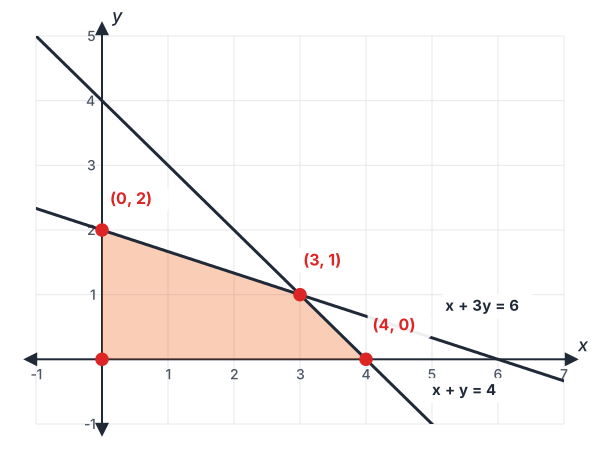
P = 20 at (3, 1)
P = 20 at (4, 0)
P = 19 at (3, 1)
P = 8 at (0, 2)
P(0,0) = 0, P(4,0) = 20, P(3,1) = 19, P(0,2) = 8. The largest is 20 at (4, 0).
Which point is in the solution set of and ?
(2, 3): 3 > 0 and 3 ≤ 4, both true. (5, 3) sits on the dashed line y = x - 2, which is excluded (3 > 3 is false). (1, 6) fails 6 ≤ 5. (6, 0) fails 0 > 4.
Which statement about is correct?
It has no solution
It has exactly one solution, x = 3
Its solution is all real numbers
Its solution is 0 ≤ x ≤ 3
x² - 6x + 9 = (x - 3)² is zero at x = 3 and positive elsewhere, so only x = 3 satisfies ≤ 0.
True or false: the solution of 1/x < 1/2 is x > 2.
True
False
False. Any negative x also works: 1/(-1) = -1 < 1/2. The full solution is x < 0 or x > 2.
Solve .
or
or
or
(x - 3)(x + 3)/x. Signs: - for x < -3, + on (-3, 0), - on (0, 3), + for x > 3. Include ±3 (numerator zeros), exclude 0 (denominator zero).
