Quiz · Medium
Twenty questions on thrust, specific impulse, jet engine components, turbofans, ramjets, nozzles and rocket propellants.
Which principle best explains jet and rocket thrust?
Newton's third law: accelerating mass backward pushes the vehicle forward
Bernoulli's principle applied to the engine casing
The Coanda effect on the exhaust
Archimedes' principle
Thrust is the reaction to momentum given to the exhaust. Bernoulli explains pressure changes along a streamline but not the thrust itself.
What does specific impulse (in seconds) measure?
The time an engine can burn
The total impulse of a rocket
Thrust per unit weight flow of propellant, a measure of propellant efficiency
The thrust-to-weight ratio of the engine
. Burn time depends on how much propellant is carried, not on Isp itself.
Which sequence correctly lists the parts of a turbojet in flow order?
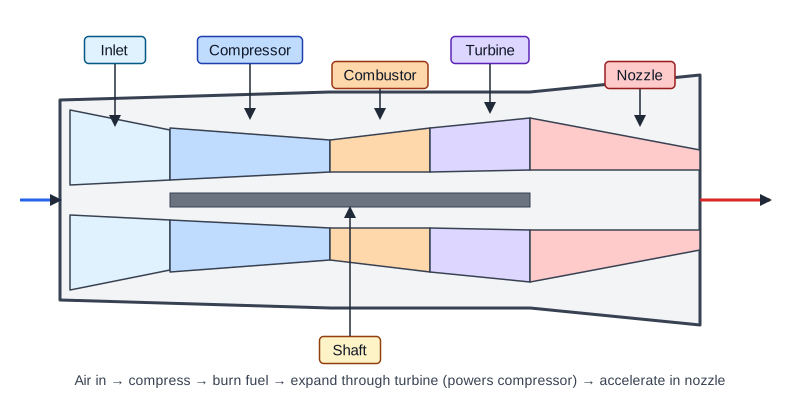
Inlet, combustor, compressor, turbine, nozzle
Inlet, compressor, turbine, combustor, nozzle
Compressor, inlet, combustor, nozzle, turbine
Inlet, compressor, combustor, turbine, nozzle
Air is compressed before burning. The turbine sits after the combustor to extract work from the hot gas.
What is the main job of the turbine in a turbojet?
Increase the exhaust pressure for thrust
Drive the compressor
Slow the airflow
Mix fuel with air
The turbine takes just enough energy from the gas to drive the compressor and accessories. The rest produces thrust in the nozzle.
Why have airliners moved to high-bypass turbofans?
Higher exhaust velocity
They need no compressor
Higher propulsive efficiency at subsonic speed and less noise
They produce more thrust at Mach 2
Accelerating more air by a smaller amount wastes less kinetic energy in the exhaust and cuts jet noise.
The ratio of bypass air mass flow to core air mass flow is called the:
Bypass ratio
Pressure ratio
Fuel-air ratio
Mass ratio
Pressure ratio is a compressor property, and mass ratio refers to rockets.
A ramjet cannot operate at zero airspeed because:
It has no combustor
It has no compressor, so it relies on ram compression from forward motion
It uses solid fuel only
Its nozzle would freeze
Without forward speed there is no ram pressure rise, so another engine must accelerate it up to operating speed.
Which engine type is best at Mach 0.4 at low altitude?
Ramjet
Scramjet
Afterburning turbojet
Turboprop
Propellers move a large mass of air gently, giving the best propulsive efficiency at low speed.
An afterburner increases thrust by:
Burning additional fuel in the exhaust stream behind the turbine
Adding a second compressor
Increasing the bypass ratio
Cooling the turbine
It uses the remaining oxygen in the exhaust. Thrust rises substantially, and so does fuel consumption.
What does the Brayton cycle describe?
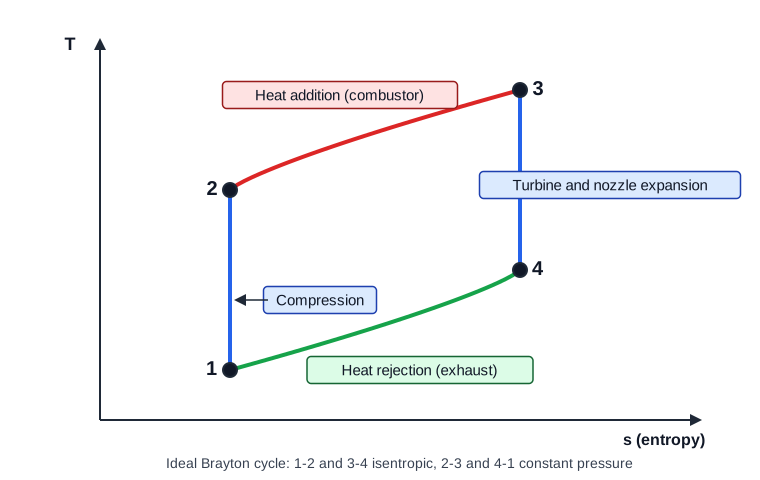
The piston engine cycle
The steam turbine cycle with condensation
The gas-turbine cycle: compress, heat at constant pressure, expand, exhaust
A rocket's combustion
Otto and Diesel cycles describe piston engines and Rankine describes steam plants.
What is the Mach number at the throat of a choked nozzle?
0.5
Greater than 1
It depends on exit pressure
1
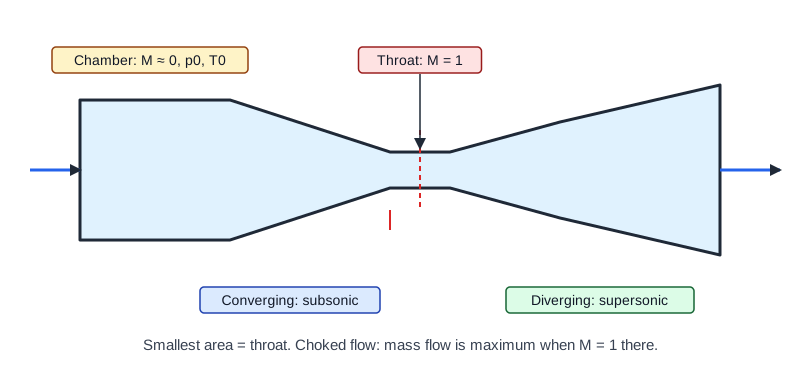
A choked throat is sonic. The nozzle's maximum mass flow occurs there, and back pressure no longer affects the upstream flow.
Why does a rocket nozzle diverge after the throat?
To slow the exhaust
Supersonic flow accelerates as the area increases
To increase the chamber pressure
To reduce the weight
In subsonic flow area increase slows the flow; in supersonic flow it speeds it up.
Which propellant combination typically has the highest specific impulse?
Kerosene (RP-1) and liquid oxygen
Hydrazine monopropellant
Liquid hydrogen and liquid oxygen
Solid ammonium perchlorate composite
Hydrogen's low molecular mass gives a very high exhaust velocity (Isp about 450 s in vacuum).
What is a hypergolic propellant pair?
Propellants that ignite on contact
Propellants stored at cryogenic temperatures
Propellants that explode on heating
Propellants that need external oxygen
Hypergolics such as hydrazine with nitrogen tetroxide need no igniter, so they are reliable for restartable thrusters.
A downside of solid rocket motors is:
Very low thrust
They cannot easily be throttled or shut down
Very low density
They need cryogenic storage
Once ignited, a solid burns until the grain is consumed unless thrust termination ports are used.
A rocket engine produces more thrust in vacuum than at sea level.
True
False
Ambient pressure falls with altitude, so the pressure term increases.
Which statement about ion thrusters is correct?
They have high thrust and low Isp
They are used for launch from Earth
They burn kerosene
They have very high Isp but very low thrust
Ion thrusters accelerate ions electrically, giving Isp thousands of seconds but thrust only in millinewtons.
For an air-breathing engine, which quantity is the ram drag term?
, the momentum of the incoming air
The fuel mass flow
Net thrust : the incoming air's momentum has to be subtracted.
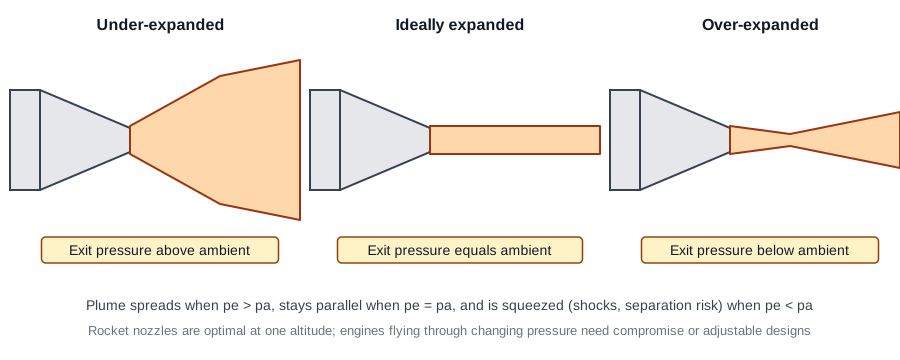
In the nozzle diagram with the plume squeezed inward, the exit pressure is:
Above ambient (under-expanded)
Equal to ambient
Below ambient (over-expanded)
Zero
An over-expanded nozzle has exit pressure below ambient. The plume contracts, and shocks or separation can form.
What do variable pitch propellers allow?
Variable bypass ratio
Higher exhaust velocity
Afterburning
Efficient blade angle at different speeds and feathering after engine failure
Blade pitch is adjusted for takeoff, cruise and feather positions.
